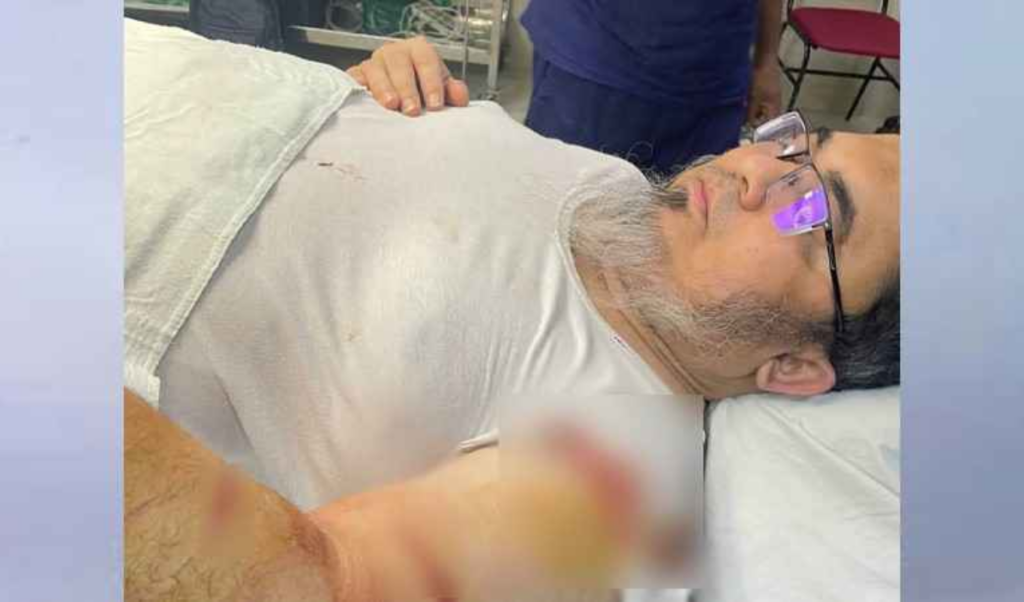
In a distressing incident that has sent shockwaves through the capital’s medical community, Dr Ahmed Hossain, the Deputy Director of the National Institute of Cancer Research and Hospital (NICRH), was subjected to a violent knife attack on Monday afternoon. The 50-year-old senior official was targeted by unidentified assailants near his place of work, leading to his emergency hospitalisation and raising serious questions regarding the safety of public health administrators.
Chronology of the Assault
The attack occurred at approximately 4:00 pm on Monday, 20th April 2026. According to Dr Hossain’s own account, he was proceeding on foot when he was suddenly intercepted by two young men. Without provocation, the duo brandished sharp weapons and launched a coordinated assault before fleeing the scene into the bustling city crowds.
Following the encounter, Dr Hossain was immediately rushed to the NICRH—the very institution he helps lead—for primary emergency care. However, as the evening progressed, medical staff determined that more specialised intervention was required. Consequently, he was transferred to the Dhaka Medical College Hospital (DMCH) at approximately 8:45 pm for comprehensive monitoring and surgery.
Medical Condition and Assessment
Upon his arrival at the DMCH emergency department, Dr Hossain was attended to by a team of trauma specialists. Dr Mustaque Ahmed, the Residential Physician at the DMCH Emergency Wing, provided a detailed assessment of the injuries sustained during the struggle.
| Type of Injury | Location of Wound | Severity Assessment |
| Incised Wound | Right Hand | Moderate |
| Incised Wound | Left Forearm | Significant |
| Laceration | Back (Posterior Torso) | Moderate |
| Overall Status | Conscious and Orientated | Stable / Out of Danger |
Dr Mustaque Ahmed reassured the public and the medical fraternity that while the wounds were serious and required surgical stitching, the Deputy Director’s vital signs remained stable. “He has been formally admitted to the hospital for observation and to prevent potential infection from the bladed weapons,” the physician stated.
Potential Motives: The Shadow of Tender Malpractice
While the police have yet to make any formal arrests, a chilling narrative regarding the motive behind the attack has begun to emerge. A close associate of Dr Hossain, speaking on the condition of anonymity, suggested that the violence may be linked to institutional procurement disputes.
It has been revealed that Dr Hossain assumed his current role at the National Cancer Hospital only two months ago. Shortly after his appointment, he reportedly began receiving intimidatory communications. Specifically, a man identified as “Rubel” had allegedly been harassing the Deputy Director for the past fortnight, demanding influence over lucrative government contracts processed through the e-GP (Electronic Government Procurement) system.
The associate confirmed that Dr Hossain had acted with integrity, refusing to succumb to these pressures and even notifying his departmental superiors about the threats. This has led many to believe that the stabbing was not a random act of street crime, but a premeditated hit intended to intimidate a civil servant who refused to facilitate “tender-based” corruption.
Institutional Safety and the Road Ahead
This brazen attack on a high-ranking official within broad daylight underscores a worrying trend of violence against professionals in the public sector. The National Institute of Cancer Research and Hospital is a critical facility for thousands of patients across the country; an attack on its leadership is seen by many as an attack on the healthcare system itself.
Law enforcement agencies have reportedly begun reviewing CCTV footage from the vicinity of the crime scene to identify the two assailants. Meanwhile, Dr Hossain remains under the protection of hospital security at DMCH. As he recovers from his physical injuries, the broader medical community is calling for a thorough investigation into the “tender mafia” that may be pulling the strings behind such cowardice.