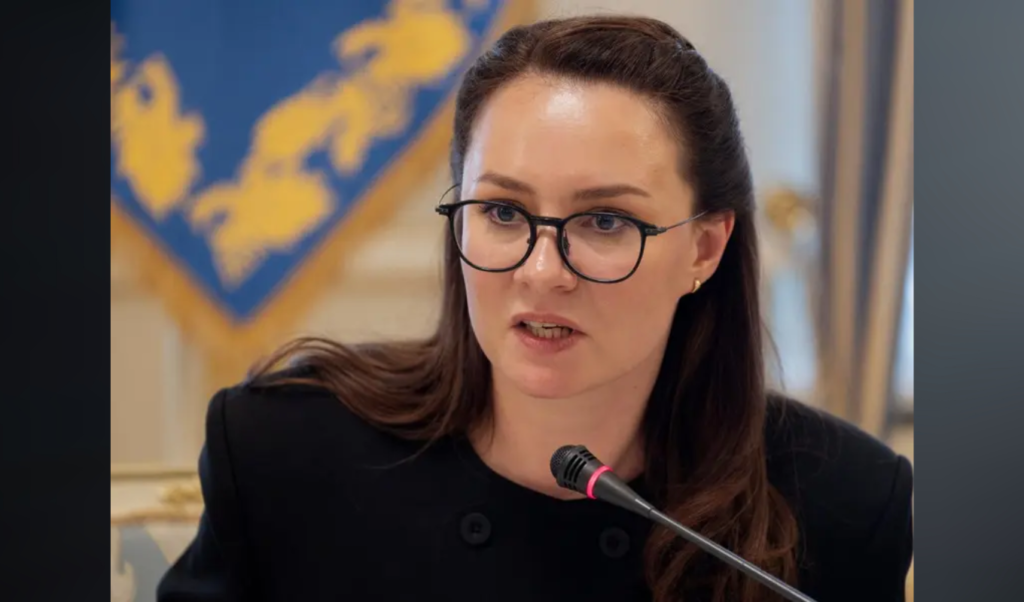
KYIV — The Ukrainian Prime Minister, Yulia Swyrydenko, has resigned from her post following a single year in office, plunging the country’s wartime administration into fresh political uncertainty. The 40-year-old economist tendered her resignation at the explicit request of President Volodymyr Zelenskyy. Ukraine’s parliament, the Verkhovna Rada, formally accepted her departure on Tuesday during a tense legislative session, effectively triggering the constitutional dissolution of the entire cabinet.
President Zelenskyy has offered little by way of explicit public justification for orchestrating such a sudden structural upheaval at the absolute apex of his government. In his nightly address, the President merely indicated that the nation’s shifting political and military strategy necessitated a refreshed leadership framework. This sudden decision did not pass without internal friction; several prominent lawmakers within the parliament openly voiced their irritation and deep concern regarding the timing of the reshuffle.
War Legacies and Diplomatic Engagements
Taking the helm of the cabinet a year ago, Swyrydenko assumed power in the immediate aftermath of a high-profile corruption scandal that had engulfed senior Ukrainian officials and provoked widespread domestic fury. Throughout her tenure, she faced persistent domestic criticism from political adversaries who claimed her administration lacked the necessary severity to root out deeply entrenched institutional graft.
The core mandate of Ukraine’s prime minister remains keeping the wartime economy afloat whilst rapidly rebuilding civilian infrastructure decimated by foreign strikes.
In stark contrast to her domestic challenges, Swyrydenko cultivated a highly respected profile on the international stage, maintaining exceptionally strong channels of communication with Washington. Following a period of strained bilateral relations between President Zelenskyy and US President Donald Trump, she proved instrumental in salvaging diplomatic momentum by successfully brokering a major critical minerals investment pact with American officials.
Her domestic critics, however, remained unimpressed. Jaroslav Zheleznyak, an outspoken lawmaker representing the opposition Holos party, delivered a scathing assessment of the outgoing administration’s record. He remarked that the government had promised daily results, but delivered little more than constant press conferences, public presentations, and a never-ending cycle of newly named suspects in corruption investigations.
The Successor Scramble and Looming Winter
In her valedictory address, the outgoing Prime Minister acknowledged the unrelenting stress of the role. She stated that every single day of the past year demanded incredibly difficult choices and decisive actions, adding that she had always steered her policy choices strictly by tangible economic outcomes.
Under Ukrainian constitutional law, Swyrydenko’s departure forces the automatic collapse of the broader government. Members of parliament have already begun debating potential successors, with Sergiy Koretsky, the current head of the state-owned oil and gas giant Naftogaz, emerging as a frontrunner to lead the new cabinet. Other high-profile names circulating in political corridors include the current Energy Minister, the former Prime Minister Denys Shmyhal, and Digital Transformation Minister Mykhailo Fedorov.
This dramatic domestic realignment arrives at a pivotal juncture in the conflict. Ukrainian forces have been intensifying long-range strikes against Russian fuel infrastructure and supply lines in an effort to alter the strategic balance. Before exiting her post, Swyrydenko issued a stark warning to the incoming leadership team, declaring that their most immediate and existential challenge would be preparing the domestic power grid for the brutal winter months, as targeted foreign strikes against electricity networks are expected to intensify.