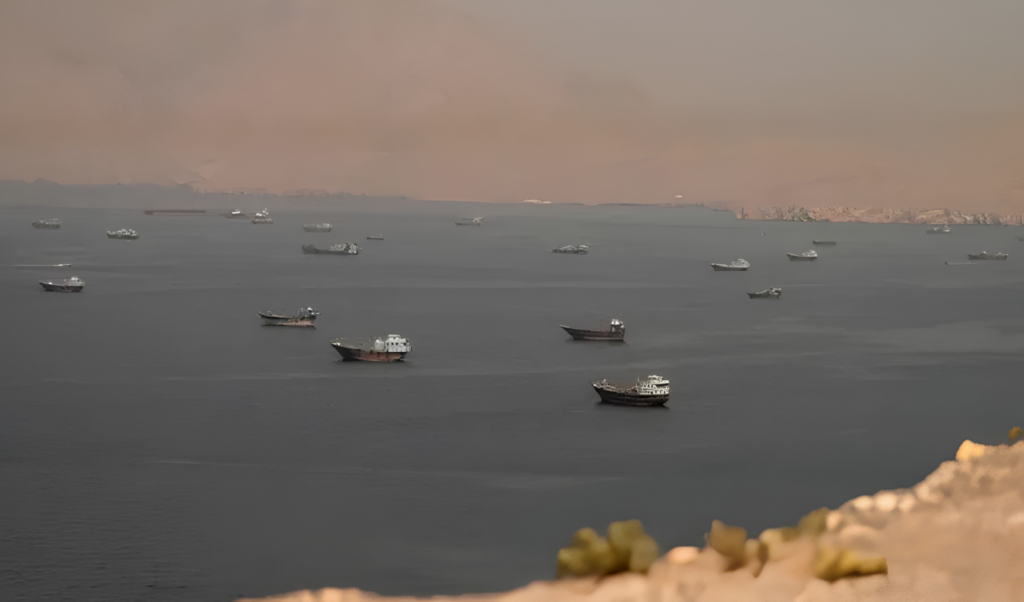
The US military launched a fresh wave of air strikes against Iranian targets on Wednesday, aimed at securing commercial shipping lanes in the strategic Strait of Hormuz. In swift retaliation, Tehran launched targeted strikes against Kuwait and Bahrain, hitting countries that host major American military installations. This rapid escalation has cast deep uncertainty over international diplomatic efforts previously underway to halt the broader conflict.
According to US Central Command (CENTCOM), the latest military operation was a direct response to Iranian attacks on three commercial cargo vessels travelling through the Strait of Hormuz on Tuesday. The strikes commenced only hours after US President Donald Trump declared the interim ceasefire with Iran effectively dead. CENTCOM asserted that its actions seek to neutralise ongoing threats posed by Tehran to international maritime trade and civilian seafarers. The American bombardment triggered immediate panic along Iran’s southern coastline, causing widespread power outages in several coastal sectors. Speaking to representative on condition of anonymity, a US official confirmed that Wednesday’s offensive was significantly larger in scale than the operations conducted the previous day.
Tehran responded without hesitation, targeting American military strongholds in neighbouring Kuwait and Bahrain for a second consecutive day. The Kuwaiti Ministry of Defence stated that its forces intercepted and downed several incoming Iranian missiles and drones. Amidst the chaos, Qatar briefly elevated its military readiness to the highest security alert before later withdrawing the measure. President Trump utilised his social media platform, Truth Social, to justify the operation as necessary retaliation for the previous day’s maritime aggression, warning that further provocations would be met with even harsher consequences.
The Strait of Hormuz remains a critical maritime chokepoint, accounting for nearly 20 per cent of the global oil supply prior to the outbreak of hostiles. Although Iran has officially denied responsibility for the recent tanker attacks, analysts suggest Tehran is leveraging its strategic position over the waterway to gain the upper hand in negotiations. Defiant in the face of American pressure, Iran’s chief negotiator, Mohammad Baqer Qalibaf, stated on social media that the US was mistaken to believe it could break promises and launch attacks without facing a response. He maintained that shipping normality would only return under an Iranian-led framework, rather than through American coercion.
This intense military exchange appears to have shattered any hope of turning the June 17 memorandum of understanding into a permanent peace treaty. Speaking to reporters before departing for the NATO summit in Turkey, President Trump remarked that the agreement felt completely over and expressed a profound lack of trust in the Iranian leadership. He did, however, downplay the likelihood of a full-scale world war, predicting that the current crisis would resolve swiftly and ultimately make global oil supply routes safer. Following the news of the conflict, Brent crude prices climbed roughly 1 per cent to $78.80 per barrel by 12:54 am GMT, though prices remain well below the peak of $120 observed in late April.
Local Iranian media outlets reported that the US strikes focused primarily on the southern coastline, stretching from the Strait of Hormuz to the Gulf of Oman. High-profile targets included the country’s largest port, Bandar Abbas, which houses vital naval bases and Revolutionary Guard facilities. Coastal towns near the Pakistani border, such as Konarak and Chabahar, were also hit. The Mehr News Agency confirmed that while a maritime traffic control tower was damaged and power was temporarily knocked out in Chabahar, electricity has since been restored to most areas. State media also confirmed that a firefighter was killed during an attack on an airport in the southeastern city of Iranshahr, whilst representative reported a separate US strike on a railway bridge near the northern city of Aq Qala.
Prior to the strikes, Iranian Foreign Ministry spokesman Esmaeil Baghaei condemned the US military campaign as a flagrant breach of the existing memorandum of understanding, arguing that Iran holds the legal mandate for ensuring safe passage through the Strait. A spokesman for the Iranian Parliament’s National Security Commission warned that Tehran might reconsider its commitment to the Nuclear Non-Proliferation Treaty (NPT) and alter its nuclear doctrine in response to the aggression. The commission also revealed that closing the Bab al-Mandeb Strait—a vital trade route at the entrance of the Red Sea—remains a serious option under consideration. Meanwhile, Iran’s permanent mission to the United Nations sent an official letter to the UN Security Council, formally accusing Washington of violating the UN Charter and international law.