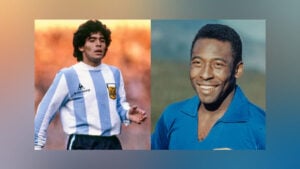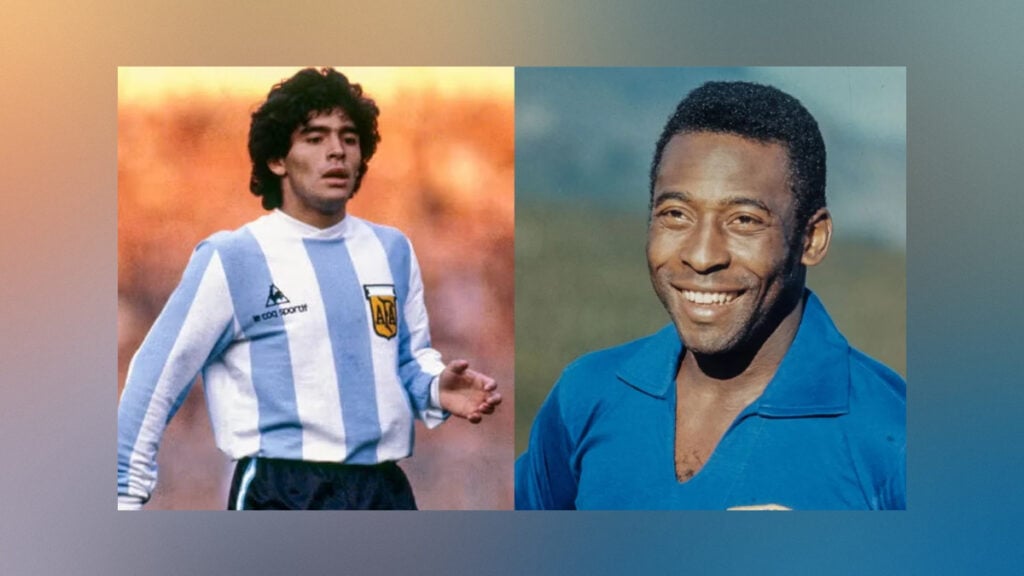
Brazilian legend Pelé and Argentina’s Diego Maradona are widely regarded as two of the greatest footballers in history. Both achieved extraordinary success, inspired generations of supporters and left an enduring mark on the sport. Yet neither won the Ballon d’Or during his playing career. The reason was not a lack of talent or achievement, but the eligibility rules that governed the prestigious individual award during their prime years.
Introduced in 1956 by French magazine France Football, the Ballon d’Or was initially restricted to European players. Footballers from other continents were excluded, regardless of their performances or accomplishments. As a result, Pelé and Maradona were unable to compete for the award at a time when they were establishing themselves among the world’s finest players.
The 1995 reform changed the rules
A significant change came in 1995, when the Ballon d’Or became open to players of any nationality, provided they played for a European club. The revision allowed non-European footballers to compete for the honour, although the requirement to play in Europe remained.
That year, Liberian striker George Weah became the first non-European player to win the award. He was playing for AC Milan in Italy at the time, and his achievement marked a turning point in the Ballon d’Or’s history.
Several Brazilian stars subsequently won the prize, including Ronaldo Nazário, Rivaldo, Ronaldinho and Kaká. Their successes reflected the growing recognition of players from outside Europe who had established themselves in European football.
However, the 1995 reform came too late for Pelé, who had already retired from professional football. It also failed to remove the nationality restriction that had prevented Maradona from being eligible during his finest years.
A worldwide competition from 2007
The eligibility rules were broadened again in 2007. From that year, players of any nationality competing for clubs anywhere in the world could be considered for the Ballon d’Or. The change removed the requirement to play for a European club, extending the award’s reach beyond the continent.
Lionel Messi later illustrated the significance of this broader framework. In 2023, he won his eighth Ballon d’Or while playing for Inter Miami in the United States. The award recognised his performances during the preceding season, particularly his influential role in Argentina’s victory at the 2022 FIFA World Cup in Qatar.
The evolution of the award highlights how its eligibility criteria have changed over time. What began as a European-focused honour eventually developed into a global recognition of individual excellence.
Why Pelé never had the opportunity
Pelé spent much of his playing career with Brazilian club Santos, where his goalscoring ability and technical brilliance established him as an international superstar. He won the World Cup with Brazil in 1958, 1962 and 1970, becoming the only player to have won the men’s tournament three times.
Despite these extraordinary achievements, he remained ineligible for the Ballon d’Or under its original rules. His career was largely based in Brazil, and the award did not recognise non-European players.
Towards the end of his career, Pelé moved to the United States to play for the New York Cosmos. He retired from professional football in 1977, almost two decades before the 1995 eligibility reform.
By the time players of all nationalities competing for European clubs became eligible, Pelé’s playing days were over. The subsequent expansion of the award could not give him an opportunity to win it during his professional career.
Maradona was excluded despite his European success
Maradona played for several prominent European clubs, including Barcelona, Napoli and Sevilla. His time at Napoli was particularly successful. Under his influence, the Italian club won its first Serie A title in the 1986–87 season and secured another championship in 1989–90.
His greatest international achievement came at the 1986 World Cup in Mexico. As Argentina’s captain, Maradona produced a series of remarkable performances that helped his country win the tournament. His influence throughout the competition cemented his reputation as one of football’s most gifted and influential players.
Nevertheless, playing for European clubs did not make Maradona eligible for the Ballon d’Or. The rules still required candidates to be European, meaning his nationality prevented him from competing for the award.
Maradona’s career also included a major disciplinary episode. In 1991, he received a 15-month suspension after testing positive for cocaine. He subsequently left European club football and returned to Argentina in 1993. Although these events formed part of his career, the fundamental reason he never won the Ballon d’Or was the eligibility system in place during his prime.
A retrospective assessment of football history
The absence of Ballon d’Or titles from Pelé’s and Maradona’s records has long been a subject of discussion among football supporters. In 2016, France Football revisited the award’s history and examined how its earlier winners might have differed if non-European players had been eligible from the outset.
The retrospective assessment suggested that Pelé could have won the award on several occasions under alternative eligibility rules. However, this was a historical analysis rather than an official revision of the winners’ records. Neither Pelé nor Maradona was added to the list of official Ballon d’Or winners for his playing career.
Their stories demonstrate how award regulations can shape the historical record. Both players achieved extraordinary success without receiving a prize that, under different rules, they might have had the opportunity to contest.
Pelé’s three World Cup triumphs and Maradona’s remarkable performances in 1986 remain central to their legacies. Their influence on football extends far beyond individual awards, and neither player’s standing in the sport depends on having won the Ballon d’Or.
Had the award adopted broader eligibility criteria earlier, both legends might have had a chance to claim the trophy. Instead, they remain enduring examples of how footballing greatness can transcend the limitations of an award’s rules.