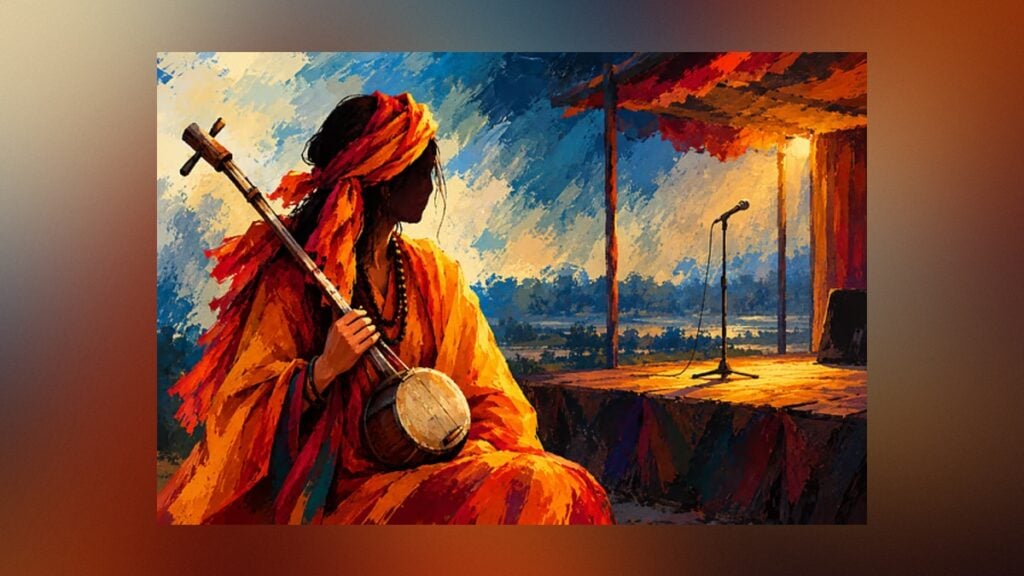
A private Baul music gathering in Sunamganj’s Dirai upazila has been cancelled following objections from local residents over the planned participation of female performers. The organiser called off the event after several residents submitted a written complaint to the police, citing concerns about religious values and the possibility of unrest.
The gathering had been scheduled for Thursday at a private residence in Hatia village, in Kulanj Union. The incident has renewed debate over the space available for cultural activities in rural Bangladesh, particularly when performances involving women encounter opposition from sections of the local community.
Hatia is close to Ujan Dhal village in Taral Union, the birthplace of celebrated Baul musician Shah Abdul Karim, whose songs have become an enduring part of the musical heritage of Bangladesh’s haor region.
According to police and local residents, Shawkat Ali, an expatriate Bangladeshi living in the United Kingdom, had arranged a small musical programme at his family home to celebrate his daughter’s birthday. Two local female Baul singers, Tanisha and Nila, were expected to perform at the gathering.
However, the plan faced opposition. On Wednesday, Ataur Ali and Kamrul Hasan submitted a written application to the officer-in-charge of Dirai Police Station on behalf of local residents, requesting that the programme be stopped.
The police subsequently contacted Shawkat Ali. He later decided to cancel the event, saying he wanted to avoid tension and preserve social harmony in the village.
Residents cite religious and social concerns
The written application described Hatia as a village with a longstanding religious tradition and Islamic heritage. It referred to the presence of an alim madrasa, a shrine associated with a religious figure, and a number of Islamic scholars living in the area.
The applicants argued that holding a musical programme featuring female performers could cause resentment among residents and potentially lead to an unwanted confrontation. They asked the authorities to take appropriate steps to protect the village’s religious traditions and maintain social harmony.
Kamrul Hasan, one of the complainants, said musical gatherings had taken place in the village in the past, but such events were no longer common. He pointed to the village’s mosques and madrasas, as well as the religious gatherings organised there each year.
According to Hasan, some residents feared that a programme presented as music could involve what they considered obscene content. He said the objections were raised from an Islamic perspective and that residents had requested the event be called off.
The report, however, did not establish that the planned performance would have included obscene material. The objection was based on concerns expressed by residents rather than any documented incident involving the proposed gathering.
Organiser withdraws programme
Shawkat Ali said the event was intended to be a modest musical gathering at his home to mark his daughter’s birthday. After objections were raised and he received a telephone call from the police, he decided not to proceed, taking the importance of maintaining social harmony into consideration.
Dirai Police Station officer-in-charge Aminul Islam confirmed that the proposed event was a private Baul music gathering. He said police officers spoke to the organiser after learning about the objections and that Shawkat subsequently informed them he would not hold the programme.
The available account indicates that the gathering was cancelled by the organiser following the objections and police contact. It does not specify whether the authorities issued a formal prohibition against the event.
Follows cancellation of girls’ football match
The incident comes after another cultural and sporting event in Dirai was cancelled following local opposition.
Earlier, a friendly football match involving female players was called off after objections from the ‘Committee for Preventing Anti-Islamic Activities in Dirai’. The match had been scheduled for 5 October at the stadium in Dirai upazila headquarters, between local club Swapnachura Sporting Club and Jara Sporting Club of Sylhet.
The cancellation prompted widespread discussion and criticism. The latest incident has brought similar concerns back into focus, as a second planned activity has been abandoned following objections from sections of the local community.
Although the two cases involve different activities, both raise questions about how cultural expression, women’s participation in public life and local religious sensitivities can be accommodated without creating unnecessary conflict.
Cultural groups express concern
Jahangir Alam, vice-president of the Sunamganj district committee of Udichi Shilpi Goshthi, described the cancellation of the two events as regrettable.
He noted that objections had previously led to the cancellation of the girls’ football match and that a similar situation had now affected a Baul music gathering. In his view, the repeated disruption of planned activities over local objections was a matter of concern.
Alam said that, even when objections were framed around religious values and the preservation of social harmony, the authorities and law-enforcement agencies needed to consider how opportunities for cultural activities and girls’ participation in sport could be protected.
Balancing local sensitivities with cultural expression
Baul music has a long history in Bangladesh, particularly in the haor region of north-eastern Bengal. Its songs frequently explore spirituality, love, human relationships, social inequalities and the meaning of life. Shah Abdul Karim, whose birthplace lies near Hatia, became one of the region’s most influential musical figures, and his work continues to resonate with audiences across generations.
The cancellation of a private gathering in the vicinity of his birthplace has therefore drawn attention to a broader question: how can communities respect religious sensitivities while allowing cultural traditions to continue?
Local residents have the right to express their concerns peacefully. At the same time, disagreements over planned events raise questions about the protection of lawful cultural activities and the participation of women in music and sport.
The recent developments in Dirai illustrate the challenges of managing such differences at the community level. Authorities face the task of preventing tensions from escalating while ensuring that decisions are made through lawful and fair procedures.
For cultural organisers, performers and sports groups, the incidents also underline the uncertainty that can arise when planned activities encounter organised opposition. Whether future events can proceed without similar disruption will depend in part on how local authorities, community representatives and organisers address disagreements and safeguard peaceful participation in public and cultural life.