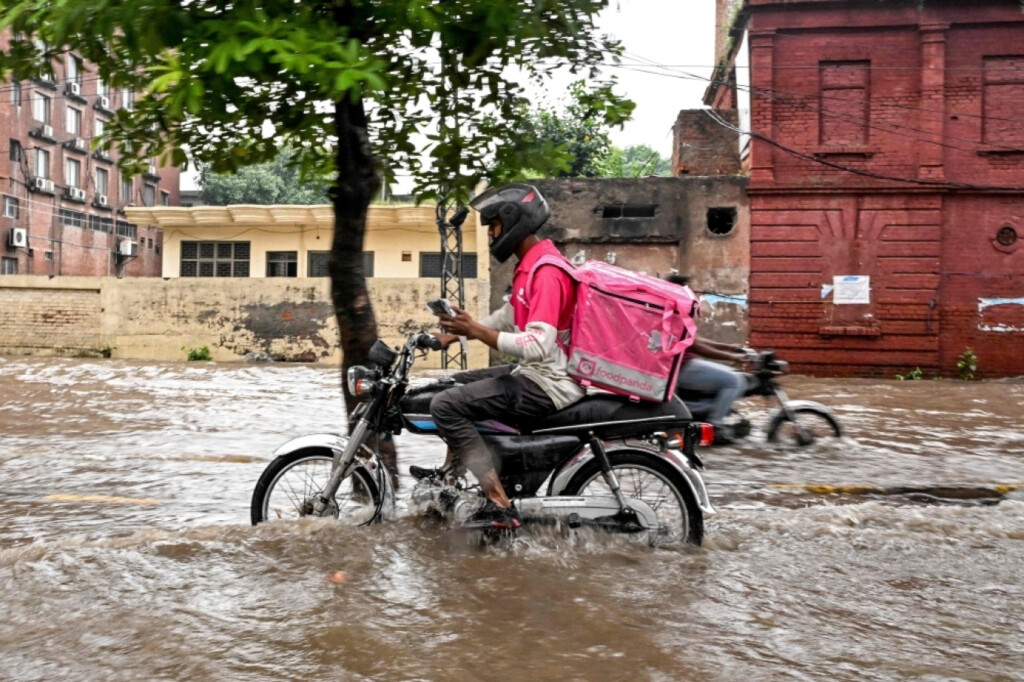
Abdullah Abbas waded through flooded streets in Lahore, struggling to push his motorcycle while delivering a food order on time. The water rose to his torso, soaking his jeans, which were rolled up over sandals, leaving him vulnerable to electrocution and waterborne diseases.
Despite the monsoon deluge affecting cities across Pakistan, food and grocery orders on the Singapore-based delivery platform Foodpanda continue to pour in.
“If I don’t deliver the orders, my Foodpanda account will get blocked, which would leave me without money,” Abbas, 19, told AFP in Lahore’s old quarter, known for its narrow, congested streets.
“I need this money to pay my high school fees,” he added, completing his last year of secondary school.
Since June, monsoon rains have claimed over 1,000 lives in Pakistan, swelling rivers and devastating rural communities along their banks. Urban centres, including Lahore (population 14 million) and Karachi (25 million), have also experienced severe flooding due to poorly planned development.
Abbas earns around $7 a day, slightly above the average salary, but only when conditions are favourable. To meet the average monthly wage of $140, he works over 10 hours a day, seven days a week, alongside his studies.
“Customers behave rudely, and you have to handle all the stress,” said Muhammad Khan, 23, a Foodpanda rider navigating Karachi’s muddy, pothole-filled streets.
Pakistan, where 45% of the population lives below the poverty line, is among the countries most vulnerable to climate change, with limited resources for adaptation.
By mid-August, Pakistan had already received 50% more monsoon rainfall than last year, according to disaster authorities. In neighbouring India, the monsoon kills hundreds annually. While the rains are vital for agriculture, climate change is making the monsoon increasingly erratic.
A report by the Human Rights Commission of Pakistan attributes flooding not only to climate change but also to clogged drains, poor waste disposal, weak infrastructure, and encroachments by elite housing societies.
Doctors warn that repeated exposure to damp conditions can trigger fungal infections and flu, while contact with dirty floodwater may cause eye and skin infections.
Gig workers, including riders for Foodpanda, Bykea, and InDrive, made up nearly 2% of Pakistan’s labour force (around 500,000 people) in 2023, according to Fairwork, a project by the University of Oxford. Fairwork rated six digital labour platforms in Pakistan and found that minimum fair work standards are largely unmet.
The International Labour Organization (ILO) also notes that gig workers lack government protections and face systemic violations of international labour standards.
Muneer Ahmed, 38, a former chef now riding for Bykea, explained the struggle: “When it rains, customers take rickshaws or buses, leaving me with no work. Rain is a curse for the poor,” he said, waiting on the side of a flooded street while checking his phone for new orders.
Daily wage labourers, often in construction, face similar hardships. Zahid Masih, 44, has been unable to work for nearly four days, taking shelter under a bridge in Karachi with other masons.
“Jobs do come up, but only after the rain stops. There is no work as long as it is raining,” said the father of three.
“Sitting idle at home is not an option, as our stoves won’t be lit.”