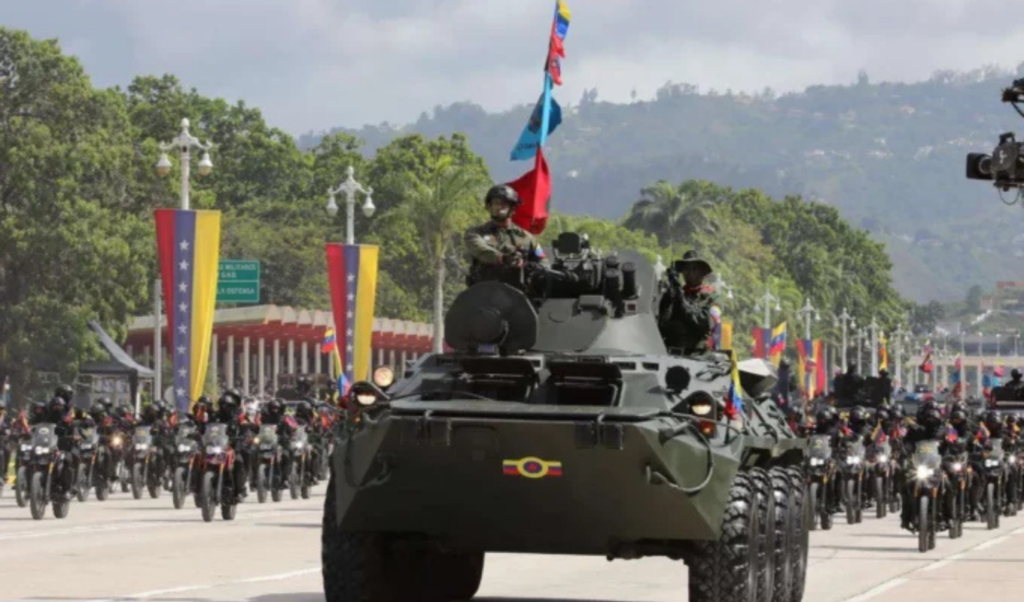
Venezuela is on high alert following the deployment of US military forces off its coast, which has raised fears of a potential invasion. In response, President Nicolas Maduro has announced disaster preparedness drills for Saturday while considering invoking emergency powers.
Maduro called for the drills on Thursday, hours after a series of minor earthquakes rattled an already anxious population. The tension comes in the wake of deadly US strikes on alleged Venezuelan narco-trafficking boats.
US President Donald Trump has dispatched eight warships and a nuclear-powered submarine to the southern Caribbean as part of a stated plan to combat drug trafficking. In recent weeks, US forces have destroyed at least three suspected drug boats, killing over a dozen people—a move condemned by UN experts as “extrajudicial execution.”
According to an NBC report citing four sources, US military officials are preparing options to target drug traffickers inside Venezuelan territory, with strikes potentially occurring “in the next several weeks,” though Trump has not yet authorised them.
Maduro, whom the US accuses of leading a narco-cartel, has accused Washington of seeking regime change. In response, thousands of Venezuelans have joined a civilian militia, participating in weapons training at military barracks and local neighbourhoods.
Adding to the anxiety, the western part of Venezuela experienced a series of earthquakes on Wednesday and Thursday, the strongest registering a magnitude of 6.3, although no major damage or casualties were reported.
Maduro cited US “threats” while announcing the drills, scheduled to begin at 9:00 am on Saturday, designed to test “the people’s readiness for natural catastrophes or any armed conflict.” Schools and hospitals are also participating “to prepare for any circumstance.”
On Tuesday, Maduro appeared on state television with a red folder labelled “Decree declaring a state of external commotion across the national territory.”
Venezuela’s constitution allows the president to issue such a decree in the event of “an external conflict that seriously endangers the security of the nation, its citizens, or its institutions.” The decree grants the government emergency powers including:
- Bypassing parliament,
- Suspending constitutional guarantees, and
- Deploying the military.
Maduro has not yet promulgated the decree but stated: “We are preparing significant decrees… for any scenario that may arise.”
Rights groups have expressed concerns that an emergency decree could be used to restrict freedoms of assembly, movement, and expression. According to Foro Penal, hundreds of people are already detained for political reasons, many following unrest after Maduro’s disputed re-election in July last year, which was not recognised by the US and other countries.
At the UN General Assembly, Colombian President Gustavo Petro called for a “criminal process” against Trump over the US Caribbean strikes, which targeted Venezuelans not convicted of any crime.
Table: Key Facts on Venezuela’s Emergency Measures
| Issue | Details |
| US Military Deployment | 8 warships, 1 nuclear-powered submarine in southern Caribbean |
| US Strikes | At least 3 suspected drug boats destroyed, 12+ killed |
| Emergency Drills | Scheduled Saturday, 9:00 am; schools and hospitals participating |
| Earthquakes | Magnitude 6.3 in western Venezuela, no major damage |
| Emergency Powers | Potential decree allows bypassing parliament, suspending guarantees, deploying military |
| Human Rights Concerns | Potential restrictions on assembly, movement, expression; hundreds politically detained |
| International Reaction | Colombian President Petro calls for criminal process against Trump |