Widespread UN sanctions against Iran returned to force late on Saturday for the first time in a decade, following the collapse of last-ditch nuclear talks with Western powers.
The measures, imposed three months after Israel and the United States attacked Iranian nuclear facilities, target Tehran’s nuclear and ballistic missile programmes, while also expected to ripple across its struggling economy.
European and US officials emphasised immediately after the sanctions took effect that diplomacy is not over:
- US Secretary of State Marco Rubio urged Iran to “accept direct talks, held in good faith” and called on UN member states to implement the sanctions immediately, to “pressure Iran’s leaders to do what is right for their nation, and best for the safety of the world.”
- The foreign ministers of Britain, France, and Germany issued a joint statement committing to seek “a new diplomatic solution to ensure Iran never gets a nuclear weapon” and urging Tehran “to refrain from any escalatory action.”
Despite the return of inspectors to Iranian nuclear sites, President Masoud Pezeshkian described US proposals – demanding Iran hand over its entire enriched uranium stockpile – as unacceptable.
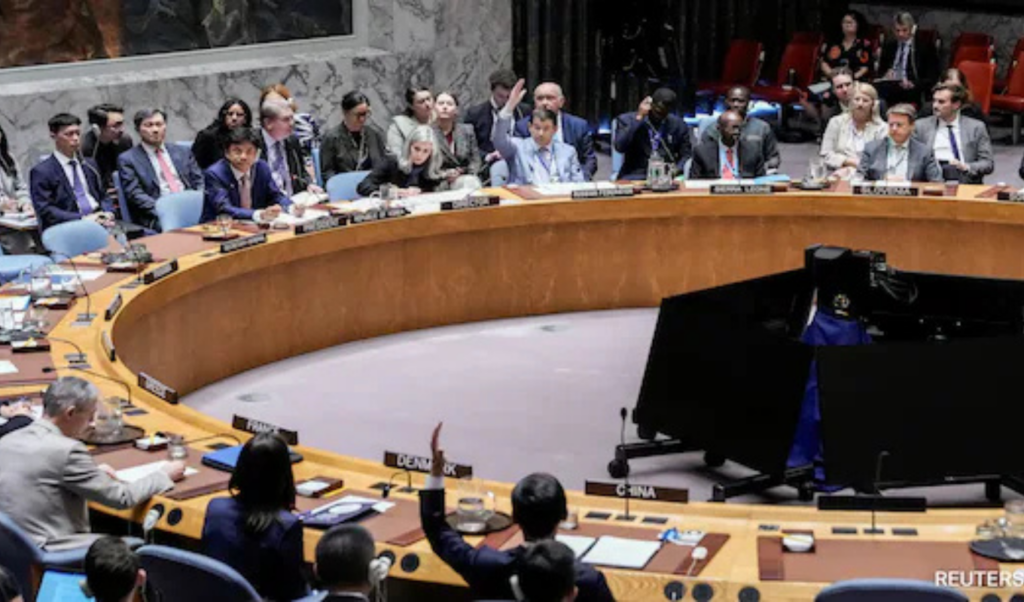
An attempt by Russia and China to postpone the sanctions until April failed to secure enough votes in the UN Security Council on Friday. Consequently, the sanctions came into effect at midnight GMT on Sunday (8 pm Saturday, New York time).
Germany, which alongside Britain and France triggered the sanctions, said it had “no choice” as Iran was not complying with its obligations. Foreign Minister Johann Wadephul told the UN General Assembly: “For us, it is imperative: Iran must never acquire a nuclear weapon. But let me emphasise: we remain open to negotiations on a new agreement. Diplomacy can and should continue.”
Russia, however, has stated it will not enforce the sanctions, labelling them invalid. Russian Foreign Minister Sergei Lavrov said the measures exposed the West’s policy of sabotaging constructive solutions at the UN and attempting to extract unilateral concessions from Tehran through pressure and blackmail.
Iran continues to maintain that it is not pursuing nuclear weapons.
The sanctions represent a “snapback” of measures frozen in 2015 when Iran agreed to major restrictions under the Obama-era nuclear deal.
- The United States had already imposed extensive unilateral sanctions, including attempts to prevent other nations from purchasing Iranian oil, following President Donald Trump’s withdrawal from the agreement.
- Iran and the United States engaged in multiple Omani-brokered talks earlier in the year, which collapsed in June after attacks by Israel and the United States on Iranian nuclear sites.
Iran recalled its envoys from Britain, France, and Germany on Saturday for consultations, according to state television.
Many Iranians are already feeling the effects. An engineer, identified only as Dariush, said: “The current situation was already very difficult, but it’s going to get worse. The impact of the renewed sanctions is already evident: the exchange rate is increasing, and this is leading to higher prices. Our standard of living is much lower than two or three years ago.”
The black-market exchange rate for the US dollar reached around 1.12 million rials, a record high. Shoppers at Tehran’s Grand Bazaar were seen rushing to buy gold, highlighting growing economic anxiety.
A table summarising key economic effects:
| Aspect | Observed/Expected Impact |
| Currency | Rial trading at record lows (~1.12 million per USD) |
| Inflation | Prices rising across food, fuel, and consumer goods |
| Market Behaviour | Rush to gold and safe assets |
| Trade | Restrictions on oil exports; US pressure on third countries |
| Infrastructure | Compounding pre-existing economic difficulties |
Broader Economic and Political Context
- The International Crisis Group notes that while Iran has adapted to US sanctions, the UN snapback is harder to reverse as it requires Security Council consensus.
- The renewed sanctions are likely to exacerbate economic malaise, including inflation, currency volatility, and infrastructural weaknesses.
- Israeli Prime Minister Benjamin Netanyahu, addressing the UN General Assembly, supported the sanctions and hinted that Israel remains ready for further military action after the 12-day bombing campaign in June, which Iranian authorities reported killed over 1,000 people.
Sources: AFP, UN Security Council, International Crisis Group, Iranian State TV