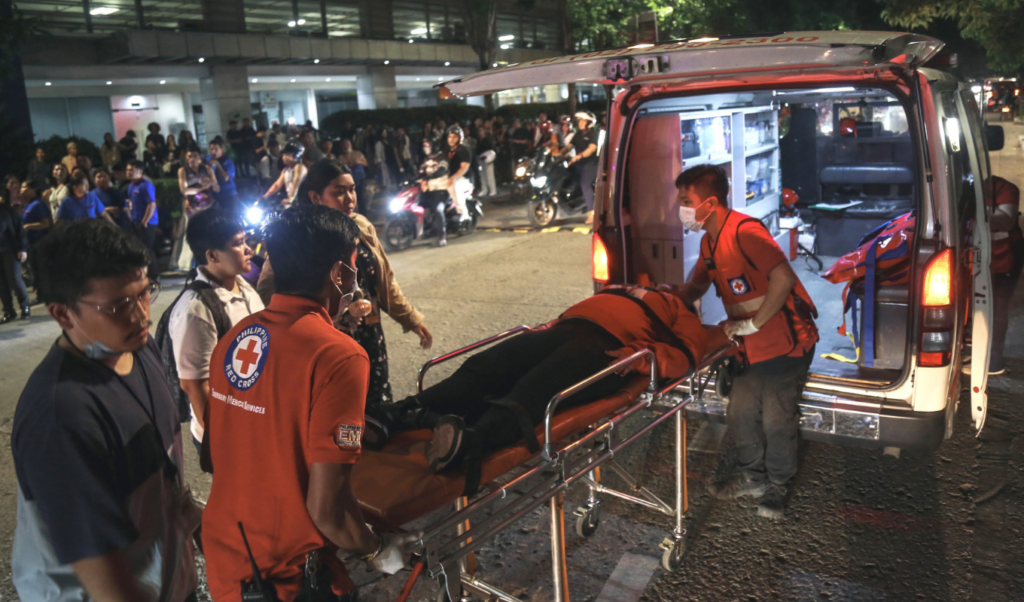
Rescuers continued to search collapsed buildings for survivors on Wednesday after a powerful 6.9 magnitude earthquake struck the central Philippines, claiming the lives of at least 31 people on the island of Cebu. Authorities have warned that the death toll could rise further.
The shallow earthquake occurred at 9:59 pm (13:59 GMT) on Tuesday, off the northern tip of Cebu near the city of Bogo, which has a population of approximately 90,000, according to the US Geological Survey (USGS).
Casualties and Injuries
| Location | Deaths | Injuries | Notes |
| Bogo, Cebu | 25 | – | Recorded by Cebu provincial hospital; medical staff treated some patients outside due to high volume of serious injuries. |
| Other parts of Cebu province | 6 | 147 | Reported by National Disaster Risk Reduction and Management Council; 22 buildings damaged. |
Cebu provincial governor Pamela Baricuatro posted on her official Facebook page: “Because of the high volume of patients with serious injuries, the medical staff tended to some of them outside the hospital.”
Provincial rescue official Wilson Ramos warned: “There could be people trapped beneath collapsed buildings.”
Recovery operations were hampered overnight by darkness and continuing aftershocks, with the Philippine Institute of Volcanology and Seismology reporting 379 aftershocks in the region.
Structural Damage and Public Impact
- A commercial building and a school in Bantayan collapsed.
- A fast food restaurant in Bogo suffered heavy damage.
- Several village roads were damaged.
- Power outages occurred across Cebu and nearby central islands after the quake caused power lines to trip, although electricity was restored shortly after midnight, according to the National Grid Corp. of the Philippines.
Dramatic footage shared on social media showed an old Catholic church on Bantayan island with a string of light bulbs swaying violently before the belfry toppled into the courtyard.
“I heard a loud booming noise from the direction of the church, then I saw rocks falling from the structure. Luckily no one got hurt,” said Martham Pacilan, 25, who was nearby when the belfry collapsed.
Local television footage captured riders being forced to dismount from motorcycles and hold onto railings as a bridge in Cebu shook violently.
Buildings were damaged as far as Cebu City, about 100 kilometres (60 miles) south of Bogo. Online shoe merchant Jayford Maranga, 21, described his experience: “My friend and I ate at the food court near closing time, and then, bang! It was as if the Earth stopped spinning. And then the mall started shaking.”
His friend sustained minor injuries.
Agnes Merza, 65, a carer based in Bantayan, said: “It felt as though we would all fall down. It’s the first time I have experienced it. The neighbours all ran out of their homes. My two teenage assistants hid under a table because that’s what they were taught in the Boy Scouts.”
The Cebu provincial government has issued a call for medical volunteers on its official Facebook page to assist with the aftermath of the quake.
Rescue efforts continued overnight despite darkness and aftershocks, highlighting the urgency of reaching people who may still be trapped under rubble.
Magnitude and Seismic Context
- Initial USGS reports suggested a magnitude of 7.0, later revised to 6.9.
- The Pacific Tsunami Warning Center confirmed that there was no tsunami threat.
The Philippines lies on the Pacific “Ring of Fire”, a region of intense seismic activity extending from Japan through Southeast Asia and across the Pacific. Quakes are frequent, but most are too weak to be felt. Strong, destructive earthquakes strike at random, and there is currently no technology to predict their timing or location.