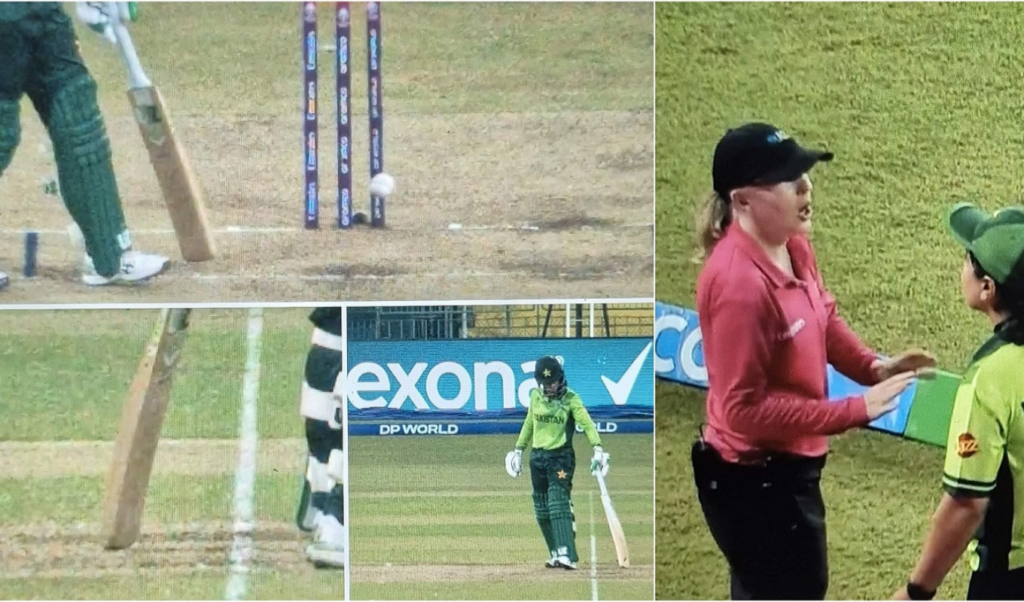
The ongoing Women’s Cricket World Cup saw India and Pakistan face off in their second match, with India emerging victorious by 88 runs in Colombo. However, the match sparked controversy surrounding Pakistani batter Muniba Ali, who was given run out by the third umpire, a decision Pakistan refused to accept. The Marylebone Cricket Club (MCC), the custodian of cricket laws, has now provided an official explanation.
The Incident
Chasing India’s total of 247 runs, Pakistan lost Muniba on the fifth ball of the fourth over. India’s pacer Kranti Gaur delivered a ball that struck Muniba’s pads, prompting a leg before wicket (LBW) appeal by the fielders. The on-field umpire rejected the LBW appeal.
At the time, Muniba was outside the crease, and her bat was not grounded within it. Indian fielder Dipti Sharma immediately threw the ball directly at the stumps, breaking them and signalling a run-out appeal.
The third umpire reviewed the video replay, confirming that Muniba’s bat was in the air and she was outside the crease when the stumps were broken. Consequently, Muniba was declared run out.
Pakistan’s Protest
Pakistan captain Fatima Sana, watching from the dugout, protested the decision, engaging in discussion with the fourth umpire. At one point, she asked Muniba to stay inside the boundary line while returning to the dressing room.
Despite the protest, MCC clarified on their website that the umpire’s decision was legally correct.
Legal Basis According to MCC
Some argued that Muniba was not out under Law 30.1.2, which applies when a batter temporarily loses contact with the crease while running or diving. MCC explained that this law does not apply here because Muniba deliberately lifted her bat and stepped out of the crease.
MCC further clarified: “Law 30, introduced in 2010 and known as the ‘Bouncing Bat Law’, protects a batter only when they unintentionally lift the bat or feet while running. Muniba deliberately raised her bat and was standing outside the crease.”
Additionally, the LBW appeal was made while the ball was still in play. The ball had not yet been fully controlled by the wicketkeeper; instead, Dipti’s direct throw dislodged the stumps during play. MCC stated: “This was clearly a run-out. The batter was not attempting a run, and the ball was not a no-ball. The fielder directly broke the stumps, and the umpires made the correct decision according to the laws.”
Cricket Law Summary
Under the Laws of Cricket:
- A batter is out if, while the ball is in play, they are outside the crease and the stumps are broken by a fielder’s action.
- Muniba’s dismissal fully adhered to this rule.
Upcoming Fixtures
- Pakistan will face Australia tomorrow in the Women’s World Cup.
- India will play South Africa on Thursday.
This clarification by MCC ends the debate over the run-out, reaffirming the umpire’s authority in enforcing cricket laws.