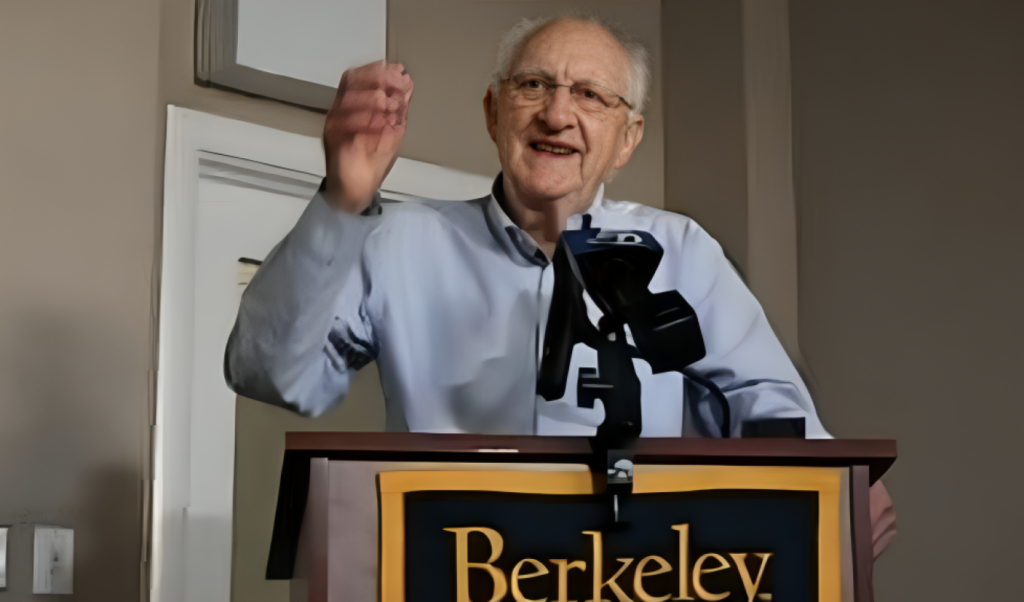
It was just after 2:00 am when Nobel laureate John Clarke received a mysterious phone call he initially thought was a prank. The surreal moment escalated when he heard “a voice from Sweden.”
“It soon became clear that it was real,” Clarke told journalists on Tuesday, following the announcement that he and two colleagues had won the Nobel Prize in Physics for their pioneering work in quantum mechanics.
Clarke, a British 83-year-old professor at the University of California, Berkeley, described the flurry of messages and requests that followed.
“My phone kept ringing, emails poured in, and people were banging on my door seeking interviews at 3:00 am (1000 GMT). I said no thank you, not at this time of night,” he said with a chuckle.
He shared the prize with Michel Devoret, a French physicist, and John Martinis, an American, both of whom worked in his Berkeley lab during their groundbreaking research.
Reflecting on the significant resources available during their research nearly four decades ago — including lab space, graduate assistants, and equipment — Clarke expressed deep concern about the impact of President Donald Trump’s policies on American science and health research.
“This will cripple much of United States science research,” he told AFP. “I know people who have taken enormous funding hits. It is going to be disastrous if this continues.”
Clarke warned that even assuming a change in administration, it could take up to a decade to restore the US research landscape to what it was merely six months ago.
“It’s a huge problem, entirely beyond the understanding of anyone who is a scientist,” he said.
This year’s Nobel physics winners conducted their experiments in the 1980s, advancing our understanding of the quantum realm. Quantum mechanics governs phenomena at subatomic scales, where the rules of classical physics no longer apply.
For example, whereas a normal ball bounces off a wall, a quantum particle can pass directly through a barrier — a phenomenon known as tunnelling. Clarke and his colleagues demonstrated tunnelling on a scale visible to the human eye.
The Nobel Committee noted that their research showed:
“The bizarre properties of the quantum world can be made concrete in a system big enough to be held in the hand.”
This foundational work has enabled modern technologies such as cell phones and underpins the development of powerful quantum computers.
Clarke stressed the vital importance of continued public funding for basic science, noting that the significance of research often only becomes clear decades later.
“Michel, John and I had no way of understanding the importance our work would have. Forty years ago, we would have said, ‘Well, it’s an interesting thing.’”
He added:
“Researchers who lay the groundwork are not the same people who actually use these effects for something vitally important. It’s crucial to do basic science, because you don’t know what the outcome will be.”
Similarly, Nobel laureate Mary Brunkow, awarded for medicine this year, has emphasised the role of US public financing in enabling transformative scientific research.
Clarke’s warning underlines the long-term risks of slashing investment in basic science, which may only reveal its full impact decades after the original research.