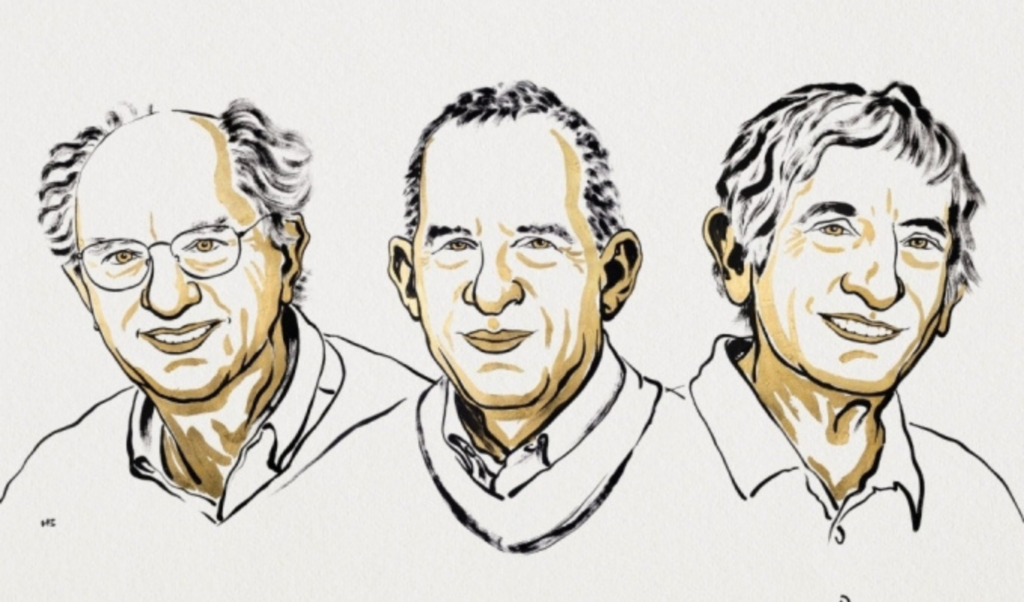
Briton John Clarke, Frenchman Michel Devoret, and American John Martinis were awarded the 2025 Nobel Prize in Physics on Tuesday for their groundbreaking work in quantum mechanics, which has enabled the development of a wide range of digital technologies — from cellphones to next-generation computers.
The Nobel Committee highlighted that their research has: “Provided opportunities for developing the next generation of quantum technology, including quantum cryptography, quantum computers, and quantum sensors.”
Quantum mechanics governs the behaviour of matter on extremely small scales.
- Normal scale: A ball hitting a wall bounces back.
- Quantum scale: A particle can pass straight through a comparable wall — a phenomenon known as tunnelling.
“What these scientists were able to do was basically do that, but on an electric circuit,” explained Ulf Danielsson, secretary of the Nobel physics committee and professor of theoretical physics at Uppsala University, to AFP.
In experiments conducted in the 1980s, the trio demonstrated that quantum tunnelling could be observed on a macroscopic scale, involving multiple particles, by using superconductors.
“This prize awards an experiment that brings the scale up to a level we can understand and measure through human standards,” Danielsson added.
Olle Eriksson, chair of the Nobel Committee for Physics, said: “It is also enormously useful, as quantum mechanics is the foundation of all digital technology.”
John Clarke, 83, professor at the University of California, Berkeley, described learning of the prize as: “The surprise of my life.”
Clarke emphasised that the researchers had been focused on pure physics, unaware at the time of the practical applications that would follow.
“It certainly had not occurred to us that this discovery would have such a significant impact,” he said.
Noting the real-world implications, Clarke pointed out that his ability to speak to reporters via mobile phone relied on the very principles his team had explored: “One of the underlying reasons that the cellphone works is because of all this work.”
He also paid tribute to his colleagues: “We would never have gotten this prize if they hadn’t done all their hard work.”
All three laureates conducted their research in the United States, reflecting the country’s longstanding investment in basic science and academic freedom.
Clarke warned that budget cuts under President Donald Trump “will cripple important research” and could have disastrous long-term consequences for US science.
“It is going to be disastrous if this continues,” he said.
Eleanor Crane, a quantum physicist at King’s College London, described Devoret’s move to the US as an example of brain drain, though she noted that the trend is being reversed under a new administration.
The physics prize is the second Nobel of 2025, following the medicine award on Monday to Mary Brunkow and Fred Ramsdell (US) and Shimon Sakaguchi (Japan) for identifying immunological “security guards.”
Brunkow emphasised the importance of federal funding in promoting scientific research, a concern echoed in Clarke’s warnings about US budget cuts.
Upcoming 2025 Nobel awards:
| Prize | Date |
| Chemistry | Wednesday, October 9 |
| Literature | Thursday, October 10 |
| Peace | Friday, October 11 |
| Economics | Monday, October 13 |
Each Nobel consists of a diploma, a gold medal, and a $1.2-million cheque, to be shared if there are multiple winners in a discipline. The laureates will receive their awards in Stockholm and Oslo on December 10, commemorating the anniversary of Alfred Nobel’s death in 1896, the founder of the prizes.
The 2025 Physics laureates’ achievement not only deepens our understanding of quantum phenomena but also underscores the critical importance of sustained support for basic scientific research, which can ultimately lead to transformative technologies impacting everyday life.