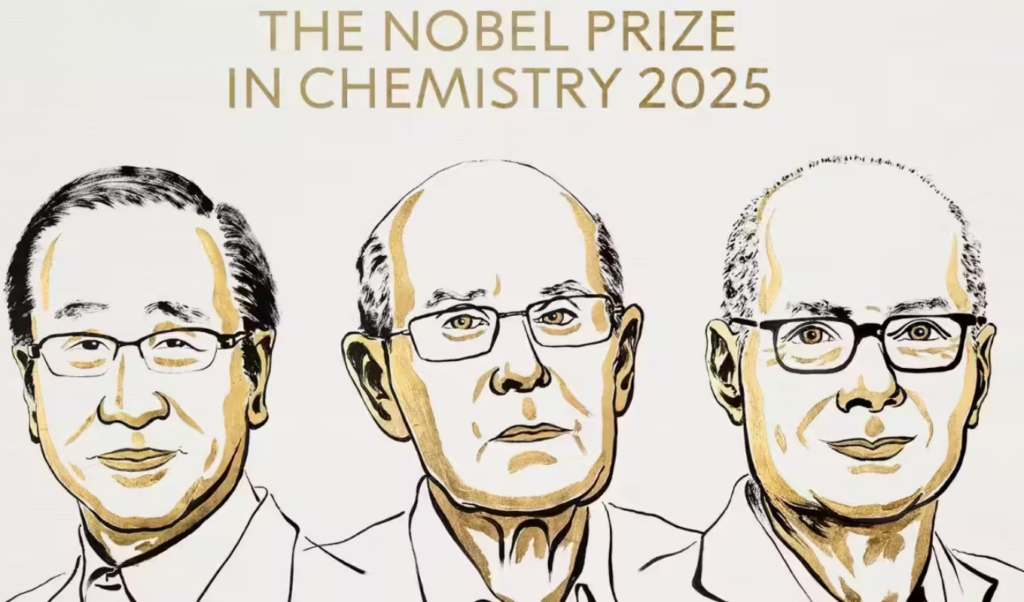
On Wednesday, Japan’s Susumu Kitagawa, UK-born Richard Robson, and American-Jordanian Omar M. Yaghi were awarded the Nobel Prize in Chemistry for their development of metal-organic frameworks (MOFs), the Nobel jury announced.
“These constructions, metal-organic frameworks, can be used to harvest water from desert air, capture carbon dioxide, store toxic gases, or catalyse chemical reactions,” the committee stated.
MOFs are crystalline compounds consisting of metal ions linked by organic molecules, creating highly porous structures. Their unique properties allow for tailored materials with applications in energy, environmental solutions, and industrial chemistry.
“Metal-organic frameworks have enormous potential, bringing previously unforeseen opportunities for custom-made materials with new functions,” said Heiner Linke, chair of the Nobel Committee for Chemistry.
Commentators had long considered Omar Yaghi a likely contender for the prize, with Kitagawa’s name frequently mentioned alongside his.
| Laureate | Nationality | Contribution |
| Susumu Kitagawa | Japan | Pioneering MOF design and synthesis |
| Richard Robson | UK | Theoretical and practical frameworks for MOFs |
| Omar M. Yaghi | US-Jordan | Development of MOFs for water harvesting and gas storage |
The practical applications of MOFs include:
- Water harvesting from arid climates
- Carbon dioxide capture for climate mitigation
- Storage of toxic or hazardous gases
- Catalysis in chemical reactions
The chemistry prize follows earlier awards this week:
- Physics (Tuesday): Briton John Clarke, Frenchman Michel Devoret, and American John Martinis for applying quantum mechanics, enabling digital technologies including cell phones and quantum computers.
- Medicine (Monday): Americans Mary Brunkow and Fred Ramsdell, along with Japan’s Shimon Sakaguchi, for identifying immunological “security guards” in the human immune system.
Upcoming prizes include:
| Date | Prize |
| Thursday, Oct 10 | Literature |
| Friday, Oct 11 | Nobel Peace Prize |
| Monday, Oct 13 | Economics |
Each Nobel Prize includes:
- Diploma
- Gold medal
- $1.2 million cheque (shared if multiple winners)
The formal award ceremonies will be held in Stockholm and Oslo on 10 December, the anniversary of Alfred Nobel’s death in 1896, who established the prizes in his will.
This year’s awards highlight cutting-edge scientific discoveries with significant potential to transform technology, medicine, and sustainability worldwide.