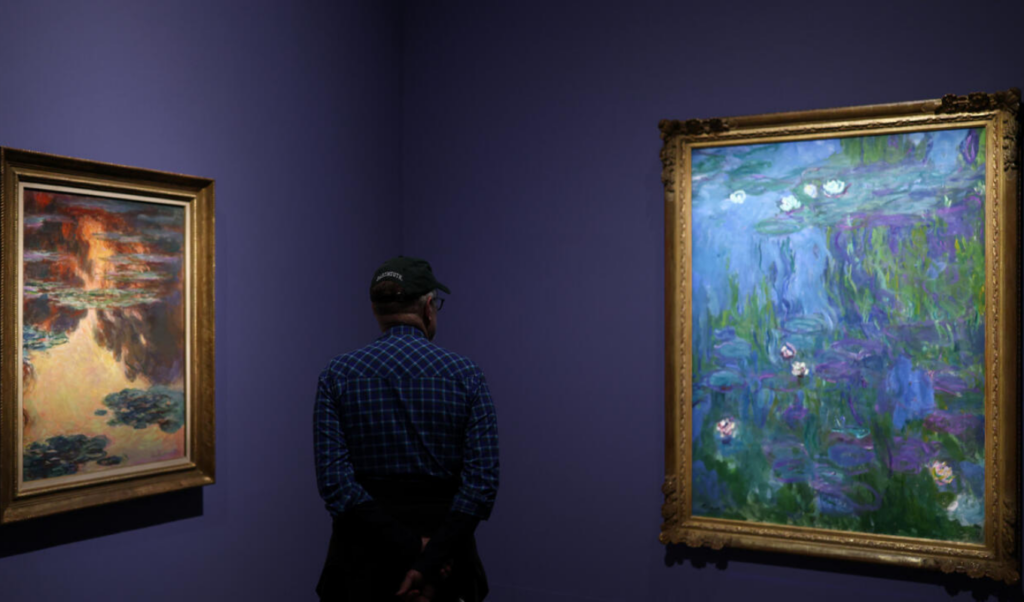
In 1908, Claude Monet — then aged 68 and deeply immersed in his celebrated Water Lilies series — was initially reluctant to journey to Venice. Persuaded only by his wife, Alice Hoschedé, the French Impressionist eventually made the trip. What followed, however, became one of the most productive and emotionally charged periods of his artistic career.
During his stay, Monet created 37 extraordinary paintings, many of which are now being showcased in a new exhibition titled “Monet and Venice”, opening Saturday at the Brooklyn Museum in New York.
“He fell in love with the city, and he had a wonderful time there with Alice,” said Lisa Small, co-curator of the exhibition, in an interview with AFP.
“They wanted to return, but sadly Alice became ill and passed away in 1911. Monet completed the paintings in Giverny, enveloped in grief and mourning.”
Running until February 2026, the exhibition retraces Monet and Alice’s Venetian journey through a blend of masterpieces, personal archives, postcards, and photographs, allowing visitors to experience both the artistic brilliance and personal tenderness behind the works.
| Exhibition Details | Information |
| Title | Monet and Venice |
| Venue | Brooklyn Museum, New York |
| Duration | October 2025 – February 2026 |
| Number of Paintings Displayed | 19 (from a total of 37 Venice works) |
| Notable Works | The Palazzo Ducale, The Grand Canal, Venice |
| Additional Artists Featured | Canaletto, J.M.W. Turner, John Singer Sargent |
Many of Monet’s Venetian paintings reveal architectural grandeur filtered through his signature Impressionist vision. The scenes capture palaces, canals, and reflections that shift with light, distance, and time of day, transforming Venice into what the curators describe as the “second protagonist” of the exhibition.
“Venice itself plays a central role,” Small explained. “It’s both the subject and the spirit that animates Monet’s compositions.”
The exhibition also draws connections between Monet’s Venice and earlier depictions of the city by masters such as Canaletto (1697–1768), J.M.W. Turner (1775–1851), and John Singer Sargent (1856–1925) — offering visitors a cross-century dialogue about Venice’s enduring allure.
The highlight of Monet and Venice is a multisensory gallery where Monet’s luminous canvases are accompanied by a contemporary symphonic composition written specially for the show by Niles Luther, the museum’s composer-in-residence.
“Art critics, especially toward the end of Monet’s career, often described his work in musical terms — a symphony of colours, a harmony of brushstrokes,” Small noted.
“So we felt it fitting to pair his art with a musical interpretation, blending classical sound with visual rhythm.”
The immersive installation invites visitors to experience Monet’s Venetian series not merely as paintings but as living, resonant compositions, where light becomes melody and colour transforms into harmony.
Though born from reluctance and concluded in sorrow, Monet’s Venetian sojourn stands today as a testament to resilience and reinvention. The works capture both the splendour of Venice and the poignancy of personal loss, bridging the artist’s emotional landscape with the ethereal beauty of the lagoon city.
As the Brooklyn Museum unveils this landmark exhibition, it offers audiences a rare opportunity to witness how a reluctant voyage evolved into a symphony of colour, emotion, and memory — one that continues to echo more than a century later.