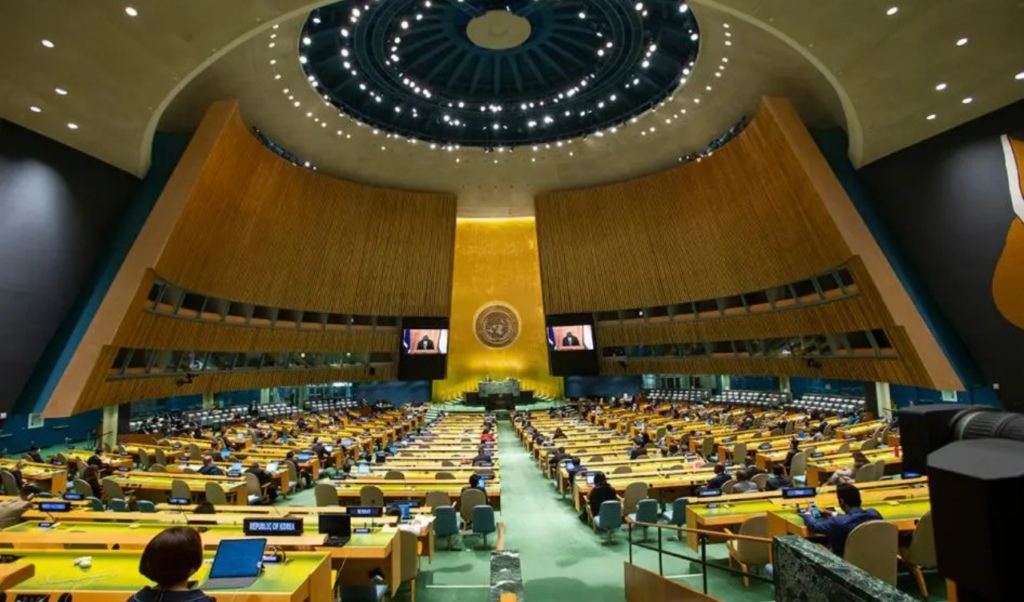
The United Nations General Assembly on Tuesday elected 14 countries to the UN Human Rights Council (UNHRC) for the 2026–2028 term — including states accused of serious rights abuses such as Egypt and Vietnam — prompting sharp criticism from international advocacy groups over what they described as a “flawed and uncompetitive” process.
The Human Rights Council, the UN’s principal body responsible for promoting and protecting human rights, is composed of 47 member states based in Geneva.
Each member serves a three-year term, with part of the council renewed every year.
Seats are distributed by geographic region, and in most cases, regional blocs pre-select their candidates, leaving the General Assembly’s secret-ballot vote largely a formality.
In this election, 14 seats were open for renewal — one for each regional group — and all nominated states won unopposed.
Newly Elected Members of the UNHRC (Term: 2026–2028)
| Region | Countries Elected | Controversial Selections Highlighted by Activists |
| Africa | Angola, Egypt, Mauritius, South Africa | Egypt criticised for repression of dissent and mass detentions |
| Asia-Pacific | India, Iraq, Pakistan, Vietnam | Vietnam and Pakistan accused of silencing journalists and minorities |
| Eastern Europe | Estonia, Slovenia | — |
| Latin America & Caribbean | Chile, Ecuador | — |
| Western Europe & Others | Italy, United Kingdom | — |
The election results were determined through a secret ballot held at the General Assembly in New York, where all candidates passed with majority votes, given that no region fielded more candidates than available seats.
Rights campaigners condemned the lack of competition, saying it undermines the Council’s credibility and effectiveness in addressing global human rights violations.
“Uncompetitive elections undermine the Human Rights Council’s reputation and work, allowing less than ideal candidates to sail through and stall human rights initiatives,”
said Madeleine Sinclair, Director of the International Service for Human Rights (ISHR) in New York.
Similarly, Louis Charbonneau, UN Director at Human Rights Watch (HRW), warned before the vote:
“Noncompetitive UN votes permit abusive governments like Egypt and Vietnam to become Human Rights Council members, threatening to make a mockery of the Council.”
Unlike previous years, where there were more candidates than available seats, this year’s election was entirely non-contested, effectively guaranteeing membership for all nominees.
In contrast, Saudi Arabia failed to secure a seat in 2024, and Russia was barred from rejoining the Council in 2023, after losing its position in 2022 when the General Assembly voted to suspend Moscow over its invasion of Ukraine.
The UN Human Rights Council continues to face criticism for allowing states with poor human rights records to sit in judgment of others — a recurring issue that activists say dilutes the body’s moral authority and hinders genuine reform efforts.