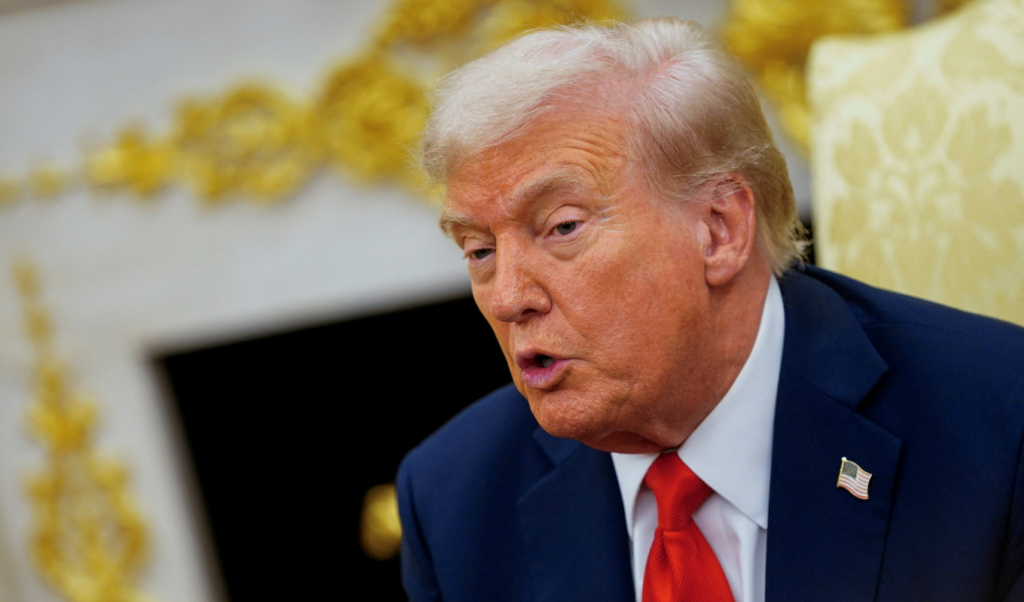
Former U.S. President Donald Trump has said he is considering imposing tariffs on Spain as a form of “punishment” for failing to meet the five per cent of GDP defence spending target that he introduced during his tenure as part of NATO’s revised financial commitments.
Speaking to reporters at the White House on Tuesday, Trump declared: “I think it’s very disrespectful to NATO. In fact, I was thinking about giving them trade punishment through tariffs because of what they did, and I may do that.”
The remarks follow Trump’s recent suggestion that Spain be expelled from NATO for not meeting the higher spending threshold.
In June, the 32-member military alliance agreed, under U.S. pressure, to increase collective defence spending to five per cent of annual economic output within the next decade. The move was widely seen as part of Trump’s push to make European members bear a larger share of the alliance’s military costs.
| NATO Defence Spending Framework (Post-Trump Initiative) | Details |
| Target Set by NATO (Traditional) | 2% of GDP per member state |
| New Target Pressured by Trump | 5% of GDP over the next decade |
| Number of NATO Members | 32 |
| Purpose of Increase | To modernise defence capabilities and reduce reliance on U.S. funding |
| Controversy | Several European states, including Spain and Italy, argue the new target is unrealistic |
Spain has consistently resisted Trump’s pressure, maintaining that it meets its alliance obligations through capability contributions rather than financial quotas. The Spanish government, led by Prime Minister Pedro Sánchez, has repeatedly stated that defence effectiveness cannot be measured solely by budget percentages.
Sánchez, who heads a Socialist coalition, argued that non-traditional defence areas — such as cybersecurity, intelligence, and environmental resilience — should be included in NATO’s assessment of member performance.
| Spain’s Defence Profile (2024–2025) | Figures / Notes |
| Current Defence Spending | Below 2% of GDP (lowest among NATO members) |
| NATO Target (Trump Initiative) | 5% of GDP |
| Government Stance | Focus on “capabilities, not fixed spending ratios” |
| Priority Areas | Cybersecurity, environmental protection, technology integration |
| PM Pedro Sánchez’s Statement | “Spain meets its capacity objectives just as much as the United States.” |
Following Trump’s expulsion threat, sources in Madrid’s government reaffirmed on Friday that: “Spain is a committed and full member of NATO, and it meets its capacity targets as much as the United States.”
Trump’s latest comments risk further straining U.S.–Spain relations and may ignite trade tensions between Washington and Madrid. The mention of tariffs as leverage recalls Trump’s earlier trade disputes with the European Union during his presidency, when he imposed tariffs on steel, aluminium, and agricultural goods.
Diplomatic analysts note that Trump’s rhetoric serves both as a warning to other European nations lagging behind on defence contributions and as a campaign signal to his domestic base emphasising his “America First” agenda.
However, critics argue that punishing European allies with trade measures could weaken NATO cohesion at a time when the alliance faces mounting geopolitical challenges from Russia and China.
While the United States remains NATO’s largest financial contributor, Trump’s insistence on the five per cent target represents a radical escalation from the alliance’s long-standing two per cent guideline established in 2014.
Many European leaders privately view the new benchmark as politically unfeasible and economically destabilising, especially for southern European economies still recovering from post-pandemic inflation and energy shocks.
As Spain holds its ground and Washington sharpens its tone, the standoff highlights a broader divide over the future of transatlantic defence cooperation — one increasingly defined by economic coercion rather than collective security consensus.