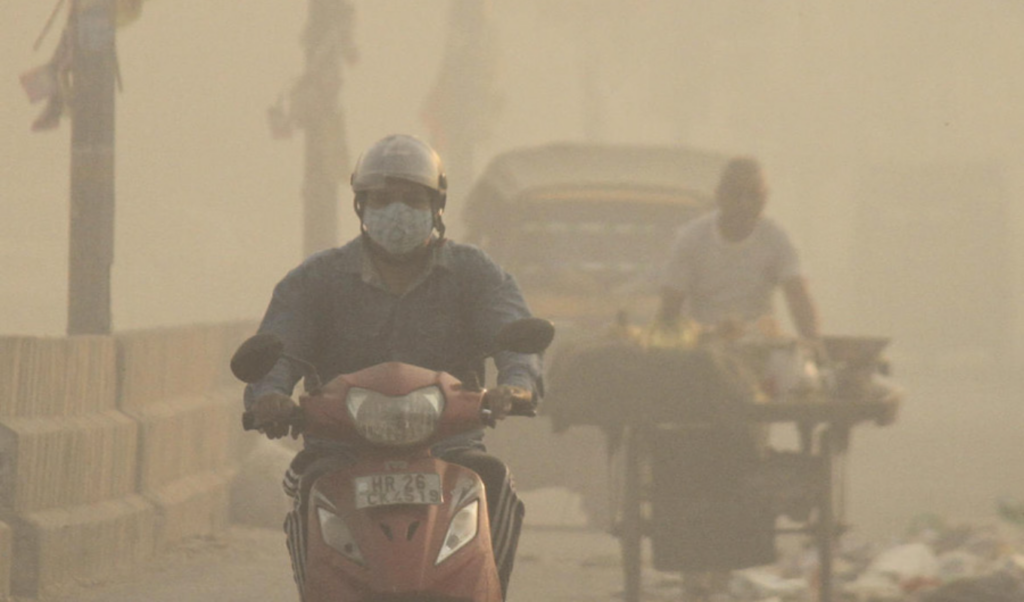
India’s capital New Delhi awoke on Monday under a dense, toxic haze, with air quality plunging to more than 16 times higher than the World Health Organization’s (WHO) recommended safe limit. The choking smog once again highlighted the city’s persistent air pollution crisis — a deadly seasonal recurrence that endangers millions.
New Delhi, along with its metropolitan region of over 30 million residents, is consistently ranked among the world’s most polluted cities. Each winter, the city’s skyline is swallowed by acrid smog as cooler temperatures trap pollutants close to the ground.
The toxic air is a lethal cocktail of emissions from:
| Source of Pollution | Description |
| Crop Burning | Farmers in nearby states burn agricultural residue after harvests, releasing large quantities of smoke and soot. |
| Industrial Emissions | Factories operating on outdated systems emit high levels of carbon and sulphur compounds. |
| Vehicular Traffic | Delhi’s massive traffic volume contributes significantly to nitrogen oxides and particulate matter. |
| Fireworks | Diwali festivities add bursts of toxic smoke and particulate pollution from fireworks. |
Pollution levels have spiked further in recent days due to fireworks celebrations marking Diwali, the Hindu festival of lights, which culminated on Monday night.
Although the Supreme Court relaxed its earlier blanket ban this year to allow “green firecrackers”—designed to emit fewer particulates—the measure had little effect. In previous years, similar restrictions were largely ignored, and this year proved no exception.
According to data from IQAir, a global air quality monitoring agency, levels of PM2.5—microscopic pollutants small enough to penetrate deep into the lungs and bloodstream—reached 248 micrograms per cubic metre in several parts of the city on Monday.
| Measurement Type | WHO Safe Limit (µg/m³) | Recorded in Delhi (µg/m³) | Exceedance Factor |
| PM2.5 (24-hour avg) | 15 | 248 | ≈16.5× higher |
These figures far exceed global safety standards and pose severe risks to human health.
The Commission for Air Quality Management (CAQM) has warned that air quality may worsen in the coming days due to stagnant weather conditions. To mitigate the crisis, several emergency actions have been rolled out:
| Measure | Objective |
| Ensuring uninterrupted power supply | To reduce the use of diesel generators, a major source of emissions. |
| Cloud seeding trials | Aircraft will release salt or silver iodide into clouds to induce artificial rain, helping clear airborne pollutants. |
| Increased pollution checks | Authorities to monitor industrial and vehicular emissions more closely. |
Delhi’s Environment Minister, Manjinder Singh Sirsa, confirmed that preparations for cloud seeding were complete:
“We’ve already got everything we need to do the cloud seeding. Flight trials and pilot training have been successfully completed,” he said earlier this month.
This marks the first time the Indian capital will attempt cloud seeding as a pollution-control strategy.
Long-term exposure to such toxic air continues to exact a heavy toll on public health.
- A 2023 study by The Lancet Planetary Health estimated that 3.8 million deaths in India between 2009 and 2019 were linked to air pollution-related causes.
- The UNICEF report warns that polluted air puts children at heightened risk of acute respiratory infections, developmental impairments, and chronic diseases.
| Health Impact | Population Group Most Affected | Associated Risks |
| Respiratory Diseases | Children, Elderly | Asthma, bronchitis, pneumonia |
| Cardiovascular Issues | Adults | Hypertension, stroke, heart disease |
| Reduced Life Expectancy | Entire Population | Early mortality due to chronic exposure |
As the haze thickens and residents reach for masks, schools consider closures, and hospitals brace for an influx of respiratory patients. Yet, experts warn that temporary fixes such as firework bans or seeding clouds will not solve Delhi’s deep-rooted air pollution crisis.
“Without sustained regional cooperation and stricter enforcement, Delhi’s air will continue to poison its people every winter,” said an environmental scientist at the Centre for Science and Environment (CSE).
For millions of Delhiites, clean air remains an unfulfilled dream — one that dims further each Diwali beneath a sky of smoke and celebration.