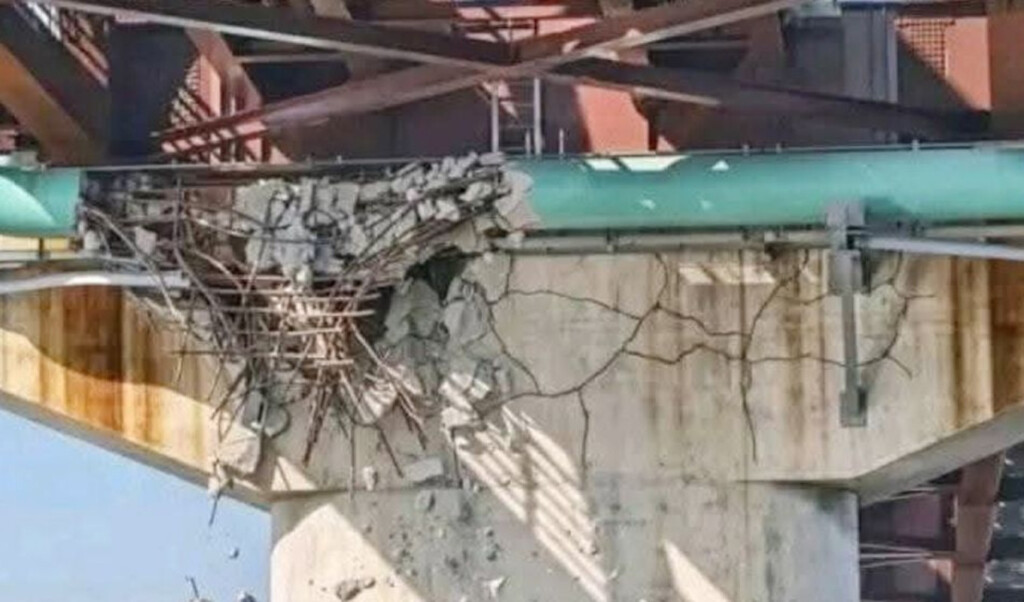
News of a crack on the Jamuna Railway Bridge quickly spread, sparking widespread discussion across social media, online news portals, newspapers, and television. However, on-site inspections reveal that there is no major crack on the bridge. The main pillars remain intact; only some hairline marks or crack-like signs have appeared on parts of the pier caps.
The Jamuna Railway Bridge was officially inaugurated on March 18. Just seven months after the inauguration, reports of cracks emerged, which later turned into rumors after being circulated by various media outlets. Some individuals even shared fake images on social media claiming the bridge had collapsed. Authorities have stated that these marks will be examined to confirm whether they are actual cracks.
On-site observations indicate that the bridge structure is strong and undamaged. Project Director Abu Fattah said, ‘There is a protective layer over the pier cap’s concrete. Some hairline marks are visible, but they do not damage the main structure.’
He added, ‘The stones used are extremely strong and resistant to wear. However, due to high temperatures, minor hairline patterns may appear on the surface layer.’
The new railway bridge has been constructed with dual-gauge, double tracks. Train operations began on one line on February 12. Project Director Al Fattah Md. Masudur Rahman said, ‘It takes two to three minutes for a train to cross the main bridge. The distance between Saidabad and Ibrahimabad stations is 13 kilometers, which the train covers in seven minutes. Previously, crossing the Jamuna Road Bridge used to take 20 to 25 minutes.’
For context, the road bridge over the Jamuna River opened in 1998, with a rail line added later, establishing rail connectivity between Dhaka and the northwest region. However, in 2006, cracks were detected on that bridge, and train speed was limited to 20 km/h.
To permanently resolve the issue, the government initiated the construction of a new, separate railway bridge in December 2016, a 4.8-kilometer-long project. The initial estimated cost was BDT 9,734.07 crore, later rising to BDT 16,780.96 crore. The project timeline has been extended to 2025.
Originally named the Bangabandhu Sheikh Mujib Railway Bridge, its name was changed to Jamuna Railway Bridge in December last year when the interim government took charge. Built over 50 pillars with 49 spans, the bridge can support trains running at speeds up to 120 km/h. However, since the connecting line is currently single-track, trains are operating at slower speeds.
Sharif