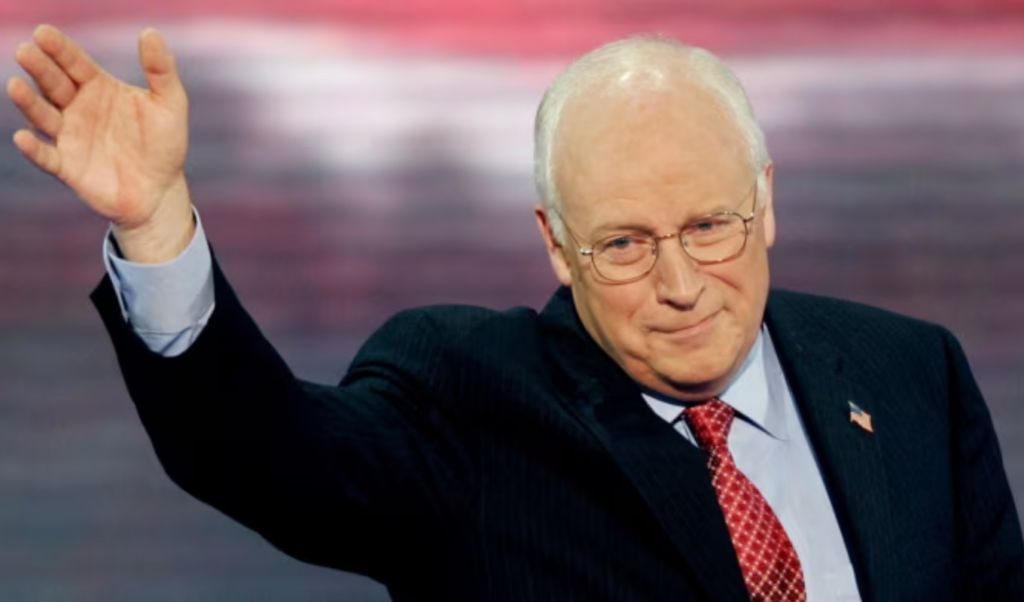
Former United States Vice President Dick Cheney has died at the age of 84, according to reports from American media outlets on Tuesday, citing a statement issued by his family.
Cheney, who served as the 46th vice president under Republican President George W. Bush from 2001 to 2009, was one of the most influential figures to ever hold the position. He became a dominant force in US politics during a tumultuous period marked by the September 11 attacks and the subsequent wars in Afghanistan and Iraq.
The statement confirmed that Cheney passed away on Monday due to complications from pneumonia and cardiac and vascular disease.
“For decades, Dick Cheney served our nation, including as White House Chief of Staff, Wyoming’s Congressman, Secretary of Defense, and Vice President of the United States,” the family statement read.
Cheney’s vice presidency transformed what was traditionally viewed as a largely ceremonial role into one of immense influence. He was often seen as the power behind the Bush administration’s major decisions, particularly those involving national security and foreign policy. As Bush launched the so-called “war on terror”, Cheney’s aggressive and unyielding approach shaped a generation of US policy — including secret renditions, the use of torture, and the establishment of the controversial Guantanamo Bay detention camp.
A deeply polarising figure, Cheney became a symbol of neo-conservative power and the expansion of executive authority. His belief in a strong presidency led him to champion a doctrine of near-unchecked executive power, particularly during wartime, a stance that drew sharp criticism for undermining civil liberties and international law.
Born in Lincoln, Nebraska, on 30 January 1941, Cheney spent most of his childhood in Wyoming, the state that would later send him to Congress. He attended Yale University but left before completing his degree, eventually graduating in political science from the University of Wyoming.
Cheney’s political career began in earnest when he served as Wyoming’s representative in the US House of Representatives for ten years. In 1989, he was appointed Secretary of Defense by President George H.W. Bush, overseeing the Pentagon during the 1990–91 Gulf War when a US-led coalition expelled Iraqi forces from Kuwait.
As vice president, Cheney brought his neo-conservative ideology to the White House, exerting an influence over policymaking that far exceeded that of most of his predecessors. He is widely considered one of the key architects of the 2003 invasion of Iraq, driven by claims — later proven false — that Saddam Hussein possessed weapons of mass destruction.
Though fiercely loyal to President Bush, Cheney was never far from controversy. He became a hate figure for many on the political left, accused of steering the United States into costly and destructive conflicts. Yet, in a remarkable late-life turn, Cheney publicly opposed Donald Trump’s bid to return to the presidency in 2024. His daughter, Liz Cheney — a former congresswoman from Wyoming — revealed that her staunchly Republican father had voted instead for Democrat Kamala Harris.
Despite his preference for privacy, Cheney frequently found himself in the public eye. Notably, he once directed an expletive at a senior Democratic senator on the Senate floor, and in 2006, he accidentally shot his friend Harry Whittington during a hunting trip — an incident that became the subject of international headlines.
Cheney’s career was also marked by persistent health issues. He suffered five heart attacks between 1978 and 2010, including one in 2000, the year he and Bush first won the White House. He underwent quadruple bypass surgery and had a pacemaker implanted in 2001, which was later replaced.
A man of immense political skill and enduring controversy, Dick Cheney leaves behind a complex legacy — one defined by power, conviction, and the far-reaching consequences of his influence on modern American governance.