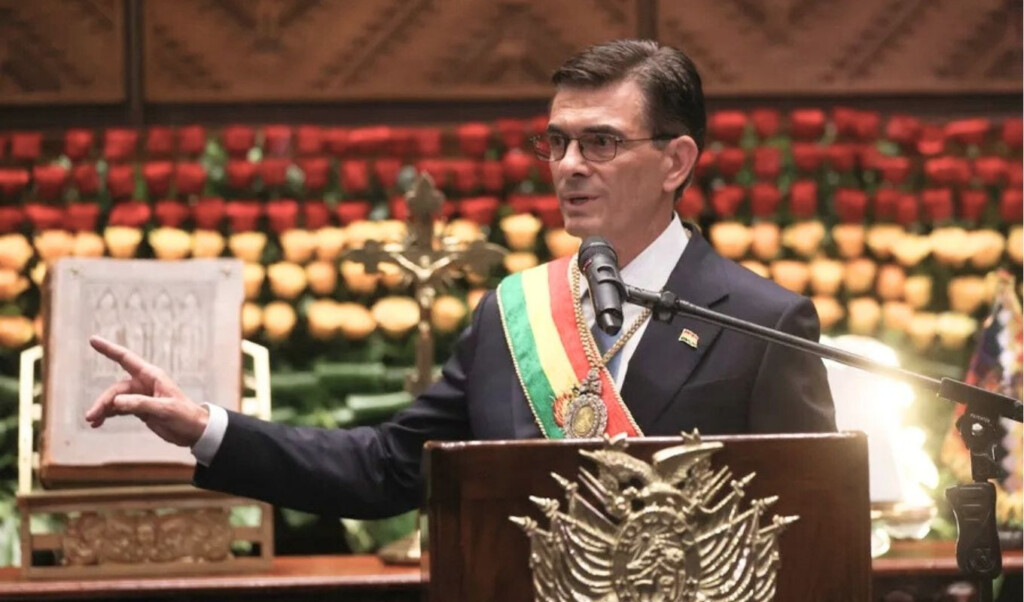
Rodrigo Paz, a pro-business conservative leader, was sworn in on Saturday as the new President of Bolivia, bringing an end to nearly two decades of socialist governance and stepping into office amid the country’s gravest economic crisis in four decades.
The 58-year-old, son of former Bolivian president Jaime Paz Zamora, took the oath of office at the Plurinational Legislative Assembly in La Paz as torrential rain poured outside. “God, family and country: yes, I take the oath of office,” he declared to resounding applause from lawmakers and guests.
In his inaugural address, Paz promised a decisive shift in direction after 20 years of leftist leadership, pledging to “open Bolivia to the world” and end the isolationist policies that, he argued, had left the nation economically paralysed.
“Never again an isolated Bolivia, bound by failed ideologies, or a Bolivia with its back turned to the world,” he said, addressing a crowd that included representatives from more than 70 countries.
His rise to power follows a run-off election last month that marked a historic turning point in Bolivian politics, ending the dominance of the Movement for Socialism (MAS) party, first led by Evo Morales and later by Luis Arce.
In one of his first official acts, President Paz moved swiftly to restore full diplomatic relations with the United States, reinstating ambassador-level ties that had been severed for 17 years. The break dated back to Morales’ 2008 decision to expel the US ambassador, accusing Washington of backing right-wing conspiracies against his government.
Paz’s decision signals a sharp pivot away from the anti-Western alliances of the Morales era, during which Bolivia strengthened ties with China, Russia, Cuba, Venezuela, and other left-leaning governments across Latin America.
His administration is expected to pursue a more market-oriented economic strategy and seek international investment to stabilise the country’s finances.
The new president inherits a nation in severe financial distress. Bolivia is grappling with its worst economic downturn in 40 years, as inflation has surged beyond 20 per cent, and the country faces chronic shortages of fuel, foreign currency, and basic commodities.
For months, motorists across major cities have endured long queues at petrol stations, a visible sign of the state’s collapsing fuel subsidy system. The previous government, led by Luis Arce, drained nearly all of Bolivia’s hard currency reserves in a desperate attempt to sustain subsidies for petrol and diesel.
Economists warn that the country is now on the brink of a balance-of-payments crisis, with limited reserves and dwindling investor confidence.
On the campaign trail, Paz championed a model he described as “capitalism for all,” blending free-market reform with social inclusivity. His platform emphasised lower taxes, decentralisation of government, and fiscal discipline, while promising to preserve key welfare programmes that have long benefited Bolivia’s poor.
“Bolivia needs an economy that rewards effort and innovation, but that also protects those most in need,” Paz said during his campaign.
However, analysts have expressed scepticism about his ability to balance economic stabilisation with continued social spending, warning that his dual promise may prove difficult to deliver given the nation’s fragile finances.
As he begins his presidency, Rodrigo Paz faces the enormous task of rebuilding public trust, re-establishing Bolivia’s global partnerships, and steering a struggling economy toward recovery — a challenge that will define the country’s next political chapter.