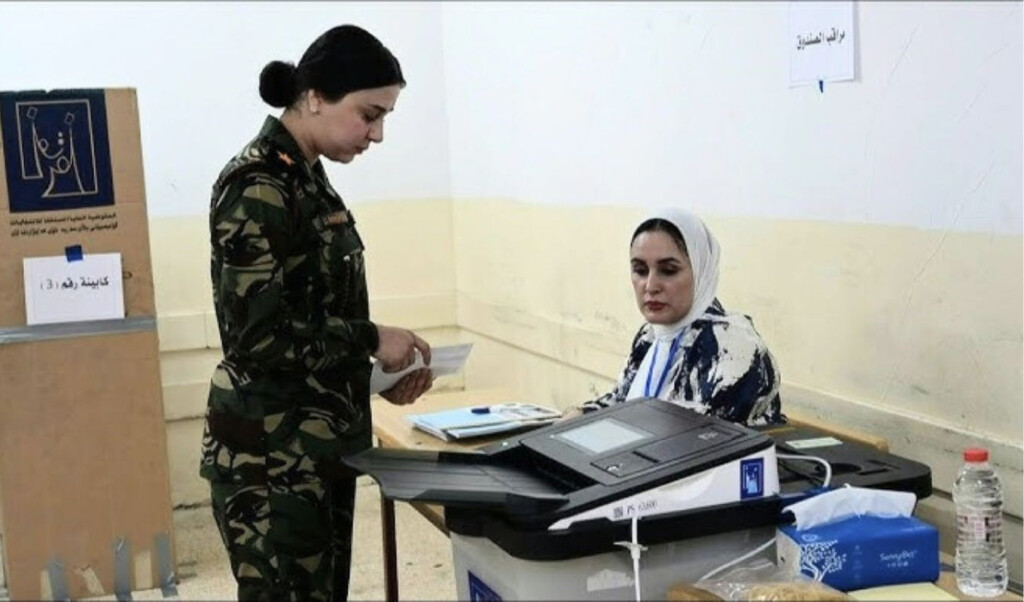
Members of Iraq’s security forces and displaced citizens began casting their ballots on Sunday in early voting, days before the country’s parliamentary elections, in a process closely watched for both political and security implications.
Polling stations opened at 04:00 GMT for members of the armed forces, who make up approximately 1.3 million of Iraq’s 21 million eligible voters. These personnel are voting early as they will be deployed to maintain security during the main election day, according to the state-run Iraqi News Agency.
In addition, more than 26,500 internally displaced people — many of whom fled their homes during years of conflict — were eligible to participate in this early round of voting.
The upcoming parliamentary election, scheduled for 11 November, marks Iraq’s sixth national poll since the 2003 US-led invasion that toppled former dictator Saddam Hussein.
More than 7,740 candidates, including nearly one-third women, are contesting the 329 seats in parliament. However, the reinstatement of an older electoral law in 2023 has drawn criticism, with many analysts arguing that it disproportionately benefits the country’s larger political parties.
While around 70 independents secured seats in the 2021 election, only 75 independents are running this year, raising concerns about a shrinking space for independent voices.
Observers fear that voter turnout could fall even lower than the record low 41 percent recorded in 2021, amid widespread frustration over political stagnation, corruption, and poor governance.
Influential Shiite cleric Moqtada al-Sadr, who commands a significant following, has urged his supporters to boycott the vote, branding it a “flawed election”.
Since the fall of Saddam Hussein, Iraq’s Shiite majority has dominated political life. Key figures such as former Prime Minister Nuri al-Maliki and cleric Ammar al-Hakim are expected to play central roles, alongside several pro-Iranian factions.
Current Prime Minister Mohammed Shia al-Sudani, who came to power in 2022 with backing from pro-Iranian parties, is seeking a second term and is widely anticipated to secure a substantial bloc in the new parliament.
By long-standing convention, Iraq’s power-sharing system reserves the prime minister’s post for a Shiite, the parliament speaker’s position for a Sunni, and the largely ceremonial presidency for a Kurd.
The next government will depend on whichever coalition manages to build the largest bloc in parliament — a process expected to involve weeks of complex negotiations after the vote.