What Happens if the ‘No’ Vote Wins in the Referendum?
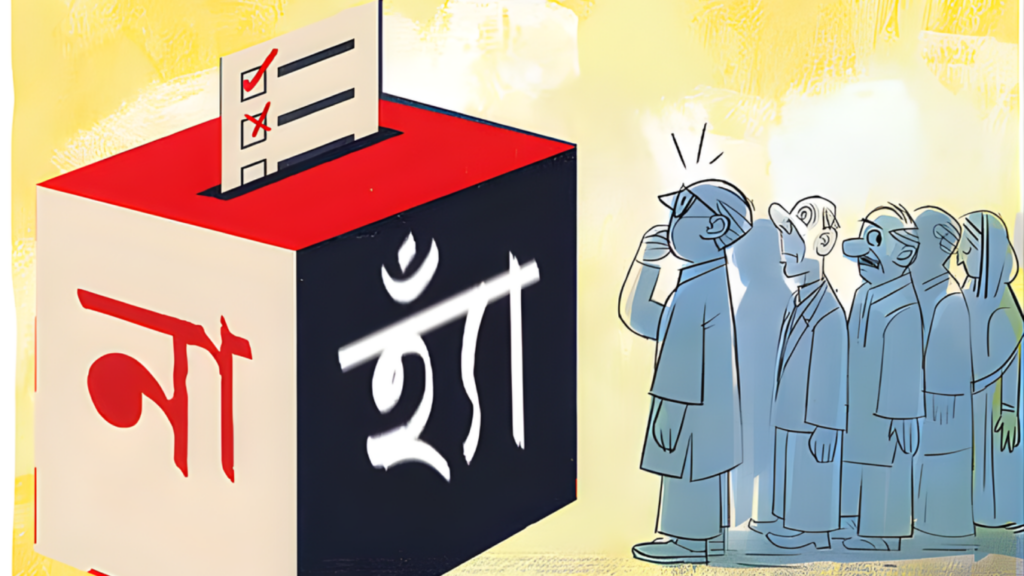
In the midst of differing political party positions, the interim government has approved a framework for implementing reforms based on the July National Charter. This framework has already gained legal status through a presidential decree. While not all major political parties are happy, they have, at least for now, accepted the process. Consequently, the uncertainty surrounding the reforms seems to have been temporarily resolved. However, the future of these reforms entirely depends on the outcome of the referendum. What happens if the ‘No’ vote prevails instead of ‘Yes’? This question is now at the forefront. Will the efforts of the Consensus Commission, the political parties, and the interim government be nullified? At this stage, no one can provide a clear answer to that question.
If the ‘No’ vote wins, the victorious party in the next general election will not be obligated to implement the reform proposals in line with the July Charter. Instead, future reforms will depend entirely on the majority party’s preferences in the new parliament. On July 13, 2023, the BNP announced a 31-point agenda aimed at constitutional and governance reforms, as well as economic liberation. Based on this, the party may pursue reforms, although this does not align with the desires of other political groups, including Jamaat-e-Islami. Jamaat, however, supports nearly all of the proposals laid out in the July Charter. Whether future reforms will follow the July Charter or if new formulas will emerge depends on the referendum outcome.
Key Reforms Under the July National Charter
The July National Charter, crafted through nine months of deliberations by the Consensus Commission, contains 84 proposals, 48 of which are related to constitutional matters. Though there were disagreements, especially with the BNP, Jamaat, and other parties, most signed the Charter on October 17. The political consensus to implement these reforms via a referendum was reached, but parties remain divided over the legal foundations, timing, and methodology of the referendum.
On October 28, the Consensus Commission offered the government two alternative recommendations for implementing the Charter, leaving the decision on the referendum’s timing to the government. On November 13, the interim government released a roadmap for implementing the reforms. The referendum will be held on the same day as the general election and will address four key issues. Although there are four issues, they all pertain to the 48 constitutional reform proposals.
If the ‘Yes’ vote wins, the next parliament will be bicameral, with a 100-member upper house formed based on proportional representation (PR) according to the votes each party receives. Therefore, for these reforms to be enacted, the ‘Yes’ vote must prevail.
Political Parties’ Position on the Reform Proposals
The Consensus Commission’s vice-chairman, Professor Ali Riaz, expressed optimism about a ‘Yes’ victory in an interview on September 27, 2025. However, he also stated that if the referendum is rejected, parties must be prepared to accept the outcome. He pointed out that since 1790, over 800 referendums have been held globally, with only 6% of them resulting in rejection. The real concern, he said, is the potential rejection of the reforms by the public, which would be a blow to the efforts thus far.
The Referendum Question
The referendum will ask a single question regarding four main issues, which include:
The formation of a caretaker government, the Election Commission, and other constitutional institutions during elections, based on the processes outlined in the July National Charter.
The formation of a bicameral parliament, with a 100-member upper house created based on proportional representation. Constitutional amendments would require approval from the majority of the upper house members.
Various reforms related to women’s representation, deputy speaker and parliamentary committee heads from the opposition, the limitation of the Prime Minister’s tenure, enhanced presidential powers, expanded fundamental rights, judicial independence, and local government.
Implementation of other reforms outlined in the July National Charter as per the commitments made by political parties.
If the ‘Yes’ vote wins, the next parliament will be bicameral, and constitutional amendments will require approval from the upper house. However, if the ‘No’ vote prevails, the formation of the upper house will not be mandatory, and the new ruling party could introduce its own system.
Possible Outcomes and Impact of a ‘No’ Vote
The referendum’s outcome will be influenced by how political parties mobilise their supporters. The BNP and some of its allies, including Jamaat, have expressed reservations about certain reform proposals, particularly the formation of the upper house and the methods of appointing constitutional positions. Should the ‘No’ vote win, it could signal a rejection of the current reform framework, and political parties may introduce alternative plans. For instance, BNP’s advisor and former opposition chief whip, Zaynul Abdin Faruk, recently urged voters in his constituency to reject the reforms in the referendum.
If the ‘No’ vote prevails, the question arises as to how reforms will be implemented, especially regarding the caretaker government and other constitutional changes. Should the BNP come to power, they may seek to implement their own version of reforms, particularly in the appointments to constitutional institutions.
Legal Implications and Future Reforms
The legal framework for appointing individuals to constitutional positions, such as the Public Service Commission (PSC), Ombudsman, and Anti-Corruption Commission (ACC), as per the July Charter, is one of the contentious points. While some parties agree with the consensus process, others, like the BNP, have proposed alternative methods, such as appointments through legislation. The outcome of the referendum will also influence how these key appointments are handled in the future.
Ultimately, the political parties and their supporters hold the key to the outcome of the referendum. If the ‘Yes’ vote prevails, a new era of constitutional reforms will begin. If the ‘No’ vote wins, many reforms could be put on hold or implemented through executive orders, depending on the ruling party’s preferences. This uncertainty reflects the complexity of the situation, as political parties continue to negotiate the future of governance in Bangladesh.
Key Points of the Proposed Constitutional Reforms
| Proposed Reform | Details |
|---|---|
| Care Taker Government | To be formed during elections as per the July Charter process. |
| Bicameral Parliament | A 100-member upper house formed via proportional representation. |
| Women’s Representation & Other Reforms | Increase in women’s representation, opposition leadership roles, and judicial independence. |
| Constitutional Reforms | Reform of institutions and governance as outlined in the July Charter. |
| Public Service Appointments | Proposed by the July Charter to be made through a selection committee. |