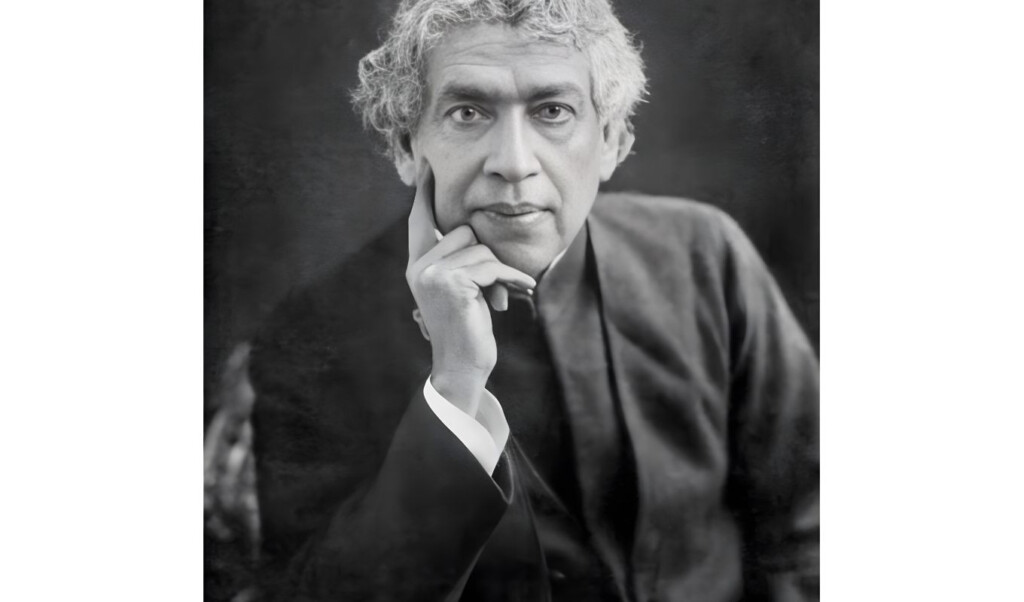
Sir Jagadish Chandra Bose remains one of the most extraordinary figures in the history of global science—a polymath whose brilliance illuminated physics, botany, electromagnetism and scientific philosophy. Often described as a visionary far ahead of his time, Bose not only redefined the scientific identity of the Indian subcontinent but also secured an enduring place in the international scientific community.
The Revolutionary Discovery: Plants Have Life and Sensation
Bose’s most iconic contribution came through his groundbreaking experiments proving that plants are capable of responding to external stimuli. Using the highly sophisticated instrument he invented—the Crescograph—he demonstrated plant growth movements with astonishing precision.
His findings challenged conventional scientific thought and opened a new chapter in plant physiology, earning him admiration from researchers across Europe and America.
A Pioneer of Wireless and Microwave Technology
Long before wireless communication became mainstream, Bose conducted pioneering experiments in electromagnetic waves. As early as 1895, he showcased the transmission of microwaves over a distance in Kolkata—an achievement that placed him among the earliest contributors to radio science.
He designed innovative devices such as the microwave receiver, advanced transmitters, and other components that later became foundational in modern wireless technology. Many contemporary historians now consider his inventions critical to the eventual development of radio, radar, and satellite communication systems.
Early Life and Education
Born on 30 November 1858 in Mymensingh (present-day Bangladesh), Bose hailed from Rarhikhal in Bikrampur. His father, Bhagawan Chandra Bose—a deputy magistrate and a committed advocate of indigenous education—played a decisive role in shaping his intellectual foundation.
After completing his schooling and college studies at St. Xavier’s in Kolkata, Bose travelled to the United Kingdom for higher education. He earned his BSc from the University of London in 1884 and soon plunged into the world of research with unmatched dedication.
Scientific Milestones & Honours
Some of his major achievements include:
1894–1896: Advanced research on electric and electromagnetic waves
1896: Knighted by the British Crown
1920: Elected Fellow of the Royal Society—one of the highest global scientific honours
1927: President of the Indian Science Congress
1928: Corresponding Member of the Vienna Academy of Sciences
His contributions were recognised by numerous scientific bodies across Europe and America—an exceptional feat for a scholar from colonial India.
Passing & Lasting Legacy
Sir Jagadish Chandra Bose passed away on 23 November 1937, but his legacy continues to inspire scientists around the world. His innovations in plant science and wireless communication remain deeply influential even in the 21st century.
A Bengali whose intellect enriched world science immeasurably—his light continues to guide generations of thinkers, researchers and dreamers.
Khaborwala/SJ