Thursday, 20th August 2026

Khabor Wala Desk
Published: 24th November 2025, 6:06 AM
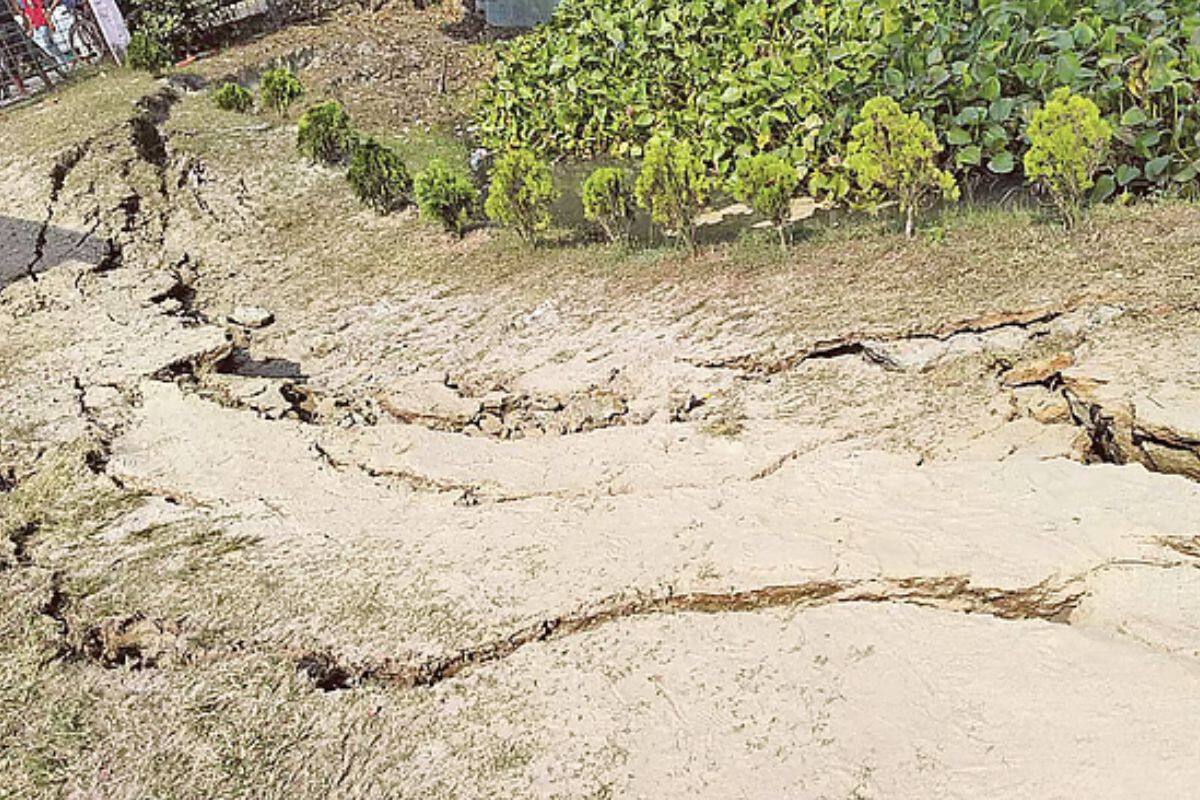
There is no need to be alarmed about the cracks appearing in the soil in various areas of Narsingdi district due to the recent earthquake. The Geological Survey of Bangladesh (GSB) has confirmed that these cracks were not caused by the fault line of the earthquake’s epicentre. The shallow cracks are safe and can be easily filled with soil.
To assess the geological impact of the earthquake, a three-member expert team from GSB visited several areas in Narsingdi last Saturday. They examined soil cracks at least in three locations. The cracks ranged from 4 metres to a maximum of 30 metres in length and were shallow.
GSB Deputy Director Md. Mahmud Hossain Khan explained that the cracks formed beside water bodies. During the earthquake, the water pressure from nearby ponds loosened the surrounding soil, creating these cracks. He assured that there is no reason for panic and the shallow cracks can be filled with soil.
The Deputy Director elaborated that the cracks were caused by ‘liquefaction’. When earthquake waves strike the dry, filled sandy layers near ponds, water is forced into the sand due to vibration. Eventually, the soil loses its load-bearing capacity and behaves like a dense liquid, causing the surface layer to collapse or crack.
On Friday at 10:38 am, the earthquake shook the capital and surrounding areas, with its epicentre in Narsingdi. Another earthquake struck the same area the following Saturday morning. The Friday quake resulted in 10 fatalities, including children, and over 600 injuries, with the highest number of five deaths in Narsingdi. Cracks appeared in at least two places in Palash Upazila, and a long crack was seen across the courtyard of a cattle farm in Lebupara, Ghorashal.
The three-member GSB team stated that it is not yet possible to confirm whether Saturday’s earthquake was an ‘aftershock’. The team members—Md. Mahmud Hossain Khan, Anisur Rahman, and Selim Reza—visited various areas for field inspection.
The US Geological Survey (USGS) epicentre location did not reveal any significant cracks. Where cracks were observed, each site was adjacent to water bodies, and the soil contained a high proportion of sand.
Geologists noted that a primary sign of an earthquake is the appearance of surface cracks. These occur when a fault line from beneath the surface extends to the ground, causing one landmass to shift up or down relative to another.
Khaborwala/TSN



Comments