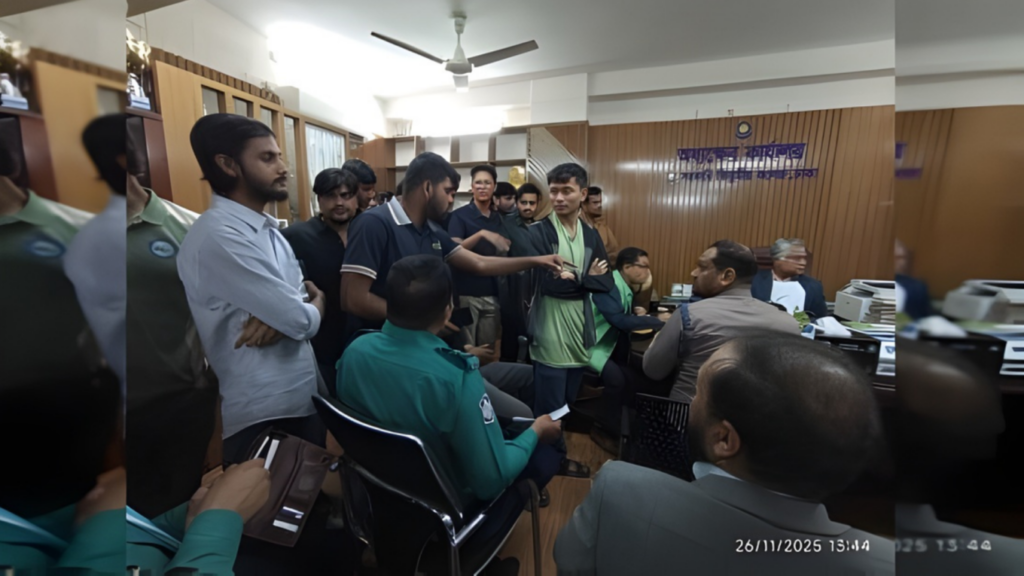
A major controversy erupted at Government Titumir College in Dhaka on Wednesday afternoon after students detained one of their peers for allegedly making insulting remarks about Prophet Muhammad (PBUH) using a fake Facebook account. The student, Biswajit Chandra Barman, who belongs to the Finance and Banking Department (Session 2023–24), was later handed over to police following growing tension on campus.
The chain of events began when students noticed a troubling comment posted from a Facebook profile under the name “Fariha Akter.” The comment appeared beneath a post from another user named “Shah Mahmud.” Within minutes, screenshots of the remark spread across various student groups, sparking outrage and calls for immediate action.
Students quickly launched their own informal investigation and soon discovered that the so-called “Fariha Akter” account was not genuine. Preliminary checks reportedly traced the profile back to Biswajit, who allegedly used the fake identity to post the controversial remarks. As news travelled, students gathered in large numbers, demanding accountability and firm action.
By early afternoon, the campus was tense. Students located Biswajit, confronted him over the allegations, and detained him. The college administration, alerted immediately, arrived at the scene to de-escalate the situation. After speaking with the accused student and reviewing the preliminary evidence, officials decided that handing him over to law enforcement was the most responsible course of action.
During the administrative inquiry, Biswajit is said to have admitted to making the offensive posts, though details of his confession have not been publicly disclosed. The administration later emphasised that the confession was made voluntarily and without coercion.
The remarks in question reportedly included deeply offensive language about Prophet Muhammad (PBUH) as well as derogatory comments about Muslim women and their attire—statements that many students found profoundly disrespectful. The reaction was swift and emotional, reflecting the sensitivity of religious issues in Bangladesh’s academic and social environment.
Tawhid Ahmed Rajan, a student from the same academic year, voiced the collective sentiment:
“We express our strongest condemnation of any disrespect toward Prophet Muhammad (PBUH). Statements that degrade Muslim women or misrepresent their modesty are equally unacceptable. These comments harm religious harmony and violate basic human respect.”
Authorities are now reviewing whether the case falls under the purview of Bangladesh’s stringent cybercrime and religious-insult laws, which carry serious penalties. Police have confirmed that an investigation is underway, though they have urged the public to remain calm and avoid speculation.
The college has taken additional steps to maintain order, including increased security and continuous monitoring of student gatherings. Faculty members have called for peace, warning students against vigilantism or taking matters into their own hands.
Digital-rights analysts note that such incidents underscore the persistent challenges surrounding online identity misuse. Fake accounts continue to fuel harassment, misinformation, and conflict in educational settings, making it increasingly important for institutions to educate students about responsible online behaviour.
As the investigation progresses, many expect the incident to reignite national debate on cyber ethics, religious sensitivity, and digital literacy among young adults.