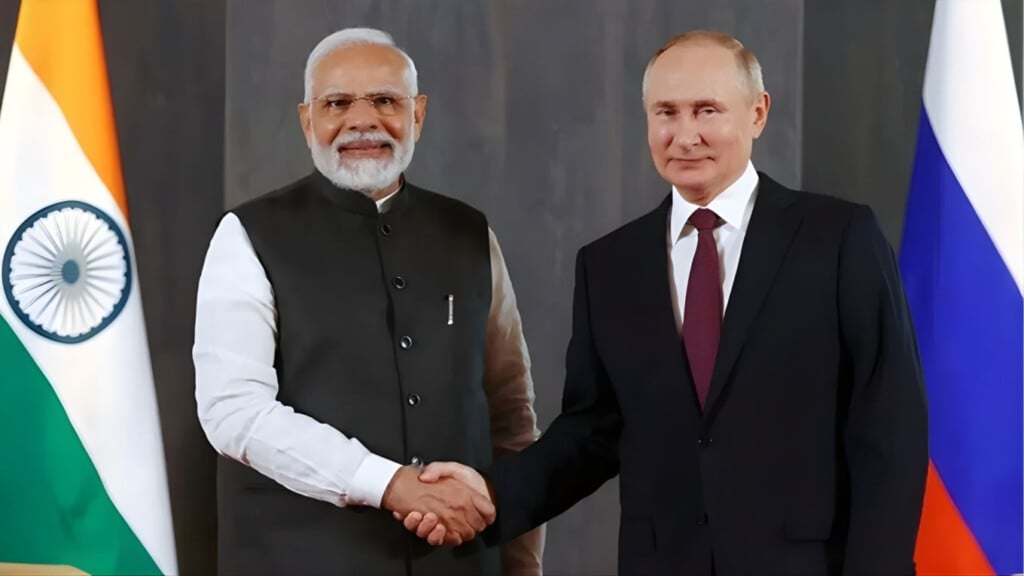
Russian President Vladimir Putin has arrived in India for a two-day visit, landing in New Delhi on Thursday evening. Prime Minister Narendra Modi received him at the Air Force’s Palam base with full honours, marking a ceremonious welcome reserved only for India’s closest partners. The two leaders will meet for a summit on Friday.
This is Putin’s first trip to India since Russia launched its war in Ukraine three years ago. His last visit to New Delhi was in December 2021. Alongside his bilateral meeting with Modi, Putin will attend the 23rd India–Russia annual summit. Before the talks, he will receive an official welcome at Rashtrapati Bhavan and later join Modi for a luncheon at Hyderabad House, where he will also stay.
The lavish reception underscores the closeness of the India–Russia relationship. Yet India is simultaneously attempting to sustain a deep strategic partnership with the United States—Russia’s principal geopolitical rival. This dual approach has long defined India’s diplomatic posture: maintaining old ties with Moscow rooted in defence and energy cooperation, while cultivating expanding opportunities with Washington in technology, investment and trade.
India’s delicate balancing act has become even more pronounced since Russia’s invasion of Ukraine. New Delhi has leveraged its strategic advantages—its vast market and key position in the Indo-Pacific—to retain influence with both the White House and the Kremlin.
But Putin’s long-delayed visit comes at a moment of discomfort for Modi. India is currently negotiating a crucial trade agreement with the United States after Washington imposed a 50 per cent tariff on Indian goods—half of which is seen as punitive action for New Delhi’s continued purchase of discounted Russian oil.
In recent weeks, India has taken steps to reassure Washington, including reducing its import of Russian crude and agreeing to purchase 2.2 million metric tonnes of liquefied petroleum gas from the United States. Yet defence cooperation remains central to its ties with Moscow. New Delhi continues to regard Russian arms—especially advanced aircraft—as essential to counter Pakistan and China, both of which have experienced boundary tensions with India in recent years.
The complexity of India’s situation becomes clearer when viewed through a wider strategic lens: Russia is a close partner of China, and China is a major supplier of arms to Pakistan. By rolling out the red carpet for Putin, India is signalling to both Western capitals and Beijing that it retains strategic alternatives, says Professor Kanti Bajpai of Ashoka University. He argues that New Delhi’s message is clear—it will not abandon Moscow despite global criticism.
The roots of the India–Russia relationship stretch back to the Cold War, when the Soviet Union played a pivotal role in supporting India’s industrial and economic development. Moscow became India’s primary arms supplier in the 1970s, especially as Washington deepened military assistance to Pakistan. Today, despite a gradual decline, Russia remains India’s leading defence partner, with the bulk of India’s frontline fighter jets still sourced from Moscow.
Kremlin spokesperson Dmitry Peskov has said discussions this week may include potential agreements involving Russia’s Su-57 fighter jets. However, defence ties are only one part of a broader equation. Since 2022, India has become one of the largest buyers of Russian crude, taking advantage of discounted prices amid Western sanctions—an arrangement that has now become a major point of contention with Washington.
Indian analysts caution that New Delhi must tread carefully, particularly with an unresolved trade negotiation still on the table. Nandan Unnikrishnan of the Observer Research Foundation argues that India’s first responsibility is to its people: “We have millions living in poverty. To lift them, India must maintain a sophisticated working relationship with every major power.”
Yet economic pressure from Washington is mounting. US tariffs imposed last August were followed in October by sanctions on two major Russian oil companies—moves that have contributed to a steep decline in India’s oil imports, expected to fall this month to their lowest level in three years.
Meanwhile, the tariffs appear to have pushed India to somewhat accelerate diplomatic engagement with China. Modi travelled to China for the first time in seven years just days after the US duties took effect, attending a summit hosted by President Xi Jinping intended to project Beijing’s global leadership.
As India navigates this complex landscape, analysts say the delicate balance between its American and Russian partnerships will remain under close scrutiny in Washington—particularly as key defence deals appear set to dominate discussions during Putin’s visit.