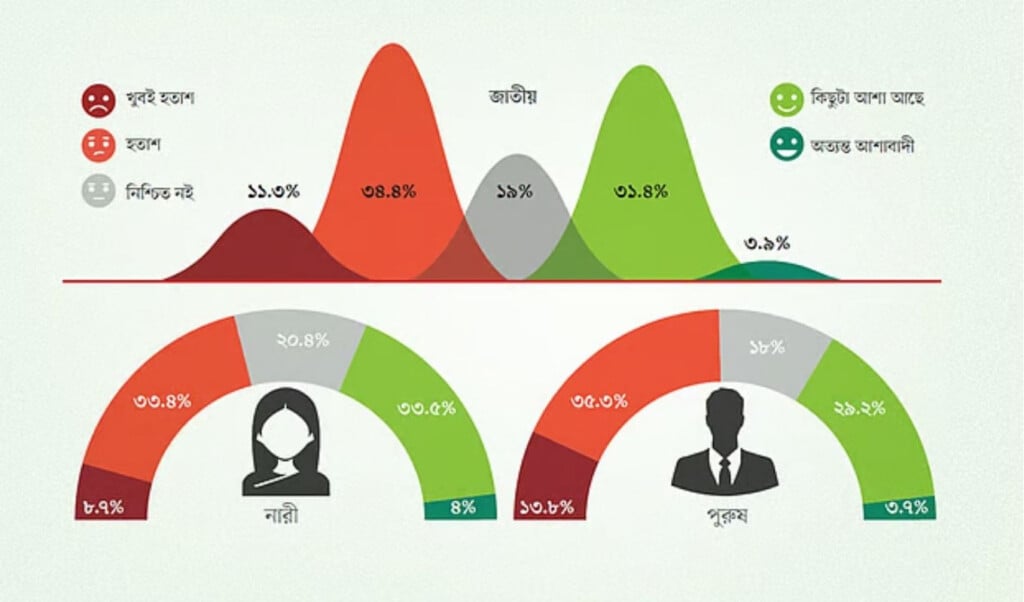
A new national survey indicates that a majority of Bangladeshis are deeply concerned about employment prospects and the state of business in the country. Conducted by Kimekers Consulting Limited for Prothom Alo, the survey highlights that 83% of respondents believe that opportunities for earning income or finding employment are currently inadequate. Only 5% felt that conditions were favourable, while the remainder were uncertain.
The survey, which included 1,342 adults aged 18–55 from both urban and rural areas, shows that perceptions of economic hardship cut across gender lines. Women and men share similar concerns regarding job scarcity. However, respondents from lower-income brackets were more likely to describe the employment environment as adverse or very adverse compared to higher-income participants.
Business conditions were similarly criticised. Over 77% of respondents expressed the view that the current environment is unfavourable for entrepreneurship or trade, with just 20% believing it is conducive to doing business. The survey also revealed that a small proportion of participants were unsure about the situation, highlighting a level of uncertainty even among those actively engaged in commerce.
Economic pessimism appears linked to broader social concerns. Nearly half of the survey’s participants expressed disappointment regarding Bangladesh’s overall trajectory, while only 35% exhibited some level of optimism. Women and younger people were generally more hopeful than men and older respondents, suggesting a generational and gender-based variation in perceptions of progress.
In addition to employment and business concerns, the survey explored public expectations of government behaviour. Over half of the respondents—approximately 54%—expressed confidence that the incoming government would demonstrate tolerance towards differing political views, while 24% expressed disappointment. When asked about tackling corruption and reducing nepotism, around 52% were optimistic, 27.5% pessimistic, and a little over 20% neutral.
Experts analysing the survey suggest that the combination of economic anxiety and political expectations reflects a critical juncture for Bangladesh. Citizens appear willing to support reform initiatives, but persistent economic and governance challenges risk undermining public confidence. The data underscores the urgency for government policies to create employment, improve the business climate, and ensure transparent, accountable governance.