Friday, 21st August 2026

Khabor Wala Desk
Published: 17th December 2025, 3:05 PM
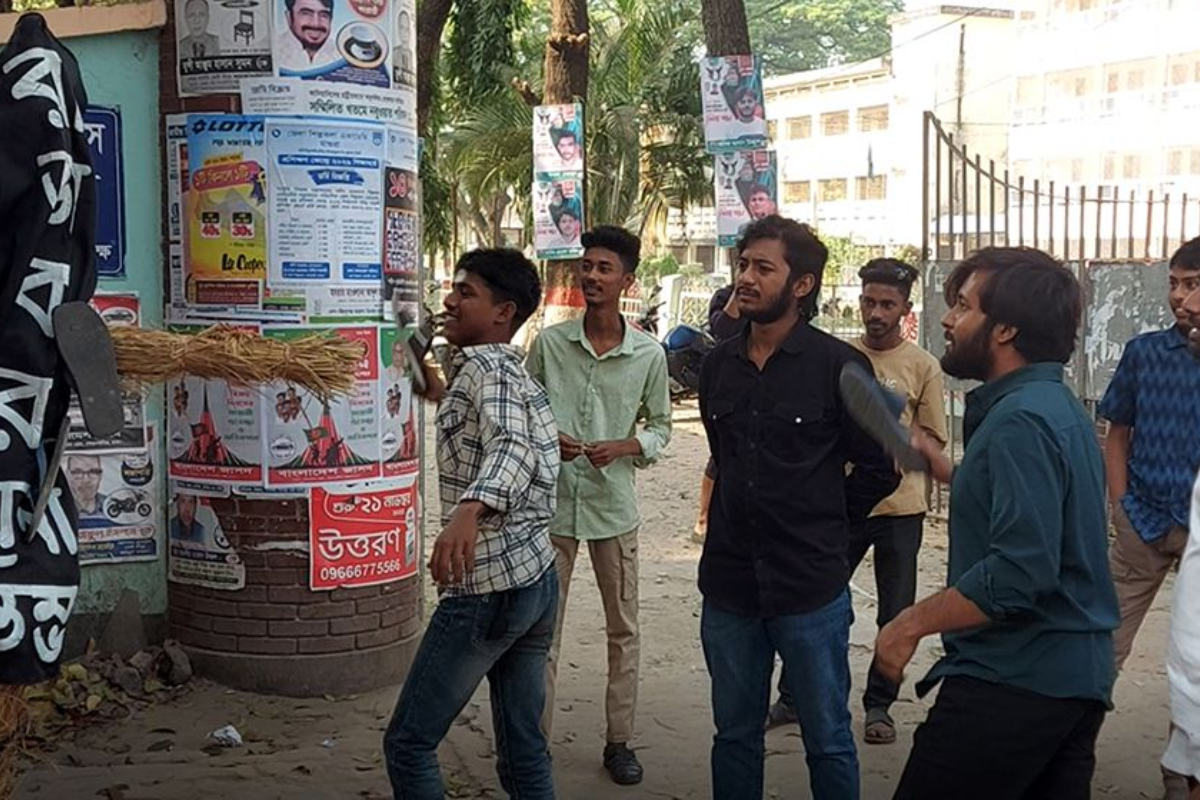
In a striking and unconventional display of civic activism, students in Magura staged a symbolic protest against anti-liberation forces as part of the celebrations marking the 54th anniversary of Bangladesh’s Victory Day. On Wednesday morning, general students of Magura Government Huseyn Shaheed Suhrawardy College erected a temporary structure they described as a “Razakar pillar” at the main entrance of the campus. From the moment it was installed, the site became the focal point of a day-long programme expressing collective anger, rejection, and historical consciousness, drawing widespread attention across the district.
From early morning, hundreds of students were seen lining up to hurl sandals at the symbolic pillar. Others vented their outrage by throwing bricks, stones, and other objects, while some expressed their contempt through gestures of symbolic rejection. Through these acts, the students sought to denounce the notorious Razakar, Al-Badr, and Al-Shams forces that collaborated with the Pakistani army during the Liberation War of 1971. The protest was not confined to students alone; passers-by, guardians, and local residents stopped to observe and many joined in, expressing solidarity with the younger generation’s stance.
Observers noted that the demonstration went beyond a routine protest. It represented a powerful message from the post-independence generation, signalling that betrayal of the nation remains unforgivable and that the memory of wartime atrocities continues to shape public conscience. Members of Magura’s civil society described the initiative as timely, courageous, and deeply meaningful, particularly during the Victory Month, when the spirit of independence is most keenly remembered.
Throughout the day, students, labourers, professionals, and local citizens gathered at the site, participating spontaneously. Many commented that the initiative served as a strong social resistance against any attempt to distort or downplay the history of the Liberation War. According to the organisers, the primary aim of the programme was to uphold the ideals of the Liberation War in the hearts of future generations and to build sustained social awareness against anti-national ideologies.
One of the prominent organisers, college student Zulfiqar Ali, told reporters that the symbolic pillar was created to express hatred towards those who betrayed their own people in 1971 despite being nurtured by the land. He stated that the message was clear: traitors hold no place of honour in Bangladesh, only rejection and condemnation.
Another student, Atik Faisal Saif, said that although they did not witness the events of 1971 firsthand, they had learned about the brutality from history books and testimonies. He added that even today, defeated forces continue to conspire against the country’s progress under various guises, making it essential to remain vigilant.
Student Iman Mollah remarked that those responsible for atrocities against women and the mass killing of innocent civilians deserve lifelong condemnation. He expressed hope that similar symbolic protests would be organised across educational institutions nationwide to inspire patriotism and historical awareness among young people.
The protest has since gone viral on social media, with many describing it as a symbolic battle where hatred of injustice, rather than weapons, became the tool of resistance. Students have announced that such awareness-driven activities will continue throughout Victory Month, ensuring that the youth remain informed about the true history of the Liberation War and alert to any forces working against the nation’s sovereignty.

Comments