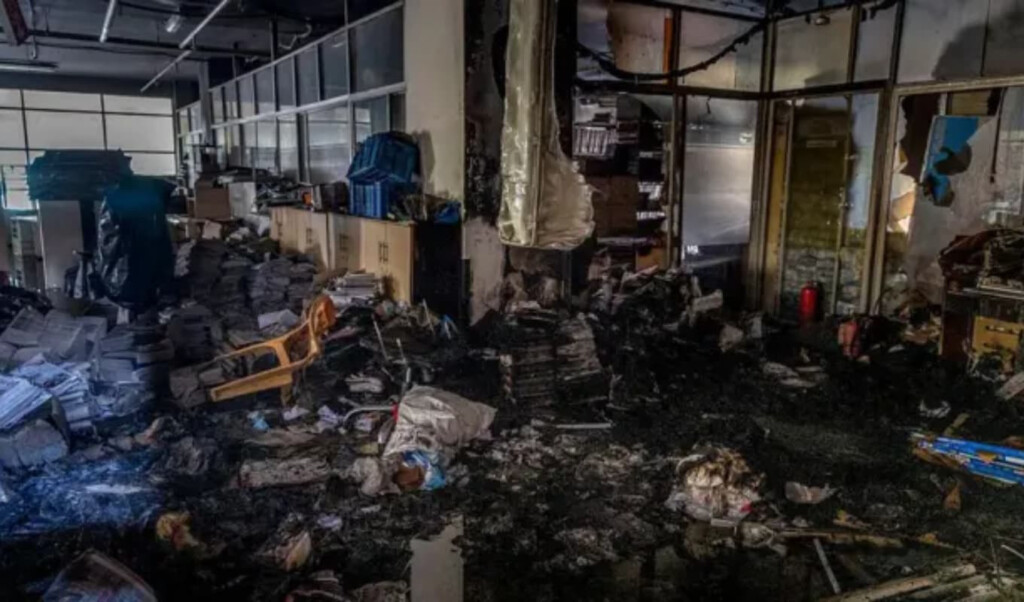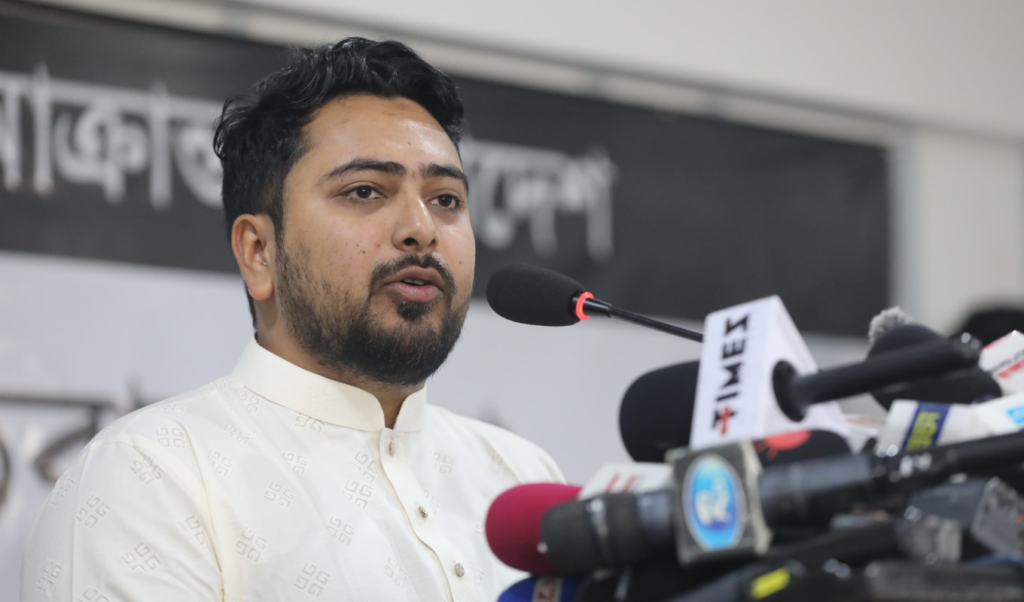
National Citizen Party (NCP) convener Nahid Islam has alleged that elements within the government were involved in the recent attacks on the offices of Prothom Alo and The Daily Star, describing the incidents as carefully planned and politically backed rather than spontaneous acts of violence.
Speaking at a protest meeting held on Monday (22 December) at a hotel in the capital, Nahid said there had been prior planning surrounding the death of Sharif Osman Hadi and the subsequent events that unfolded across the country. “What would happen after Sharif Osman Hadi’s death, how incidents would be triggered—these things appear to have been planned in advance,” he said. “From the very beginning, we have said that a section within the government is involved in this.”
The protest meeting was jointly organised by the Editors’ Council and the Newspaper Owners’ Association of Bangladesh (NOAB) to condemn what they described as growing “mob violence” in the country, particularly the attacks on leading media houses and cultural institutions.
Nahid Islam said it was deeply unfortunate that those responsible for the attacks had misused the slogans and symbols of the July mass uprising. “The attackers used the slogans of the July uprising and even invoked the name of Sharif Osman Hadi. Using our slogans, they carried out attacks on Prothom Alo and cultural organisations,” he said. According to Nahid, such actions had distorted the spirit of the uprising and undermined the democratic aspirations that many hoped would follow it.
Reflecting on the broader political context, he said Bangladesh was drifting away from the future envisioned after the July uprising. “We are not moving towards the Bangladesh we hoped for. This situation is tragic, particularly for those of us who took part in that uprising,” he remarked.
Nahid argued that the attacks could not have taken place without coordination, political protection and consent built up over time. “These were not incidents involving thousands of people suddenly gathering. The courage to do this came from political backing, consent and planning. Without all three coming together, this would not have been possible,” he said, adding that the sequence of events following Hadi’s death suggested a clear conspiracy.
Acknowledging responsibility, Nahid said those who participated in the July uprising also bore some accountability. “Personally, I was responsible for the Ministry of Information at the time. That makes this even more painful for us,” he said.
He also reflected on the term “mob violence”, noting that he and others initially resisted its use because opponents of the uprising had labelled the July movement as a mob from the outset. “We said it was not mobocracy,” he explained. “But one and a half years later, what we are seeing now is not revolutionary chaos—it is organised crime, aimed at steering national politics and elections in a particular direction.”
Nahid called for collective pressure on the government to ensure an impartial investigation and justice. He also demanded accountability for the shooting of Sharif Osman Hadi, describing it as particularly alarming that an MP candidate and a prominent face of the July movement could be attacked publicly in Dhaka.
The meeting, moderated by Dewan Hanif Mahmud, editor of Bonik Barta and general secretary of the Editors’ Council, was attended by a wide range of political leaders, civil society figures and rights activists.