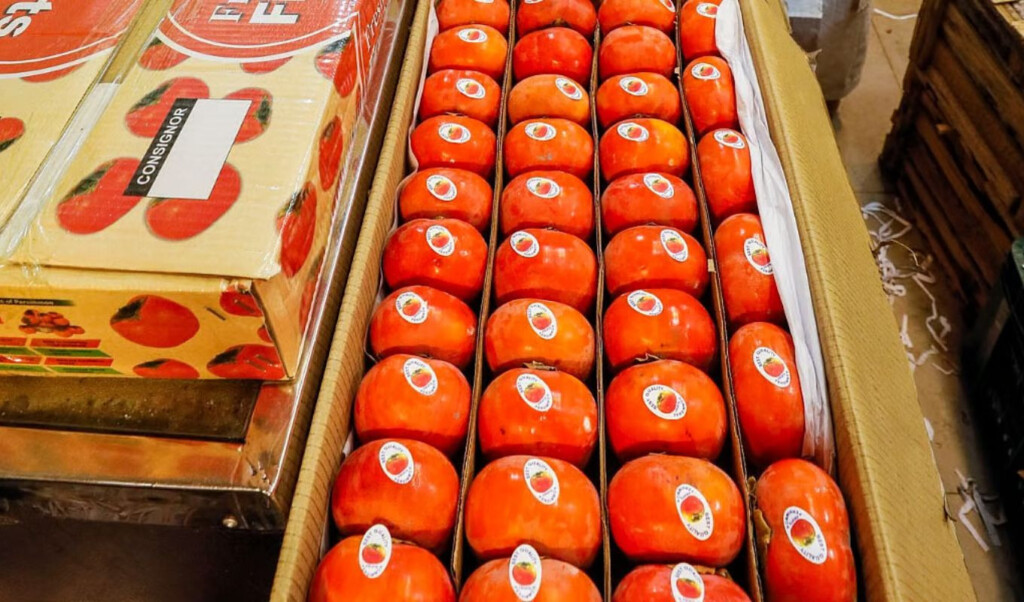
Chattogram, Bangladesh – Once considered a “luxury fruit” in Bangladesh, persimmon is now becoming increasingly available in local markets. Known for its sweet, juicy taste, similar in texture to ripe papaya, the fruit has gained popularity in recent years. Previously sold in select high-end markets, persimmon was a rare sight in ordinary shops. However, its growing presence in local markets raises questions about the recent price decline.
At the major fruit wholesale market on Station Road in Chattogram, it was evident that persimmons were being sold at several wholesale shops. Traders mentioned that last year, the wholesale price for persimmon was between 1,000 to 1,200 Taka per kilogram. This year, the price has dropped to 720 to 780 Taka per kilogram, a reduction of 300 to 400 Taka. With this price drop, the demand has surged. Retail prices have also fallen, with persimmons now being sold at 850 to 900 Taka per kilogram, down from 1,400 Taka last year.
The Story Behind the Price Drop
Before diving into price negotiations and sales figures, it’s important to understand the backstory of persimmon. Multiple studies and research articles, published by renowned global publishers and the Ministry of Agriculture’s Agri-Bataayan, shed light on the history and nutritional benefits of this fruit.
Persimmon, known as “Kaki” in Japan, is the national fruit of the country. It has been cultivated in East Asia, especially in China, Korea, and Japan, for over a thousand years. In Japan, the autumn season is synonymous with persimmons, with the vibrant orange fruit appearing on trees, often depicted in poetry, art, and rural festivals.
Historically, during famines or food crises, dried persimmons (Hoshigaki) have helped sustain many lives. This legacy has contributed to its informal status as Japan’s national fruit.
Nutritional Benefits
Persimmon has garnered significant attention for its health benefits. According to a study published in the Swiss-based international journal Nutrients, the fruit is rich in dietary fiber, vitamins A and C, carotenoids, polyphenols, and tannins. These components act as powerful antioxidants, contributing to heart health, reducing inflammation, and regulating cholesterol levels.
Current Market Trends in Chattogram
This year, the presence of Indian persimmons has contributed significantly to the lower prices. While last year, Japan and Thailand were the primary exporters, India, particularly regions like Himachal Pradesh, Kashmir, and Uttarakhand, is now the dominant supplier. Indian persimmons are comparatively cheaper, which has led to the price drop.
Mohammad Rasheed, the owner of Messrs Haat Hazarika Farm in Chattogram’s wholesale market, shared that their daily sales of persimmons have increased significantly this year. Last year, the fruit was mostly imported from Japan and Thailand, but this year, Indian persimmons dominate the market. The price for wholesale persimmons now ranges from 680 to 780 Taka per kilogram, and on average, they sell about 800 kilograms per day.
At another wholesale shop, Messrs New Ahi Enterprise, Muhammad Abdul Karim, the owner, noted that sales had increased this year due to lower prices. The demand in upscale areas like Kazir Dewri, Khulshi, and Nasirabad remains high, but now even rural areas like Hathazari, Patiya, and Boalkhali are also seeing increased sales.
Chattogram’s Daily Persimmon Sales
While there is no specific statistic for the daily sale of persimmons, Tawhidul Alam, General Secretary of the Chattogram Fruit Merchants’ Association, estimated that around 3,000 kilograms of persimmons are sold daily in the city. Over the years, persimmons have slowly entered the mainstream market, and now 10 to 12 wholesale suppliers and about 50 retailers are engaged in the fruit’s sale in the city.
Global Production and Import Trends
According to FAO (Food and Agriculture Organization) statistics, the global production of persimmons in 2023 was around 5.5 million tons. China alone accounted for 40.6 million tons, making up approximately 80% of the global production. South Korea, Azerbaijan, and Japan follow with smaller but significant shares. By 2024, global production is expected to rise to 5.9 million tons.
Persimmon in Bangladesh is fully import-dependent, unlike more commonly available fruits like apples, oranges, and grapes. Recently, however, persimmon has piqued the interest of local importers. While local climatic conditions are suitable for growing certain varieties of persimmons, challenges such as the lack of quality saplings hinder large-scale domestic cultivation.
Import Trends: A Shift in Dynamics
Customs data shows the import volume of persimmons has varied greatly in recent years. In the 2020-21 fiscal year, Bangladesh imported 22,610 kilograms of persimmons. This number increased in the following two years, reaching 36,000 and 35,430 kilograms, respectively. However, in 2023-24, the volume decreased to just 18,000 kilograms due to high international prices and slow sales. Import volumes surged again in 2024-25, with imports reaching 64,630 kilograms, nearly three times the previous year.
This rapid increase in imports continued in the 2025-26 fiscal year, with the total volume reaching 182,636 kilograms by December 2025 — a 202% increase compared to the same period in the previous year.
Looking Ahead: Local Cultivation and Challenges
Despite the rising import figures, Bangladesh’s Agricultural Research Institute (BRRI) has been conducting small-scale experiments to cultivate persimmons in areas like Jessore and Bandarban. However, challenges remain, including the lack of quality saplings and the long cultivation period for the fruit, as persimmon trees typically begin to bear fruit only after 7 years of planting. Currently, Bangladesh’s focus is on bringing quality saplings from countries like India and Thailand to meet the increasing demand.