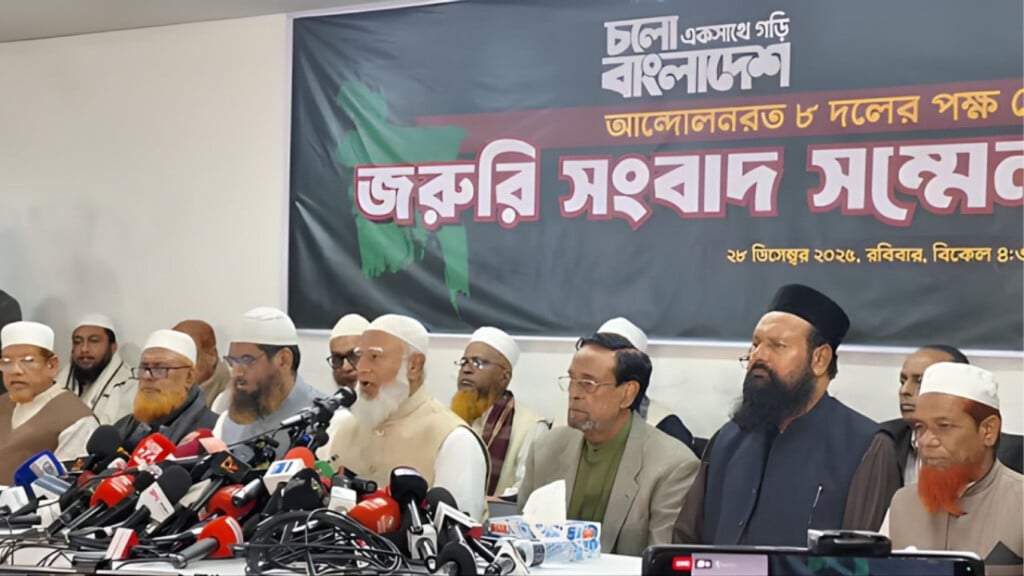
In a significant realignment of opposition forces ahead of the February 2026 general elections, the Liberal Democratic Party (LDP), led by Colonel (Retd) Oli Ahmad Bir Bikram, has formally entered into a seat-sharing agreement with Bangladesh Jamaat-e-Islami. This development was made public on Sunday, 28 December 2025, during an emergency press conference at the National Press Club in Dhaka. Dr Shafiqur Rahman, the Ameer of Jamaat-e-Islami, announced that the inclusion of the LDP and the student-led National Citizen Party (NCP) has expanded their existing electoral bloc into a robust ten-party alliance. This coalition aims to consolidate the votes of the pro-uprising and Islamist factions, presenting a unified front against other major political groupings.
The decision to join forces with Jamaat has not been without controversy, particularly within the LDP itself. The party’s long-standing Secretary General, Redwan Ahmed, recently defected to the Bangladesh Nationalist Party (BNP) following internal disagreements regarding this very alliance. Redwan Ahmed has since been confirmed as the BNP’s candidate for the Cumilla-7 constituency, taking his supporters with him and creating a notable fracture in the LDP’s organisational structure. Despite this high-profile departure, Colonel Oli Ahmad remained steadfast in his commitment to the new alliance, though he notably maintained a stoic silence throughout the press conference.
Colonel Oli Ahmad is a figure of considerable historical and political weight in Bangladesh. A decorated veteran of the 1971 Liberation War, he was the first Bengali military officer to revolt against the Pakistani forces on the night of 25 March 1971. His gallantry earned him the ‘Bir Bikram’ title, and he served with distinction as a sub-sector commander under Major Ziaur Rahman. After retiring from the military in 1980, he was a founding member of the BNP and served as the Minister of Communications during the 1991–1996 administration. He eventually broke away to form the LDP in 2006, citing a need for reform and a break from the corruption and nepotism he felt had plagued traditional politics.
The Ten-Party Alliance: Composition and Leadership
| Political Party | Primary Leadership | Key Political Identity |
|---|---|---|
| Bangladesh Jamaat-e-Islami | Dr Shafiqur Rahman | Islamist / Senior Alliance Partner |
| Liberal Democratic Party (LDP) | Col (Retd) Oli Ahmad | Centre-Right / Right-Wing Nationalist |
| National Citizen Party (NCP) | Nahid Islam | Youth-led / July Uprising Proponents |
| Islami Andolan Bangladesh | Mufti Syed Muhammad Rezaul Karim | Islamist |
| Khelafat Majlis | Maulana Abdul Basit Azad | Islamist |
| Jatiya Ganotantrik Party (JAGPA) | Rashed Pradhan | Nationalist |
| Bangladesh Development Party | (Affiliated with former Jamaat leaders) | Moderate Islamist / Development-focused |
The alliance’s strategy involves fielding a single candidate in each of the 300 parliamentary constituencies to prevent the splitting of the opposition vote. This “one seat, one candidate” policy is seen as a direct response to the new political landscape following the July Revolution of 2024. While the LDP and NCP represent different demographic and ideological sectors—the former being a veteran right-wing force and the latter representing the revolutionary youth—their merger under the Jamaat umbrella suggests a pragmatic, if tense, consolidation of power. Observers are now watching closely to see how this ten-party bloc will fare against the BNP, which remains the primary contender for state power in the upcoming national polls.