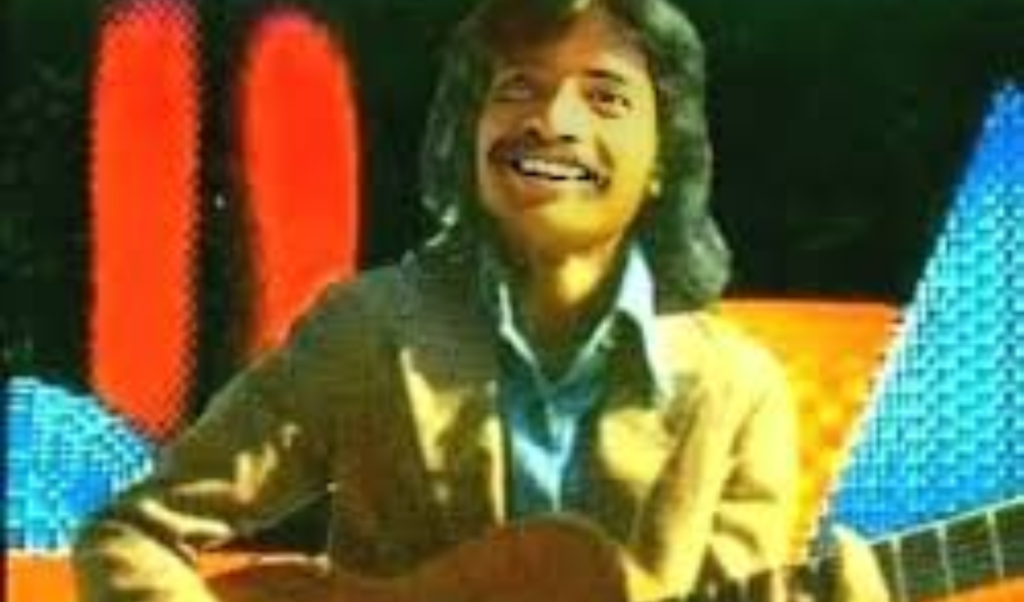
A young man stands with a guitar in his hands, singing softly: “My heart will not listen to me, nothing feels right / Who plays the flute, why does my soul refuse to settle?”
Beside him sits Suborna Mustafa, listening in quiet admiration. The scene unfolds further with the presence of Raisul Islam Asad and Naila Azad Nupur. For many viewers, this moment remains unforgettable. The song featured in the 1980 film Ghuddi captured not only cinematic beauty but also introduced a rare musical soul—Happy Akhand.
At the time, Happy was barely twenty years old. Yet his journey into music had begun far earlier. Born on 12 October 1960 in Dhaka, Happy Akhand was already displaying extraordinary talent by the age of thirteen. In 1973, audiences at the University of Dhaka’s TSC were spellbound when a young boy played the keyboard alongside the band Spandan. That mesmerising teenager and the young man seen later in Ghuddi were one and the same.
Happy’s formal entry into music was guided by his elder brother, the celebrated composer and singer Lucky Akhand, who was then gaining prominence through his work with Swadhin Bangla Betar Kendra. Lucky quickly recognised his younger brother’s instinctive mastery of musical instruments. Happy grew up listening to Latin blues and jazz, while also being exposed to Russian, Roman and Greek music—an eclectic education that shaped his distinctive sound and phrasing.
At just fifteen, Happy recorded the timeless song “Abar Elo Je Shondhya”. Its origin is almost poetic: standing by the banks of the Little Jamuna River in Naogaon at dusk, Lucky Akhand conceived a tune inspired by the fading light. The lyric was later completed by S M Hedayet, and Happy’s voice immortalised it. When Lucky played the recording to legendary singer Manna Dey in Kolkata, the maestro famously praised Happy’s voice and exceptional vocal projection.
National recognition followed swiftly. In 1977, Happy performed the song on Bangladesh Television’s music programme Bornali, improvising it in a jazz style. The response was overwhelming. He also performed “Ei Prithibir Buke Ashe Jara”, again demonstrating his command over jazz phrasing and rhythm.
Beyond singing, Happy was already an accomplished arranger. As a teenager, he arranged music for songs such as “Emon Ekta Ma De Na” and “Ek Second-er Nai Bhorosha”. In 1979, alongside Feroz Rashid, he co-founded the legendary band Miles. Their debut album Miles (1982) became Bangladesh’s first full English-language album, followed by A Step Further in 1986.
Although an exceptional guitarist, Happy primarily played keyboards in Miles. He left the band in 1986, but his influence endured. His guitar work in songs like “Nil Nil Shari Pore”, “Pahari Jhorna”, and the unforgettable intro solo of “Tumi Amar Prothom Premer Gaan” remains among the most romantic and technically refined in Bengali music history.
Happy Akhand was not only a performer and composer, but also a passionate mentor. In an era without formal music institutions, he taught countless musicians through informal gatherings and long practice sessions. Artists such as Ayub Bachchu, James, Shafin Ahmed, Kumar Bishwajit, and even renowned Kolkata composer Madhu Mukherjee benefited from his guidance.
Despite his brilliance, the socio-political climate of the time undervalued rock and band music, offering little scope for it as a full-time profession. Disillusionment followed. On 28 December 1987, at just 27, Happy Akhand passed away, leaving behind an irreplaceable silence.
Yet his music flows on—like a mountain stream—clear, restless, and eternal.
Happy Akhand: Key Facts :
| Category | Details |
| Full Name | Happy Akhand |
| Date of Birth | 12 October 1960 |
| Place of Birth | Dhaka, Bangladesh |
| Date of Death | 28 December 1987 |
| Primary Roles | Singer, Composer, Guitarist, Keyboardist, Music Director |
| Notable Songs | Abar Elo Je Shondhya, Ke Banshi Bajay Re, Tumi Amar Prothom Premer Gaan |
| Bands | Miles (Co-founder) |
| Musical Styles | Jazz, Blues, Rock |
| Legacy Projects | Shesh Upohar cassette, Happy Touch band |