Thursday, 20th August 2026

Khabor Wala Desk
Published: 3rd January 2026, 1:51 PM
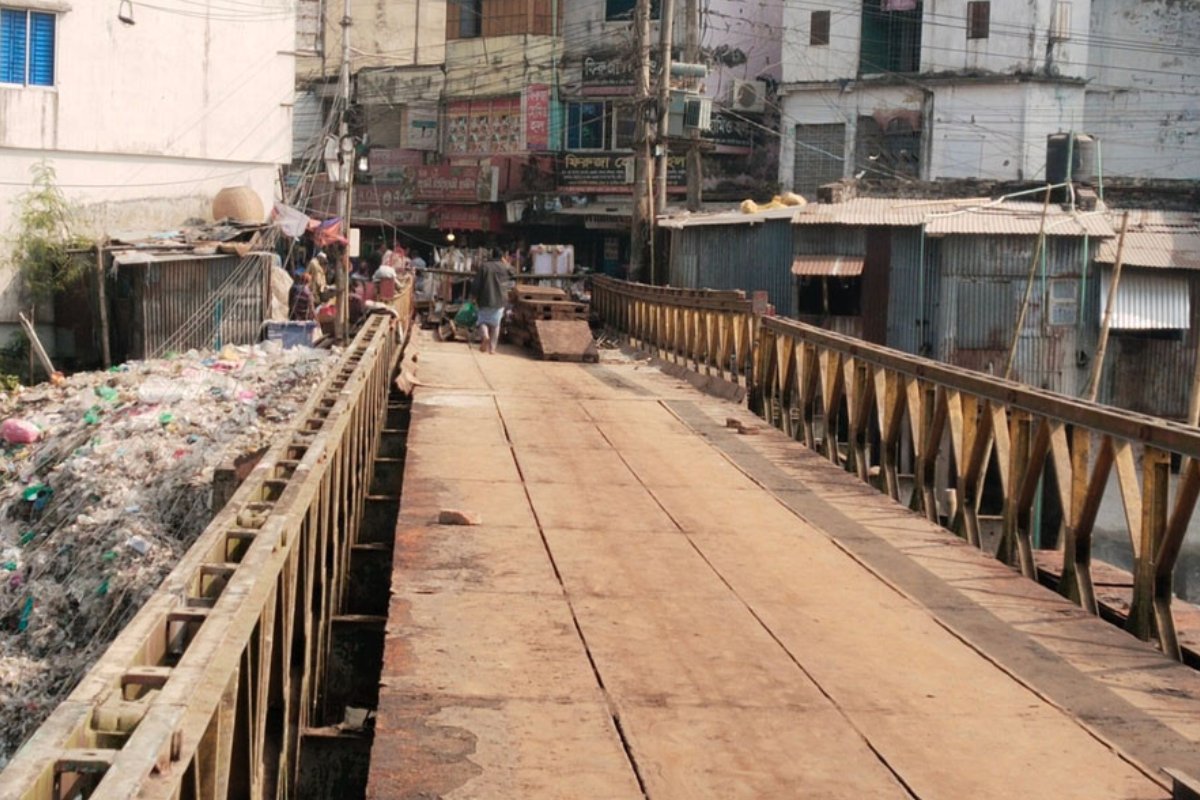
The Bailey bridge serves as the sole link between three major commercial hubs: Haji Shariatullah Bazaar, Titumir Bazaar and the wider New Market area. From dawn until late at night, this narrow structure carries an immense volume of traffic, including buses, rickshaws, delivery vans and freight vehicles transporting goods worth millions of taka. Yet, astonishingly, no permanent concrete bridge has been constructed here since the colonial era.
Local traders describe the bridge as the economic lifeline of Faridpur. Any disruption instantly paralyses commerce, supply chains and daily life. However, its limited width and structural fragility frequently trigger traffic congestion and accidents. Business leaders argue that the city’s substantial revenue contributions have not translated into visible infrastructure development, particularly at this crucial junction.
Urban planners estimate that the construction of a modern, wide and well-designed permanent bridge could directly benefit around five million people across the greater Faridpur region. Such a project, they claim, could reduce urban traffic congestion by as much as 66 per cent, while also improving safety, trade efficiency and emergency response times.
Frustration has intensified following the latest round of repair work on the Bailey bridge, which began on 10 December. The closure of the crossing to all vehicles has placed enormous pressure on alternative routes, causing severe delays and hardship for traders, students and ambulances alike. Many residents see these repairs as mere “cosmetic fixes” that fail to address the core problem.
Social activist and former central vice-president of Jubo Dal, Mahbubul Hasan Pinku, has voiced strong criticism, alleging that annual repair budgets—often cited at Tk 50–60 lakh or more—vanish without delivering a lasting solution. He argues that if such funds had been strategically invested over the decades, Faridpur would not still be dependent on a temporary structure after eighty years. Pinku further suggests that a planned one-way concrete bridge with properly designed approach roads could revolutionise the city’s transport system.
Echoing this sentiment, former president of Shariatullah Bazaar, Md Nur Islam, questioned how a city aspiring to modernity can continue to rely on a Bailey bridge indefinitely. “Governments have come and gone,” he said, “but the heart of the city remains neglected.”
Meanwhile, the Roads and Highways Department acknowledges both the urgency and the demand. Executive Engineer Khalid Saifullah Sardar confirmed that repairs were unavoidable for safety reasons and noted that a permanent bridge is indeed “under consideration”. However, he was unable to provide a timeline for when construction might begin.
For Faridpur’s residents, assurances without action offer little comfort. As repairs continue and congestion worsens, the question grows louder: how much longer must a modern city wait for a permanent solution?
| Issue | Details |
|---|---|
| Location | Moyrapatti, near Haji Shariatullah Bazaar, Faridpur |
| Existing Structure | Bailey bridge |
| Years Without Permanent Bridge | Approximately 80 years |
| Connected Markets | Haji Shariatullah Bazaar, Titumir Bazaar, New Market |
| Estimated Annual Repair Cost | Tk 50–60 lakh (approx.) |
| Potential Beneficiaries of New Bridge | Around 5 million people |
| Estimated Traffic Reduction | Up to 66% |


Comments