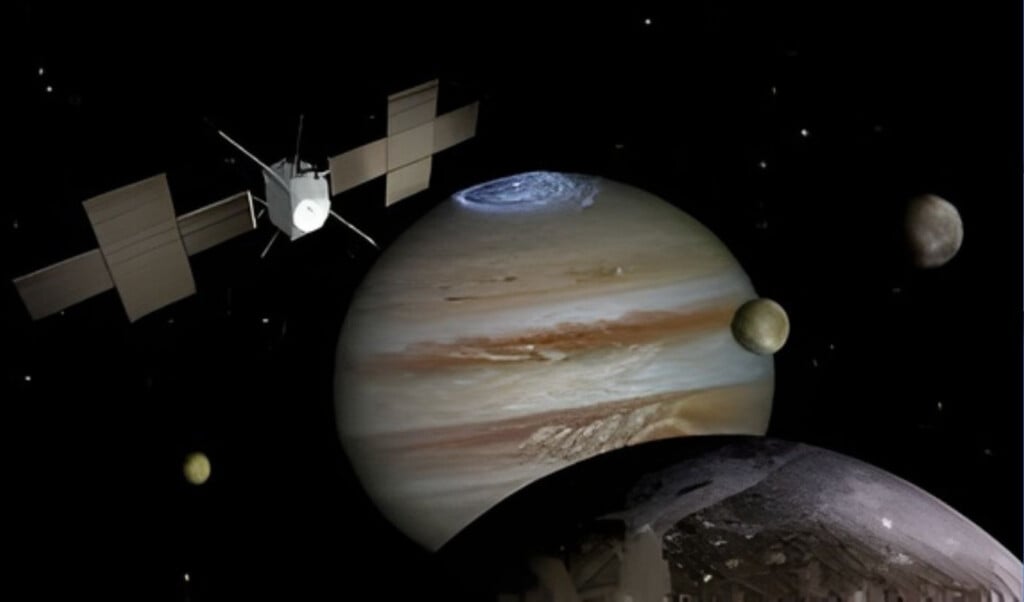
This week, the Solar System’s largest planet, Jupiter, will reach its closest approach to Earth, offering skywatchers and astronomy enthusiasts a rare and spectacular viewing opportunity. According to a recent report by The Guardian, the gas giant will shine prominently in the night sky, easily visible to the naked eye.
Jupiter will form a slightly irregular triangle with the two brightest stars of the Gemini constellation, Castor and Pollux. Thanks to the planet’s thick cloud cover reflecting sunlight, it appears remarkably bright, even though it is much farther away than Venus. With a diameter more than eleven times that of Earth, Jupiter’s sheer size contributes to its impressive visibility. The planet can be observed from both the Northern and Southern Hemispheres.
At its closest approach, Jupiter will be approximately 633 million kilometres from Earth. Sunlight takes around 43 minutes to reach the planet, while sunlight reflected from Jupiter takes roughly 35 minutes to travel back to Earth, illustrating the vast distances within our planetary system.
Observers are encouraged to look towards the eastern sky on the night of 9 January, when Jupiter will be clearly visible without any optical aids. Those equipped with binoculars or small telescopes can enjoy even more detailed views. A standard binocular with 10x magnification or a small telescope will allow stargazers to see Jupiter’s cloud bands, while binoculars can reveal its four largest moons—Io, Europa, Ganymede, and Callisto, collectively known as the Galilean moons.
For added clarity, the following table summarises key viewing information for Jupiter’s close approach:
| Feature | Details |
|---|---|
| Closest Approach Distance | ~633 million km |
| Visible From | Northern & Southern Hemispheres |
| Best Viewing Date | 9 January |
| Visible With Naked Eye | Yes |
| Visible With Binoculars | Galilean moons visible |
| Visible With Small Telescope | Cloud bands and surface features observable |
| Alignment | Forms a triangle with Castor & Pollux |
| Light Travel Time (Sun → Jupiter) | ~43 minutes |
| Light Travel Time (Jupiter → Earth) | ~35 minutes |
Experts recommend that enthusiasts with telescopes or binoculars set up away from city lights to enjoy a clearer view of Jupiter’s distinctive cloud patterns and the orbital dance of its moons. This event is an exceptional chance for both amateur and professional astronomers to observe the planet in detail, as Jupiter will not come this close to Earth again until the next scheduled opposition.
Whether observed with the naked eye, binoculars, or a telescope, Jupiter’s brilliance this week promises an unforgettable celestial experience.