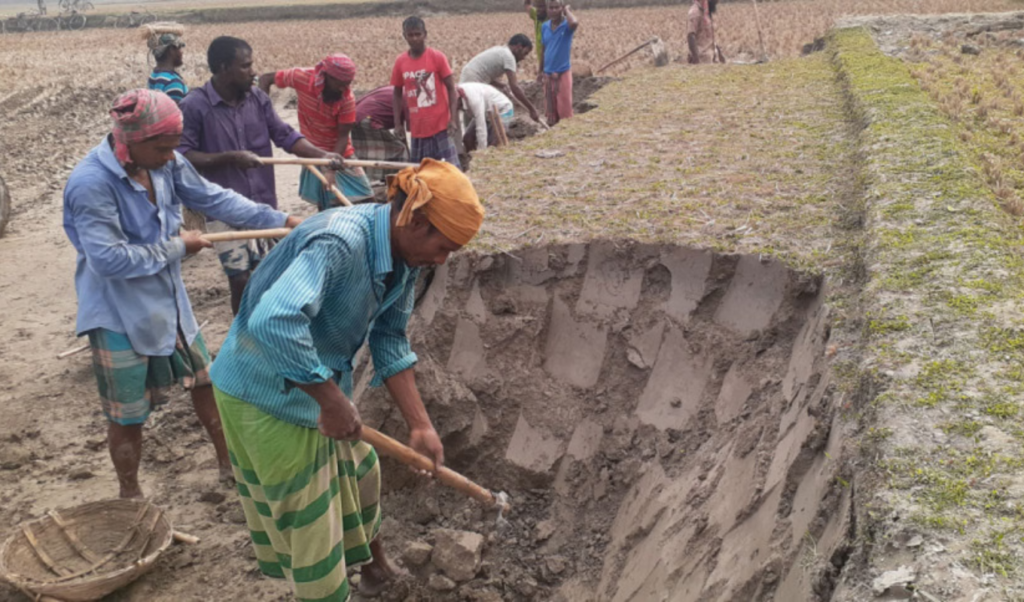
Large-scale extraction of fertile topsoil from agricultural land is accelerating across four northern districts of Bangladesh, raising serious concerns about long-term food security, environmental degradation and rural livelihoods. According to officials from the Department of Environment, at least 595 brick kilns operating in Rangpur, Gaibandha, Kurigram and Lalmonirhat are routinely using the upper layer of cropland soil as their primary raw material for brick production.
Agricultural experts warn that topsoil—the uppermost layer of land—is the most productive and biologically active component of farmland. It contains the highest concentration of organic matter, nutrients and microorganisms essential for crop growth. Once removed, natural restoration of soil fertility can take more than a decade, even under favourable conditions. Continued extraction therefore threatens sustained agricultural productivity in a region heavily dependent on farming.
Environmental authorities report that despite existing regulations prohibiting the use of fertile agricultural soil in brick kilns, enforcement remains weak. Over the past week alone, mobile courts fined 12 brick kilns a total of Tk 1.5 million for illegally sourcing topsoil. These enforcement drives were carried out in Hatibandha and Patgram in Lalmonirhat; Phulbari, Nageshwari and Ulipur in Kurigram; Sundarganj in Gaibandha; and Taraganj in Rangpur. However, local officials concede that penalties have failed to deter the practice.
The scale of soil consumption is vast. Jamal Uddin, a technician at a brick kiln in Nageshwari, Kurigram, said each brick requires approximately five kilogrammes of soil. A single kiln produces between four and five million bricks annually, translating into thousands of tonnes of topsoil removed every year from surrounding farmland.
While kiln owners argue that farmers willingly sell their soil in exchange for cash, farmers describe a far more coercive reality. Afzal Hossain, a kiln owner in Hatibandha, claimed farmers approach kilns voluntarily due to attractive prices and warned that shutting kilns would disrupt development projects. Yet farmers say they are often left with no alternative. When large plots of land have their topsoil removed, neighbouring fields become uneven, waterlogged or unsuitable for irrigation, forcing others to sell soil simply to maintain land usability.
Afatab Uddin, a 65-year-old farmer from Durgapur village in Ulipur, explained that once surrounding plots are excavated, farming becomes impractical. Narayan Sarkar, a farmer from Pirgachha in Rangpur, added that although one bigha of topsoil can fetch Tk 18,000 to Tk 20,000 initially, crop yields decline sharply for several consecutive years.
Experts say the environmental consequences are severe and long-lasting. Dr Safinur Rahman, senior scientific officer at the Rangpur Soil Resource Development Institute, noted that removing topsoil destroys soil biodiversity and weakens land resilience. The Department of Agricultural Extension has also reported declining yields in affected areas.
Estimated Brick Kiln Presence by District :
| District | Estimated Kilns Using Topsoil |
|---|---|
| Rangpur | High concentration |
| Gaibandha | Widespread |
| Kurigram | Extensive |
| Lalmonirhat | Significant |
| Total | 595 |
Environmental officials say enforcement efforts are continuing, while Rangpur Divisional Commissioner Shahidul Islam has instructed district administrators to take tougher action to protect agricultural land. Specialists argue, however, that long-term solutions will require stricter regulation, alternative construction materials and greater protection for farmers to prevent irreversible damage to northern Bangladesh’s fertile plains.