Since taking office on 20 January 2025, United States President Donald Trump has injected significant turbulence into international politics through a series of aggressive policies and military threats. During his inauguration at the White House, Trump portrayed himself as a “messenger of peace” and a “unifier.” Yet, within his first year in office, his actions have largely contradicted this image, escalating tensions across multiple regions worldwide.
Over the initial twelve months, Trump issued military threats against 11 countries and authorised airstrikes in seven nations. His administration also imposed stringent tariffs on more than 90 countries and enacted partial or full travel bans affecting citizens from 38 countries. Analysts argue that these measures starkly diverge from the peaceful and diplomatic persona he initially projected.
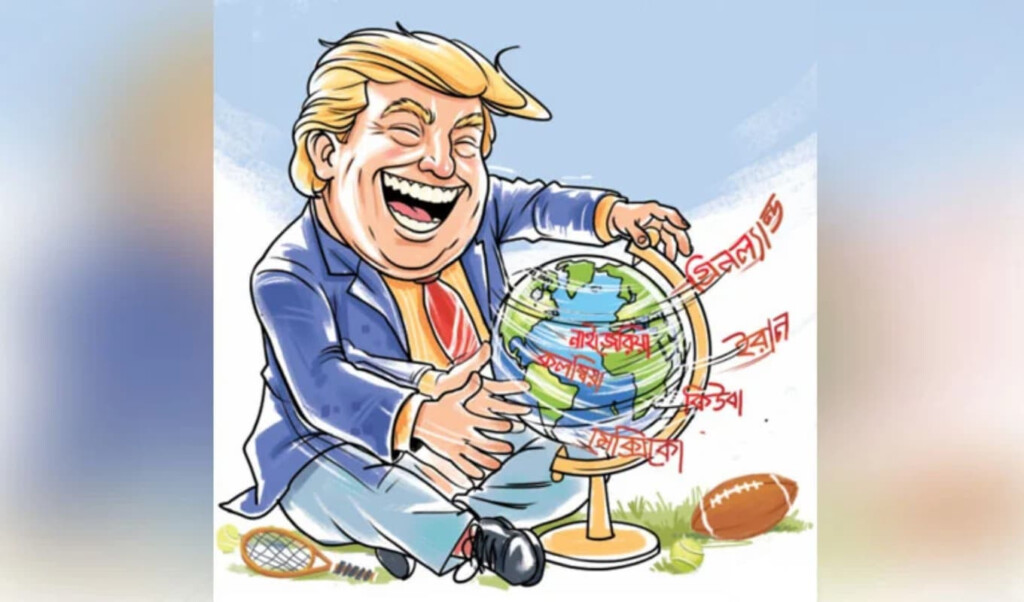
Tensions are particularly acute in Latin America. In Venezuela, a heightened U.S. military presence and efforts to undermine President Nicolás Maduro’s authority have been widely criticised as violations of international law. Iran, Greenland, Colombia, Cuba, and Mexico have also faced threats of varying severity. Meanwhile, tariffs of up to 500% on Chinese and Indian goods have disrupted global trade flows and supply chains.
Country-Specific Threats and Measures
| Country | Type of Threat | Details / Impact |
|---|---|---|
| Venezuela | Military aggression | Attempts to weaken President Maduro’s authority |
| Iran | Threats | Pressure through punitive measures and suppression |
| Greenland | Land acquisition plans | Danish military alert and diplomatic tensions |
| Mexico | Intervention on crime | Proposed constitutional amendments to target cartels |
| China & India | Tariffs | Trade disruption, economic consequences |
Trump has also exhibited a dismissive attitude towards international law. In a public statement, he remarked, “I don’t need international law. I do not want to harm anyone.” Experts warn that such rhetoric increases the likelihood that weaker nations may succumb to U.S. pressure.
Meanwhile, China has strengthened its ties with Latin America, notably Venezuela and Cuba. Venezuela alone holds an estimated 300 billion barrels of oil, representing roughly 17% of global reserves. Chinese investments in the region heighten the stakes, raising the risk of military confrontation. Greenland’s strategic position has similarly drawn international attention, with NATO member Denmark cautioning that U.S. actions could complicate regional stability.
Additionally, Taiwan, several African nations, Syria, and parts of the Middle East have experienced heightened uncertainty under the Trump administration’s policies. Analysts contend that this combination of military posturing and aggressive economic measures threatens to destabilise the delicate global balance of political, economic, and military power.