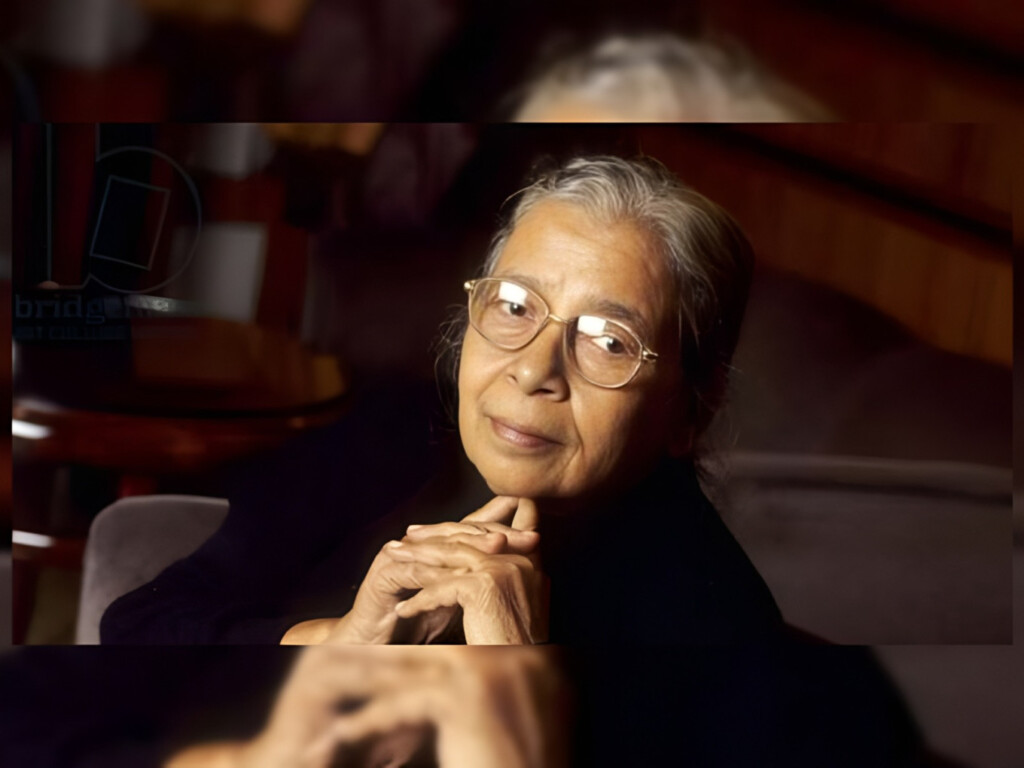
Mahasweta Devi occupies a singular place in the history of Bengali literature and human rights activism. Far beyond being a prolific and powerful storyteller, she was the unflinching voice of the marginalised, especially India’s tribal communities such as the Santhals, and oppressed women. Her writings resonated with protest, empathy, and a profound sense of social justice. Among her voluminous works, the novel Hajar Churashir Maa (Mother of 1084) brought her international acclaim, depicting the anguished grief of a mother set against the brutal realities of state violence during the Naxalite movement. This work has since become a definitive classic of Bengali literature.
Early Life and Family Background
Mahasweta Devi was born on 14 January 1926 in Dhaka, then part of British India, into an educated and culturally vibrant middle-class family. Her father, Manish Ghatak, was a renowned writer of the Kallol era, while her uncle, Ritwik Ghatak, became a legendary filmmaker whose artistic vision deeply influenced her own creative and intellectual development.
Education and Career
She began her education at Santiniketan and later earned a Bachelor’s degree from the University of Calcutta, followed by a Master’s in English Literature from Visva-Bharati University. In 1964, she started teaching at Vijaygarh College while simultaneously engaging in journalism and literary pursuits. Over time, she evolved from being solely a writer to a committed human rights activist, working tirelessly on the ground—from tribal villages to the courts—advocating for the disenfranchised.
Literary Contributions and Activism
Mahasweta Devi’s writings primarily explored land rights for tribal communities, state oppression, women’s exploitation, and historical truths hidden from mainstream narratives. She famously asserted:
“Writing is not merely an art; writing is a responsibility.”
Her major works include:
| Bengali Title | English Translation | Focus / Theme |
|---|---|---|
| Hajar Churashir Maa | Mother of 1084 | State violence, maternal grief |
| Aranyer Adhikar | Right to the Forest | Tribal land rights |
| Stree series (Stree, Rudali) | Women’s narratives | Exploitation and resilience |
| Titu Mir | Titu Mir | Historical rebellion |
| Chotti Munda | Chotti Munda and His Arrow | Tribal identity and resistance |
| Agungrabh, Prasthan Parba, Unnatrish Number Dharar Asami | Various | Social critique, activism |
Awards and Recognition
Her unparalleled contributions earned her prestigious accolades:
| Award | Year | Significance |
|---|---|---|
| Ramon Magsaysay Award | 1997 | International recognition for humanitarian work |
| Jnanpith Award | – | Highest literary honour in India |
| Padma Vibhushan | 2006 | National civilian honour |
| SAARC Literary Award | 2007 | Regional literary excellence |
Personal Life
Mahasweta Devi was married to the eminent theatre personality Bijon Bhattacharya. Their only child, Nabarun Bhattacharya, emerged as a distinctive and rebellious voice in Bengali literature.
Legacy
A fearless frontline activist, Mahasweta Devi participated in numerous social and political struggles, including movements against land acquisition. Her pen and activism were equally potent tools for justice. Though she passed away on 28 July 2016, her writings and spirit of resistance continue to live on, embodying protest, humanity, and the ethical conscience of history.
Mahasweta Devi remains eternal—through the language of dissent, in the literature of compassion, and as the moral compass of history.