The Governor of the Bangladesh Bank, Ahsan H. Mansur, has expressed high confidence that the nation’s foreign exchange reserves will exceed the $35 billion mark by the end of the current fiscal year. Speaking at a seminar on Monday, 19 January 2026, the Governor highlighted that this milestone is achievable through organic economic growth and market stability, independent of any impending loan tranches from the International Monetary Fund (IMF).
A Self-Sustaining Economic Trajectory
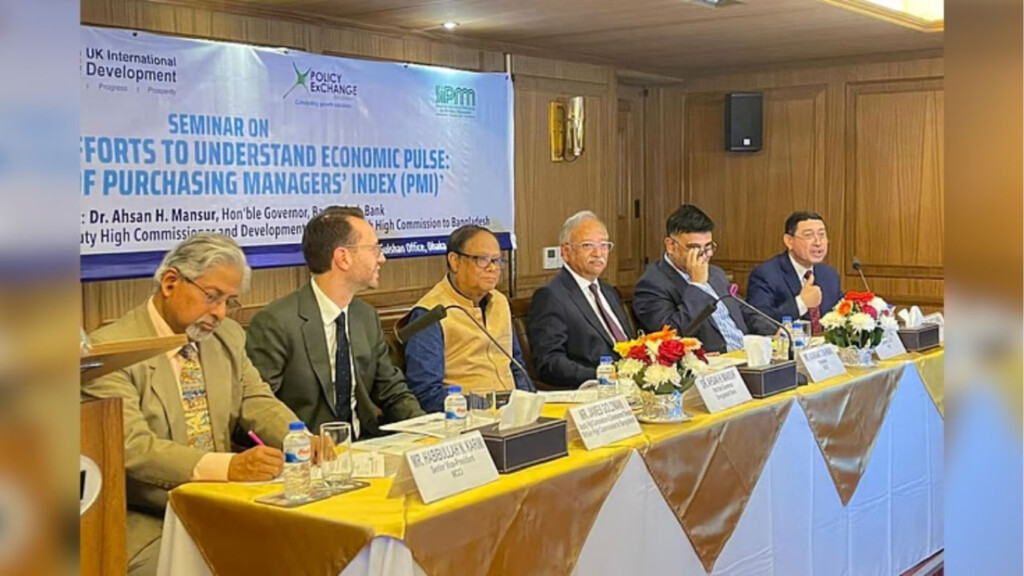
During the seminar titled “Bangladesh’s Macroeconomic Outlook and Business Activities in Light of the Purchasing Managers’ Index (PMI)”, held at the Metropolitan Chamber of Commerce and Industry (MCCI) office in Gulshan, Governor Mansur detailed a narrative of “macroeconomic consolidation.” He noted that improvements in the Balance of Payments (BoP) and the external sector have paved a clear path toward the $35 billion target.
“We are on track to meet or even surpass our goal without relying on IMF funds,” the Governor stated. “Any additional external financing we receive will simply be ‘the icing on the cake,’ but our core stability is now driven by internal market dynamics.”
Key Economic Indicators: Bangladesh FY 2025–26
| Metric | Current Status / Year-End Target | Outlook |
|---|---|---|
| Foreign Exchange Reserves | Targeting $35bn+ | Optimistic (Self-sustaining) |
| Inflation Rate | Currently >8% | Goal: Under 5% |
| Deposit Growth Rate | 11% (as of December) | Expected to reach 14% |
| Total Bank Deposits | ৳20 Trillion | Increasing liquidity |
| Currency Market | Net purchase of $3.7bn | Stable without intervention |
Stabilising the Taka and Curbing Inflation
Governor Mansur highlighted that the central bank’s primary concerns—interest rates and exchange rates—are showing positive trends. The Taka has become increasingly attractive to investors, leading commercial banks to voluntarily sell dollars to the central bank. To date, the Bangladesh Bank has purchased $3.7 billion from the open market without imposing conditions, a figure that exceeds the current IMF assistance and has injected approximately ৳45 billion into the local economy.
Regarding inflation, the Governor remains resolute. “While inflation remains above 8%, my target is to bring it below 5%. This will take time, but if global markets and domestic supply chains remain stable, we will reach it. Only then will we begin reducing the policy rate.” He further noted that lending rates for prime customers have already cooled to 11–12%, a reduction of roughly 200 basis points.
“Oxygen” for the Private Sector
The banking sector is also witnessing a resurgence in confidence. Deposit growth rose to 11% in December, bringing total deposits to ৳20 trillion. Governor Mansur anticipates this growth will hit 14%, driven by the BoP surplus rather than the printing of new currency. This projected growth is expected to unlock ৳2 trillion in financing for the private sector, which the Governor described as “the oxygen of the economy,” essential for resolving liquidity shortages and lowering interest rates.
International Perspective: Modernisation and Data
The seminar also featured James Goldman, the Deputy British High Commissioner, who emphasised that successful economic transitions require “better rules, not just more rules.” He noted that transparency and reliable, timely data are critical to building investor confidence.
Echoing this, M. Masrur Reaj, Chairman of Policy Exchange Bangladesh, described the data held by government bodies like the Bangladesh Bureau of Statistics (BBS) as a “gold mine.” However, he cautioned that for this data to be useful to investors and policymakers, it must be published with greater frequency, regularity, and in alignment with international standards.