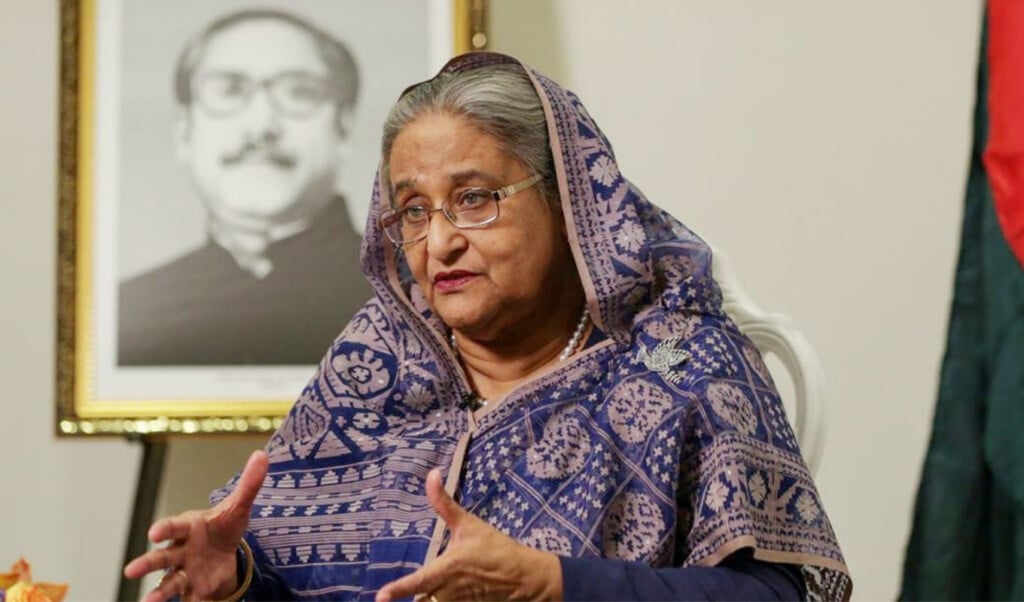
In her first international address since being ousted in the 2024 coup, Bangladesh’s former Prime Minister Sheikh Hasina delivered a forceful critique of the country’s interim administration from exile in India. Speaking via a recorded audio message at the Foreign Correspondents’ Club of Delhi, she launched a series of pointed attacks against the interim government’s chief adviser, Yunus.
According to reports by NDTV, Sheikh Hasina labelled the current administration as an “illegitimate and violent regime,” asserting that under Yunus’s leadership, Bangladesh has entered a period marked by fear, disorder, and the erosion of democratic norms. She alleged that the rule of law has collapsed and citizens’ fundamental rights are being severely undermined.
In her remarks, Sheikh Hasina repeatedly described Yunus as a “murderer,” “tycoon,” “money launderer,” and a “power-hungry traitor.” She further accused him of prioritising foreign interests over national sovereignty and of pushing the nation toward instability.
The press conference, titled “Save Democracy in Bangladesh”, took place on Friday. Sheikh Hasina did not attend in person; however, her pre-recorded message was broadcast to the assembled journalists. Present at the event were several former Awami League ministers and senior party officials, who responded to questions after the audio presentation.
Sheikh Hasina’s address painted a grim picture of the country’s current state:
| Issue | Allegations by Sheikh Hasina |
|---|---|
| Law & Order | Widespread public beatings, looting, and extortion from cities to villages |
| Human Rights | Systematic suppression of freedoms, targeting women and religious minorities |
| Political Stability | Removal from office on 5 August 2024 through a planned conspiracy |
| Media Freedom | Destruction of independent journalism and free press |
| National Sovereignty | Government allegedly ceding control of resources to foreign interests |
Sheikh Hasina described Bangladesh as facing a “deep crisis,” likening the country to a “vast prison” shrouded in “fear of death.” She called for the unification of all democratic, progressive, and secular forces aligned with the Liberation War ideals, stressing that restoring the constitution written in the blood of martyrs is now imperative.
Her message included a five-point programme for national reconstruction: removal of the Yunus-led interim government, reinstatement of democratic governance, creation of free and fair electoral conditions, ending violence and lawlessness, ensuring security for women and minorities, and halting politically motivated harassment and arrests.
Finally, she demanded an independent, UN-monitored investigation into the events of the past year, asserting, “Without uncovering the truth, national reconciliation is impossible.” NDTV observed that her statement highlights the deep divisions in Bangladesh’s political landscape, framing the current crisis not merely as a political transition but as a struggle to protect democracy, national interest, and the values of the Liberation War.