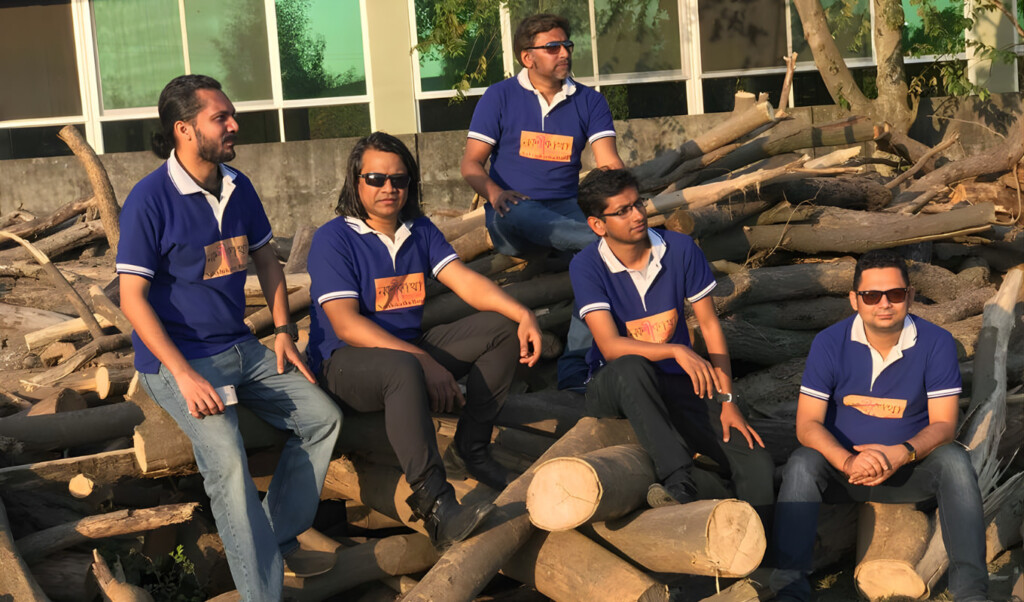
Bangladesh’s band music scene has traditionally revolved around personal emotions, love, heartbreak, and the rhythm of urban life. Yet the musical expression of the band Nokshikatha stands apart. For two decades, the band has used its melodies to highlight societal injustices, environmental degradation, and human rights issues, forging a legacy of awareness and activism.
Under the leadership of Sajed Fatemi, Nokshikatha began its journey on 25 January 2006, and formally launched as a band on 25 January 2007. Over these twenty years, Nokshikatha has not only produced music but also established itself as a continuous social and cultural movement, embedding advocacy into the nation’s collective consciousness.

Music with a Purpose
Every song produced by Nokshikatha goes beyond mere entertainment, serving as a vehicle for questioning, protest, and reflection. Issues such as river and tree conservation, environmental crises, child labour, child marriage, women’s rights, racism, and border violence resonate at the heart of their compositions. Drawing on the rich heritage of Bangladeshi folk music, the band has successfully fused traditional rhythms with contemporary band arrangements, introducing younger audiences to the nuances of folk culture in a modern musical context.

From Theatre to Song
Fatemi explains, “I initially worked with NGOs performing street theatre on dengue, women’s reproductive health, child labour, child marriage, and racism for seven years. Eventually, I realised that these issues could also be communicated through music. Songs allow the message of environmental protection—rivers, trees, and nature—to reach far wider audiences.” This shift from theatrical dialogue to lyrical expression gave Nokshikatha a distinctive musical identity.
Albums and Notable Tracks
The band’s vision is reflected in the themes of its albums:
| Album | Release Year | Notable Songs | Themes |
|---|---|---|---|
| Nojor Rakhees | 2008 | Bhore’r Shishir, Hater Golmal, Nojor Rakhees, Bhalobashar Gaan, Ek Sho Bochor | Social awareness, environment, human rights |
| Nokshikathar Gaan | 2016 | Noya Bari, Chor, Sat Asman, Tuke Liye | Folk essence and contemporary social issues |
Beyond these albums, Nokshikatha has released 58 original tracks and is currently working on at least 20 new compositions. A selection of key songs illustrates the breadth of their engagement:
| No. | Song | Album / Independent | Year | Main Theme |
|---|---|---|---|---|
| 1 | Bhore’r Shishir (Morning Dew) | Nojor Rakhees | 2008 | Environmental awareness |
| 2 | Hater Golmal (Market Commotion) | Nojor Rakhees | 2008 | Social life and awareness |
| 3 | Nojor Rakhees (Keep Watch) | Nojor Rakhees | 2008 | Society and human rights |
| 4 | Bhalobashar Gaan (Song of Love) | Nojor Rakhees | 2008 | Human relationships |
| 5 | Ek Sho Bochor (One Hundred Years) | Nojor Rakhees | 2008 | History and memory |
| 6 | Noya Bari (New Home) | Nokshikathar Gaan | 2016 | Contemporary social issues |
| 7 | Chor (Thief) | Nokshikathar Gaan | 2016 | Poverty and injustice |
| 8 | Sat Asman (Seven Skies) | Nokshikathar Gaan | 2016 | Life struggles |
| 9 | Tuke Liye (For You) | Nokshikathar Gaan | 2016 | Love and social protest |
| 10 | Brishtir Rupali (Silver of Rain) | Independent | 2017 | Environment and natural disasters |
| 11 | Nodir Dak (Call of the River) | Independent | 2017 | River and environmental awareness |
| 12 | Simanter Gaan (Border Song) | Independent | 2018 | Border violence |
| 13 | Shishur Chokhe (Through a Child’s Eyes) | Independent | 2018 | Child labour and rights |
| 14 | Balyobibah (Child Marriage) | Independent | 2018 | Protest against child marriage |
| 15 | Brikkhorokkha (Tree Protection) | Independent | 2019 | Environmental conservation |
| 16 | Nogorer Nirbota (Silence of the City) | Independent | 2019 | Urban social challenges |
| 17 | Eka Pothik (Lonely Traveller) | Independent | 2019 | Personal struggle and human values |
| 18 | Harano Gaan (Lost Song) | Independent | 2020 | History and preservation of folk music |
| 19 | Matir Manush (People of the Soil) | Independent | 2020 | Rural life and culture |
| 20 | Bhore’r Alo (Morning Light) | Independent | 2020 | New generation and hope |
| 21 | Duhsahoshik Din (Daring Days) | Independent | 2021 | Social injustice and resistance |
| 22 | Ojanar Gaan (Unknown Song) | Independent | 2021 | Human rights and awareness |
| 23 | Rater Chhaya (Shadow of the Night) | Independent | 2021 | Contemporary social issues |
| 24 | Nodi O Nodi (River and River) | Independent | 2021 | River conservation and environment |
| 25 | Chander Alo (Moonlight) | Independent | 2021 | Love and human sensitivity |
| 26 | Asha (Hope) | Independent | 2022 | Struggle and human inspiration |
| 27 | Simahin (Without Boundaries) | Independent | 2022 | Racism and social equality |
| 28 | Harano Shohor (Lost City) | Independent | 2022 | Challenges of urban life |
| 29 | Balika (Girl) | Independent | 2022 | Women’s rights and education |
| 30 | Sonali Shokal (Golden Morning) | Independent | 2022 | Rural life and hope |
| 31 | Nodir Gaan (Song of the River) | Independent | 2023 | Environmental awareness |
| 32 | Andhokarer Chhaya (Shadow of Darkness) | Independent | 2023 | Social injustice |
| 33 | Muktir Dak (Call for Freedom) | Independent | 2023 | Human rights |
| 34 | Shishur Shopno (Child’s Dream) | Independent | 2023 | Child labour and rights |
| 35 | Notun Shokal (New Morning) | Independent | 2023 | Hope and revival |
| 36 | Matir Gatha (Stories of the Soil) | Independent | 2023 | Rural life and history |
| 37 | Durbori Sur (Distant Melody) | Independent | 2024 | Life struggles and human messages |
| 38 | Brishtir Chhoa (Touch of Rain) | Independent | 2024 | Environmental awareness |
| 39 | Harano Kontho (Lost Voice) | Independent | 2024 | Preservation of folk music |
| 40 | Simanter Golpo (Border Stories) | Independent | 2024 | Border violence |
| 41 | Shishuder Gaan (Children’s Song) | Independent | 2024 | Child labour and children’s rights |
| 42 | Eka Nayok (Lone Hero) | Independent | 2024 | Social injustice and protest |
| 43 | Pother Dhoni (Sound of the Path) | Independent | 2024 | Struggle and human message |
| 44 | Jhornaar Jol (Water of the Falls) | Independent | 2025 | Environmental awareness |
| 45 | Diner Alo (Daylight) | Independent | 2025 | Hope and new generation |
| 46 | Nodi Tire (By the River) | Independent | 2025 | River and environment |
| 47 | Shonar Gaan (Golden Song) | Independent | 2025 | Rural culture |
| 48 | Harano Shopno (Lost Dream) | Independent | 2025 | Human struggle |
| 49 | Mukti (Freedom) | Independent | 2025 | Human rights and social awareness |
| 50 | Shishur Hasi (Child’s Smile) | Independent | 2025 | Child labour and rights |
| 51 | Durproshari Sur (Far-reaching Melody) | Independent | 2025 | Society and culture |
| 52 | Notun Probhat (New Dawn) | Independent | 2025 | Hope and human message |
| 53 | Bornomala (Alphabet) | Independent | 2025 | Education and social awareness |
| 54 | Matir Chhaya (Shadow of Soil) | Independent | 2025 | Rural life |
| 55 | Nodi O Nirbota (River and Silence) | Independent | 2025 | Environment and river conservation |
| 56 | Chhayar Gaan (Song of Shadows) | Independent | 2025 | Society and human issues |
| 57 | Shopnilo Poth (Dreamy Path) | Independent | 2025 | Hope and struggle |
| 58 | Shesh Dekha (Last Meeting) | Independent | 2025 | Personal and social protest |
A Legacy of Responsibility
Over twenty years, Nokshikatha has demonstrated that music can be far more than a source of entertainment. Through melodies advocating for rivers, trees, women, and children, the band has made an indelible mark on Bangladesh’s cultural consciousness, proving that art can be both beautiful and socially accountable.