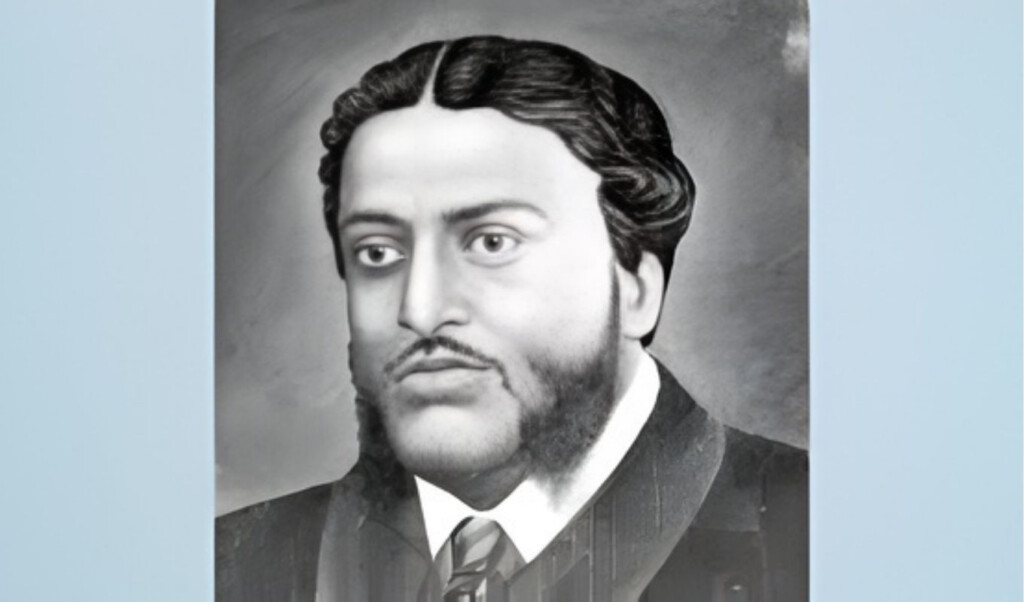
On 25 January, literary circles and admirers of Bengali literature pause to honour Michael Madhusudan Dutt, one of the most luminous and revolutionary figures of the 19th century. Far beyond a mere poet, Dutt was a dramatist, satirist, and an audacious innovator who challenged the conventions of Bengali literary tradition, leaving an indelible mark on the cultural landscape of Bengal.
Born in 1824 in Sargoda, a village in Keshabpur, Jessore (now in Bangladesh), Dutt hailed from a Kayastha zamindar family. His father, Rajnaraayan Dutt, was a distinguished lawyer in the Calcutta Dewani Adalat, and his mother, Jahnabi Devi, nurtured his early sensibilities. From a young age, Dutt exhibited a remarkable literary talent, though his life was never free from struggle.
A pivotal moment in his youth was his conversion to Christianity, a choice that estranged him from his paternal home and thrust him into social conflict. This decision marked the beginning of a life imbued with dramatic tension, financial hardship, and emotional turbulence. Despite these challenges, Dutt’s creative spirit never waned.
He is celebrated as a pioneering force of the Bengali Renaissance, rejecting conventional poetic forms and introducing innovative styles that earned him the title of the first rebel poet of modern Bengali literature. Influenced heavily by Western literary traditions, he initially pursued literary endeavours in English, though recognition largely eluded him. It was only upon his return to Bengali literary pursuits that his genius found full expression.
During this phase, Dutt composed landmark works in poetry, drama, and satirical prose, blending classical forms with modern sensibilities. He introduced sonnets and amitrakshar (unequal metre) verse to Bengali poetry, forever transforming its rhythmic and expressive possibilities. His magnum opus, the epic poem ‘Meghnad Badh Kavya’, based on the Ramayana, exemplifies the synthesis of rebellious voice, humanist insight, and a modern perspective—a work that continues to inspire scholars and readers alike.
Michael Madhusudan Dutt’s life was tragically brief; he passed away on 29 June 1873, at the age of 49. Yet, his literary rebellion, innovative language, and visionary imagination continue to illuminate Bengali literature.
Key Milestones of Michael Madhusudan Dutt
| Year | Event | Significance |
|---|---|---|
| 1824 | Born in Sargoda, Keshabpur | Entry into a zamindar family of Jessore |
| 1843 | Conversion to Christianity | Social estrangement; deep personal conflict |
| 1840s–1850s | Early literary work in English | Influenced by Western literary traditions |
| 1850s–1870s | Return to Bengali literature | Composition of pioneering dramas, poems, and satirical works |
| 1861 | Composition of ‘Meghnad Badh Kavya’ | Epic poem marking a new era in Bengali literature |
| 1873 | Death in Calcutta | Life ended at 49; legacy continues |
Michael Madhusudan Dutt remains a beacon for generations of writers, a testament to the power of defiance, creativity, and unwavering dedication to art. His legacy is a reminder that true literary brilliance often flourishes amidst adversity.
Tribute: Michael Madhusudan Dutt—rebel, innovator, poet.