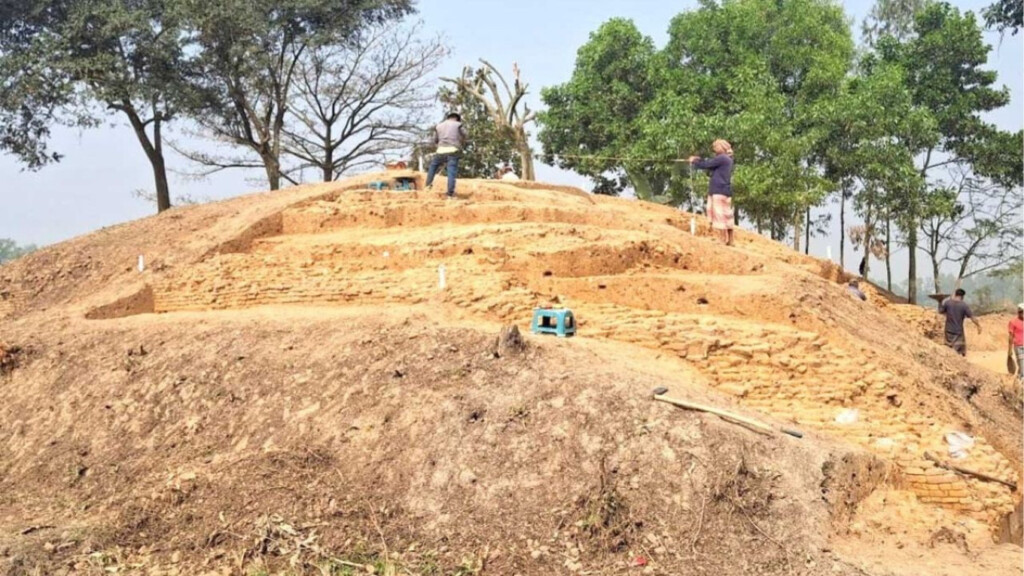
A recent excavation in the historic Mahasthangarh site in Bogura has revealed traces of five distinct settlement periods in the western Durganagar area, specifically at Bishmordan. The six-member archaeological team commenced digging on 12 January 2026, with the project scheduled to conclude by the end of the month. Officials from the Bogura Regional Office of the Department of Archaeology estimate that the temples discovered may have been constructed between 800 and 1,000 years ago.
Archaeologists report that Mahasthangarh, one of Bangladesh’s most significant ancient fort-cities, has yielded artefacts spanning multiple historical eras, including pre-Mauryan, Mauryan, Gupta, Pala, Sena, and early Muslim periods. Excavations across the site have unearthed hundreds of items of historical and cultural significance, including stamped gold coins, decorated terracotta plaques, figurines, and various objects made of metal, clay, and stone. Remarkably, some artefacts predate the birth of Jesus Christ, including a clay hairpiece, highlighting the site’s extensive antiquity.
The primary aim of the current excavation is to establish links between settlements within the fort-city and those surrounding it, identifying continuity and development over time. The Bishmordan site alone has revealed structures from five different settlement phases, suggesting that temples were constructed sequentially over centuries. The lowest layers were built upon the floodplain of the ancient Karatoa River, with structural comparisons suggesting affinities to Mauryan-era fortifications. Archaeologists believe that each temple was constructed after the previous one had fallen into ruin.
Key Findings at Bishmordan Excavation
| Feature | Description |
|---|---|
| Location | Western Durganagar, Bishmordan, Mahasthangarh |
| Settlement Periods | Five distinct phases identified |
| Artefacts | Stamped gold coins, terracotta plaques, clay figurines, ancient bricks |
| Temple Structures | Multi-layered brick constructions, up to 5 metres high |
| Construction Materials | Reused Pala-era bricks, fired clay, terracotta |
| Chronology | Estimated 4th–12th century CE |
| Special Discoveries | Clay hairpiece predating Christ, fragments of female figurines, pottery shards |
A.K.M. Saiful Rahman, Regional Director of the Department of Archaeology, stated that the brick temple structures unearthed were likely constructed on solid ground above flood-prone land, with materials from earlier Pala-era structures reused in subsequent constructions. Research assistant S.M. Hasanat Bin Islam noted that the excavation revealed temple floors and walls, with evidence of multiple construction phases. Much of the structure found 100 metres west of Durganagar has been destroyed, prompting deeper excavation to uncover additional evidence.
Rajia Sultana, custodian of the Mahasthangarh Museum, described the finds as “exceptionally significant,” citing decorated bricks, numerous pottery fragments, broken terracotta plaques, clay female figurines, and intricately designed clay lattice rods. Many of these artefacts were discovered buried beneath destroyed temple foundations, indicating long-term human occupation and temple rebuilding activities.
The ongoing excavation promises to deepen understanding of the urban planning, religious practices, and cultural continuity of one of Bangladesh’s oldest archaeological sites, shedding light on centuries of settlement development at Mahasthangarh.