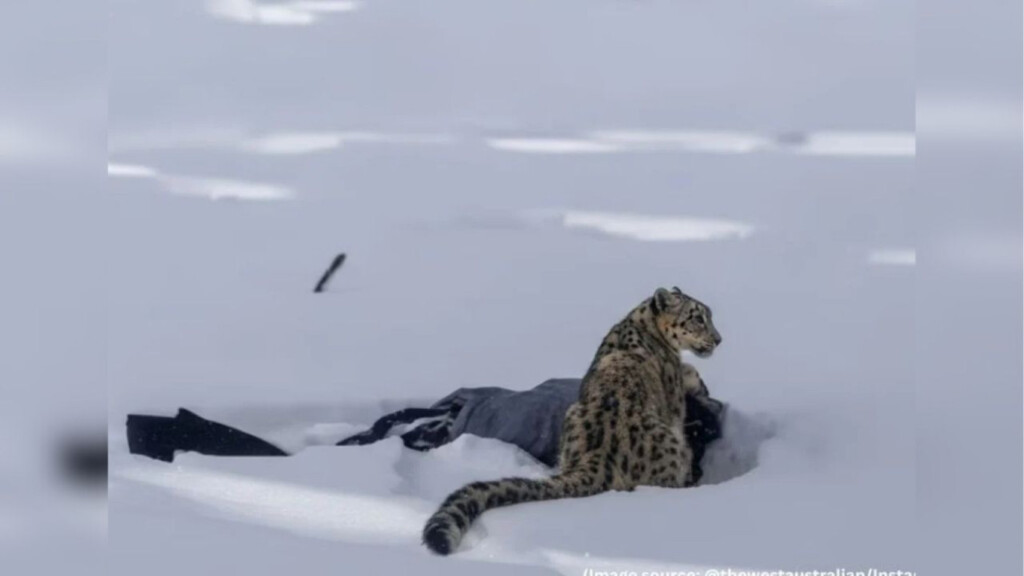
A holiday in the rugged wilderness of north-western China took a harrowing turn last Friday when a tourist was mauled by a snow leopard. The incident occurred near a popular ski resort in Koktokay, located in the Xinjiang Uygur Autonomous Region—a territory famed for its dramatic mountain ranges and as a sanctuary for some of the world’s most elusive predators.
According to reports from local authorities and state broadcaster CCTV, the encounter began when the tourist spotted the feline while driving back to his hotel. Often referred to as the “ghost of the mountains” due to their shy nature and extraordinary camouflage, snow leopards are a bucket-list sighting for wildlife enthusiasts. Driven by the desire for a close-up photograph, the individual reportedly exited his vehicle and approached the animal, breaching a safe distance and triggering a defensive, violent reaction from the leopard.
A Brutal Encounter Caught on Film
Disturbing footage circulating on social media captured the immediate aftermath of the assault. One video shows the victim lying motionless on the snow with the leopard standing guard nearby. A subsequent clip depicts the man—still wearing his ski helmet—with a bloodied face, being assisted to safety by two passers-by.
Local forestry bureau officials confirmed that the victim was rushed to a nearby hospital. Fortunately, despite the severity of the attack and significant blood loss, his condition has been described as stable.
Conservation Status and Rare Aggression
Wildlife experts have noted that such attacks are extraordinarily rare. Snow leopards typically avoid human contact at all costs. However, as human encroachment into mountainous habitats increases through tourism and infrastructure, these “accidental” encounters are becoming more frequent.
China remains the primary stronghold for this endangered species. The following data highlights the global distribution and status of the snow leopard:
| Category | Statistic |
|---|---|
| Estimated Global Population | 4,000 – 6,500 individuals |
| Percentage Residing in China | Approximately 60% |
| IUCN Red List Status | Vulnerable |
| Typical Habitat Altitude | 3,000 – 4,500 metres |
| Primary Threats | Habitat loss, poaching, and climate change |
Expert Warning
The World Wildlife Fund (WWF) emphasises that while snow leopards are not inherently aggressive toward humans, they are powerful apex predators. Experts suggest that the tourist’s decision to leave the safety of his vehicle was a critical error. When a wild animal feels cornered or threatened by a sudden approach, its instinct is to neutralise the perceived threat. Local authorities have since issued a stern reminder to visitors to remain within designated areas and never approach wildlife, regardless of how docile an animal may appear.