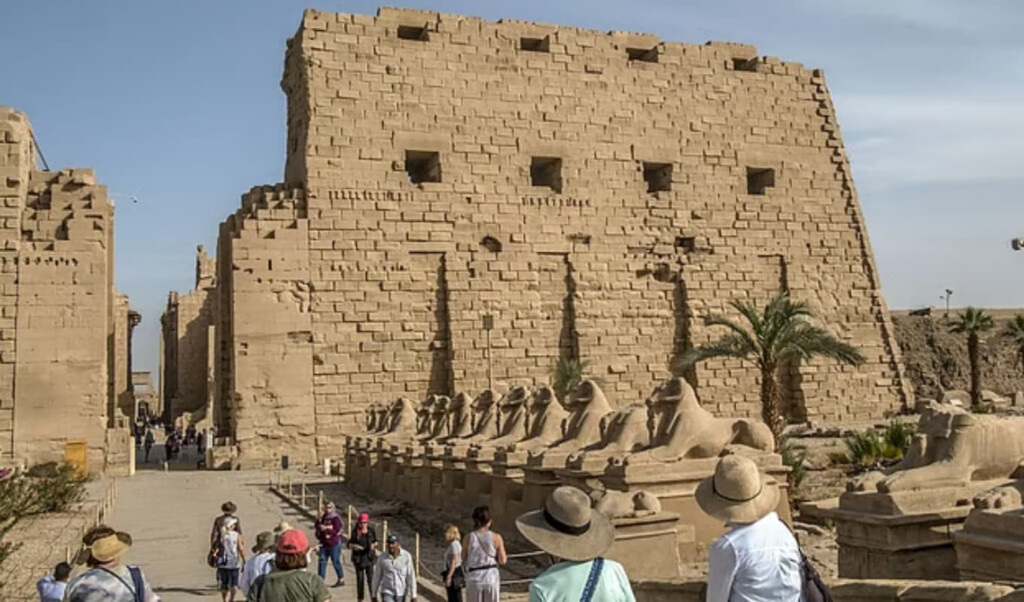
Archaeologists have recently uncovered a long-lost branch of the Nile River, dormant for over four millennia, shedding fresh light on the geographical and cultural evolution of the Karnak Temple complex. This remarkable discovery has been made possible through a combination of archaeological excavation, sediment analysis, and advanced polymetric studies.
The Karnak complex was constructed on a naturally elevated landmass, historically surrounded by a network of Nile tributaries and minor canals. Researchers indicate that before approximately 2,520 BCE, this region was largely unsuitable for permanent settlement. Over time, natural shifts in the river’s flow transformed the terrain into a more stable, island-like formation, creating a prime location for monumental construction and habitation.
Analysis reveals evidence of the ancient Nile branch to both the east and west of Karnak. Minor channels once traversed the temple complex, although some waterways were naturally silted and filled over centuries. Significantly, archaeologists note that the architects of ancient Egypt did not rely solely on natural land formations; during the New Kingdom period, they deliberately redirected or filled certain channels to facilitate major construction projects.
The key findings are summarised in the table below:
| Subject | Details |
|---|---|
| Rediscovered Branch | Eastern branch of the Nile |
| Approximate Period | 2,520–2,000 BCE (First Intermediate Period to New Kingdom) |
| Landform | Elevated, island-like, initially unstable |
| Human Settlement | Became suitable for permanent settlement and temple construction |
| Ancient Evidence | Pottery layers, polymetric strata; artefacts from Old Kingdom and First Intermediate Period |
| Human Intervention | Selected river channels deliberately filled to prepare land for construction |
The discovery also provides a fascinating intersection between geography and mythology. The island-like terrain of Karnak closely mirrors the ancient Egyptian cosmogony, which describes a sacred hill emerging from primordial waters. The alignment between myth and reality offers compelling evidence that landscape features influenced both practical and symbolic aspects of temple planning.
By combining stratigraphic analysis, ceramic studies, and modern dating techniques, researchers have filled crucial gaps in understanding the early development of Karnak. The complex emerges not merely as a collection of monumental stone structures but as a living testament to the interplay of the Nile’s changing flow, natural environment, and human ingenuity.
This finding deepens insight into how the Egyptians harnessed and adapted their environment, transforming an initially unstable riverside terrain into one of the most iconic religious landscapes of the ancient world.