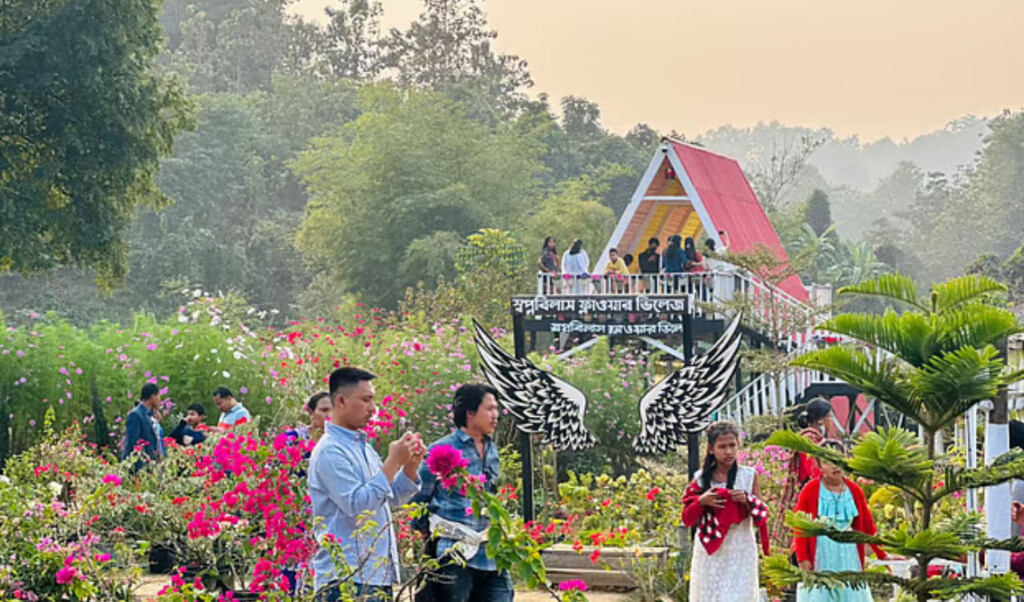
Where once the acrid stench of burnt clay and a pall of black smoke poisoned the air, today the fragrance of fresh flowers drifts gently on the breeze. In Murapara village of Mahalchhari upazila, Khagrachhari, an abandoned brick kiln has been transformed into a vibrant floral landscape known as Swapnobilash Flower Village. The project stands as a compelling example of environmental restoration blended with grassroots entrepreneurship, driven by the vision, courage and perseverance of young entrepreneur Khaled Masud Sagar.
Located about 24 kilometres from Khagrachhari town along the Rangamati–Khagrachhari road, the two-acre site is now meticulously laid out. Rows of flower beds stretch across the land, intersected by planned walking paths, seating areas and designated photo corners that invite visitors to linger. For a modest entrance fee of just 30 taka, guests can immerse themselves in a colourful panorama where blossoms merge harmoniously with the surrounding green hills, creating a striking visual contrast.
Despite holding a law degree, Khaled Masud Sagar chose not to follow a conventional professional path. Instead, he sought an endeavour that would generate income while also creating employment opportunities for local people. Having family ties to Mahalchhari, he regularly passed the derelict brick kiln and began to imagine a different future for the scarred land. Nurturing a lifelong interest in flowers, he leased the kiln site and adjoining plots in late 2023, investing approximately 500,000 taka to bring his idea to life.
The transformation was far from straightforward. Years of brick production had left the soil severely degraded, requiring extensive rehabilitation. Clearing debris, restoring soil fertility and developing basic infrastructure demanded time, labour and persistence. Full-scale flower cultivation began in 2024. Today, the garden hosts around 200 types of flowers, encompassing more than 400 varieties. Marigolds, roses, hibiscus, chrysanthemums, dahlias and sunflowers bloom alongside orchids, shiuli, hasnahena, frangipani, aparajita and dolonchapa, ensuring colour throughout the year. The hill soil and local climate lend particular charm during the winter months, when the garden is at its most striking.
The initiative has had a tangible impact on the local community. Fifteen people are employed on a regular basis, with an additional five hired seasonally. Nearby residents have also begun purchasing saplings to cultivate flowers at home, spreading horticultural interest beyond the site itself. To enhance the visitor experience, a small, environmentally conscious coffee corner and light refreshments area has been added.
Gradually, Swapnobilash Flower Village is emerging as a new tourist attraction in Khagrachhari. For students, families and nature lovers, it offers not only recreation but also inspiration. During peak flowering seasons, the project generates a net monthly income of around 45,000 to 50,000 taka. Looking ahead, the entrepreneur plans to introduce further eco-friendly ventures, including fish farming, to diversify both income and sustainability.
At a Glance: Swapnobilash Flower Village
| Aspect | Details |
|---|---|
| Location | Murapara, Mahalchhari, Khagrachhari |
| Total area | Approximately 2 acres |
| Project launch | Late 2023 |
| Flower types | Around 200 |
| Total varieties | More than 400 |
| Permanent employment | 15 people |
| Entry fee | 30 taka |
The journey from an abandoned brick kiln to a flourishing flower village demonstrates that, with clear vision and determination, environmental conservation and economic development can progress hand in hand.