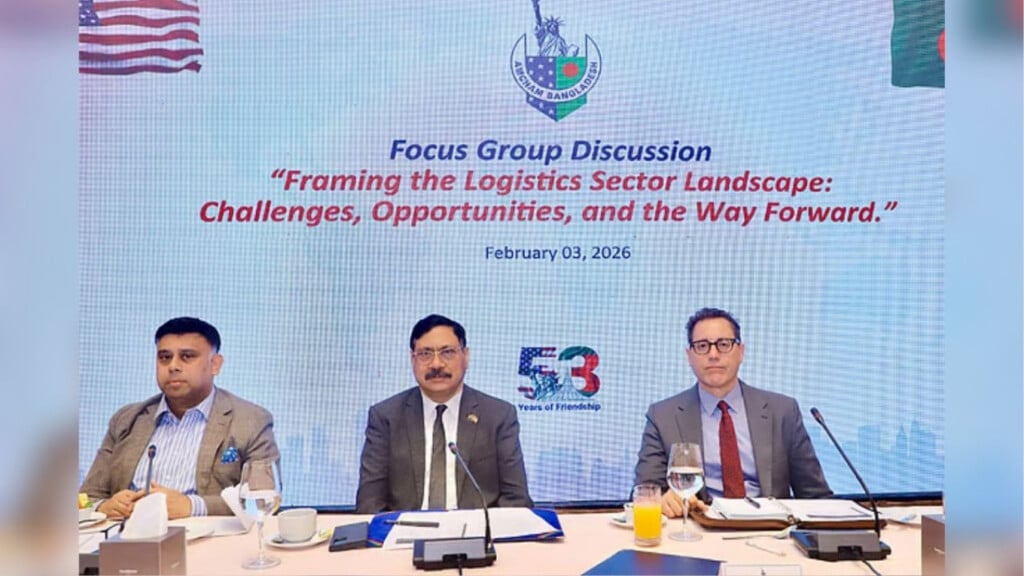
The fragility of Bangladesh’s logistics infrastructure was cast into sharp relief this week as experts warned that the ongoing industrial action at Chittagong Port could have devastating consequences for the national economy. Speaking at a high-level stakeholder discussion titled “Shaping the Logistics Landscape: Challenges, Opportunities, and the Way Forward,” Dr M. Masrur Rejaz, Chairman of the Policy Exchange Bangladesh, emphasised that any disruption to the supply chain acts as a direct throttle on national growth.
The event, hosted by the American Chamber of Commerce in Bangladesh (AmCham) in Gulshan, brought together a distinguished assembly of development partners, logistics specialists, and officials from the US Embassy to address the escalating crisis at the nation’s primary maritime gateway.
The Chittagong Standoff
At the heart of the current crisis is a fierce labour dispute at the Newmooring Container Terminal (NCT). Workers have commenced a work abstention programme to protest against the government’s decision to lease terminal operations to foreign firms. This strike has effectively paralysed the loading and unloading of containers, creating a bottleneck that threatens the flow of essential international trade.
Dr Rejaz pointed out that Bangladesh’s port efficiency remains alarmingly low relative to its economic ambitions. He argued that without Public-Private Partnerships (PPP) and the integration of global operators—not just at NCT but in future projects like the Bay Terminal and Matarbari Deep Sea Port—Bangladesh will struggle to remain competitive in the global market.
The Economic Stakes
The financial implications of logistical inefficiency are staggering. As Bangladesh eyes a $760 billion GDP by 2030, the modernisation of its ports is no longer optional. Dr Rejaz highlighted a critical correlation: a mere 1% reduction in logistics costs could boost exports by approximately 7%. This leverage is particularly vital as the country prepares for its graduation from Least Developed Country (LDC) status, where trade preferences will diminish.
Critical Logistics Metrics and Goals
| Metric | Current Challenge / Target | Economic Impact |
|---|---|---|
| GDP Goal 2030 | $760 Billion | Requires rapid infrastructure expansion. |
| Logistics Efficiency | 1% Cost Reduction | Equates to a 7% increase in exports. |
| Air Freight | 20-25% more expensive than road | Deters high-value e-commerce growth. |
| Future Projects | Bay Terminal & Matarbari | Essential for “post-LDC” competitiveness. |
| Policy Reform | National Logistics Policy 2025 | Aims to centralise governance under the PMO. |
Global Trends and Local Hurdles
Syed Ershad Ahmed, President of AmCham Bangladesh, noted that while the local sector has evolved, it remains significantly behind global peers. He identified five global shifts—Artificial Intelligence (AI), decarbonisation, geopolitical realignment, regionalisation, and supply chain resilience—as forces that are rapidly redefining the industry. Bangladesh, he warned, must close its “knowledge and capability gap” to survive these shifts.
Further challenges were raised regarding air logistics. Mahbubul Anam, Managing Director of SAF Global, noted that air freight costs in Dhaka are 20-25% higher than road transport, stifling the burgeoning e-commerce sector. He specifically called for the establishment of direct cargo flights to the United States to match the facilities currently enjoyed for European Union exports.
The Path to Reform
Nusrat Nahid Bobi, Senior Transport Specialist at the World Bank, urged the new government to maintain the reform momentum established in 2022. She advocated for the immediate approval of the National Logistics Policy (NLP) 2025 and the creation of a dedicated Logistics Department under the Prime Minister’s Office to ensure high-level oversight.
The consensus among stakeholders was clear: unless the government resolves the port deadlock and digitises customs procedures—specifically through the full implementation of the Customs Act 2023—the nation’s “Golden Goal” of 2030 may remain out of reach.