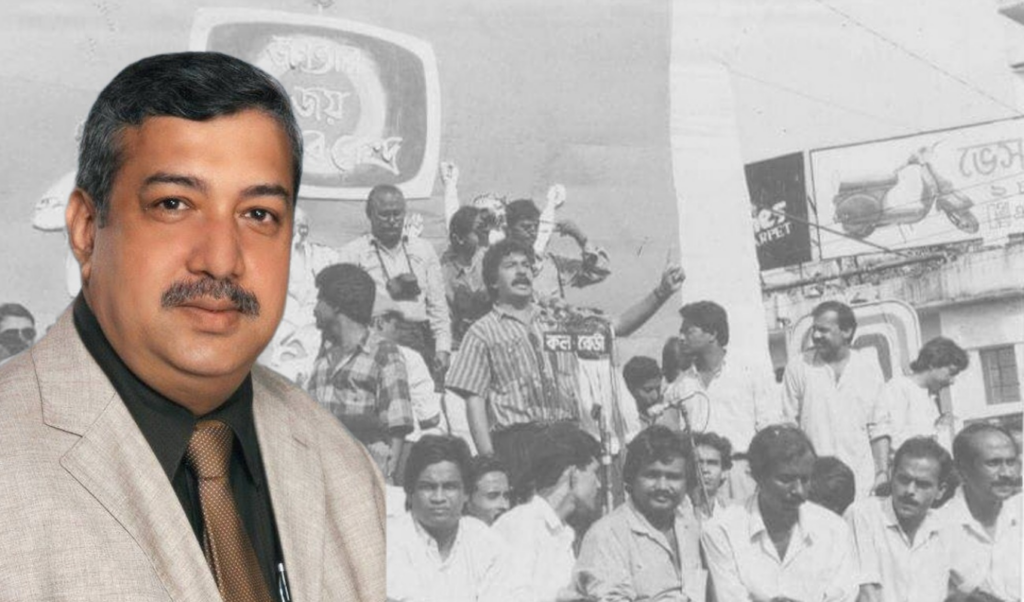
Jahangir Sattar Tinku’s life was a luminous blend of courage, intellect, and unwavering commitment to justice. As one of the foremost leaders of the turbulent student movements of the 1990s, he shaped the course of student politics with a rare combination of bravery and vision. Tinku, the last elected president of the National Student League, succumbed prematurely to a terminal illness, leaving behind an indelible legacy.
Shortly before his diagnosis with a brain tumour, he summoned me to the office of his old Paltan-based business. His deep, resonant voice carried both gravity and warmth as he expressed a long-cherished desire: to write his autobiography. He entrusted me with the task, providing guidance on style and tone, even requesting epigraphs to accompany his reflections. Though initially daunted by the enormity of the responsibility, his confidence in me became a source of inspiration.
Tinku’s journey in student politics began in his formative years, marked by the unrest of the late 1970s and early 1980s. On the very first day of college, he survived a violent attack by a communal student organisation, an experience that shaped his lifelong dedication to justice and activism. Rising through the ranks of the National Student League, he merged scholarly pursuits with political activism, publishing the literary periodical Sparsh alongside his contemporaries. His leadership extended to Dhaka Medical College, the University of Dhaka, and eventually to the national stage, where he played a crucial role in resisting military authoritarianism and fostering student unity.
A strategist and visionary, Tinku coordinated with fellow student leaders to protect campus spaces during critical movements, confronting armed assailants to safeguard the rights of thousands of students. His courage under fire earned him admiration across political divides, and his organisational acumen solidified his status as a legendary student leader. Beyond politics, he nurtured literature, arts, and culture, leaving a mark on every sphere he touched.
Tinku passed away on 8 February 2012, leaving behind his beloved wife Khuzista Nur-e-Nahrin (Munni) and children Dhruv and Shreya. Yet his legacy persists, a testament to a life where intellect and bravery coalesced into an enduring symbol of principled leadership.
Key Milestones in Jahangir Sattar Tinku’s Life:
| Year/Period | Event/Accomplishment |
|---|---|
| Late 1970s–1980s | Active in student movements; survived communal attack |
| Early 1980s | Joined National Student League; published Sparsh magazine |
| 1984 | Contributed to formation of National Student League’s unified committee |
| Mid-1980s | Advocated arts, literature, and culture within student politics |
| Late 1980s–1990s | Elected central committee president; coordinated anti-authoritarian campaigns |
| 10 October 1990 | Played pivotal role in student unity after Ullapara incident |
| 8 February 2012 | Passed away, leaving lasting legacy |
Jahangir Sattar Tinku’s life reminds us that when courage and intellect merge, they create a tapestry of resistance, vision, and inspiration—one that continues to illuminate the paths of those who follow.
Writer: Journalist and political analyst