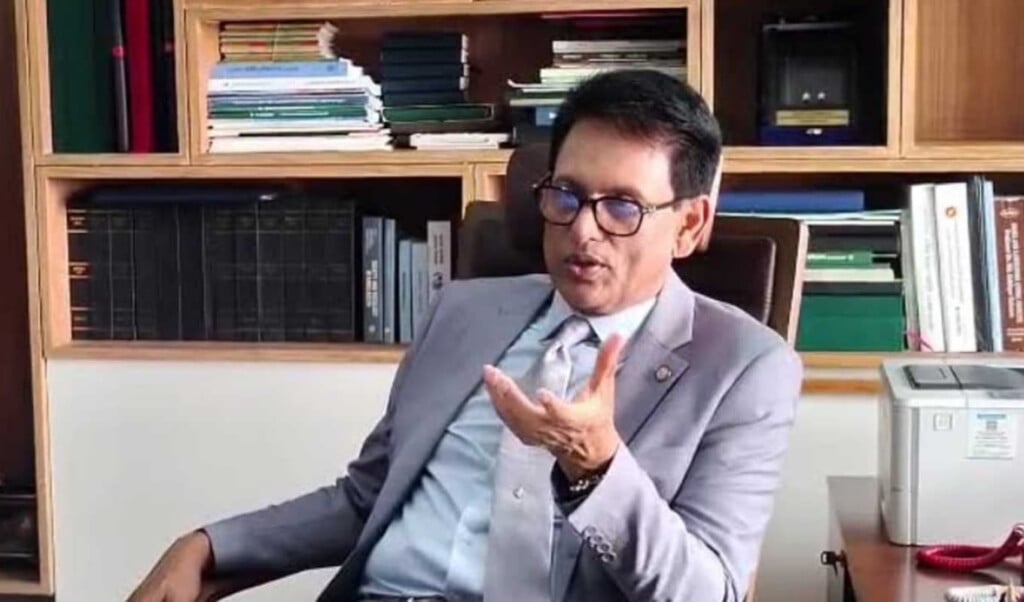
The newly appointed Education Minister of Bangladesh, A N M Ehsanul Haque Milon, has called for a substantial increase in public investment in education, arguing that sustainable development and the cultivation of a skilled workforce depend fundamentally on strategic financing of the sector.
Speaking at a press briefing at the Secretariat on Wednesday (18 February) after formally assuming office, the minister observed that although more than five decades have passed since independence, education has yet to receive the highest priority in national budgetary allocations. In the early years of statehood, he acknowledged, it was both rational and necessary to prioritise food security and physical infrastructure. However, he stressed that the present global context—defined by knowledge-based economies and technological transformation—demands a decisive shift in policy emphasis.
Currently, public expenditure on education in Bangladesh stands at approximately 2 per cent of gross domestic product (GDP), significantly below the internationally recommended benchmark of 4–6 per cent. The minister maintained that, to achieve meaningful long-term gains in human capital development, research capacity, and the expansion of technical and vocational education, the allocation should be raised to at least 5 per cent of GDP.
He cautioned, however, that numerical increases alone would not yield the desired outcomes. “Without policy clarity and strategic planning, merely enlarging the allocation envelope will not ensure systemic improvement,” he remarked. Effective prioritisation, governance reform, and targeted programme design, he added, are essential to maximise fiscal impact.
Comparative Regional Snapshot
To contextualise Bangladesh’s position within South Asia, the minister referred to approximate regional expenditure patterns:
| Country | Education Spending (% of GDP) | Strategic Emphasis |
|---|---|---|
| Bangladesh | ~2% | Infrastructure and primary education focus |
| Nepal | ~4% | Primary and inclusive education initiatives |
| Sri Lanka | ~3–4% | Human capital and higher education investment |
He noted that neighbouring countries are increasingly leveraging higher educational outlays to strengthen innovation ecosystems and workforce competitiveness. Policymakers in Bangladesh, he suggested, must take these comparative trends into account when framing medium- and long-term fiscal strategies.
Addressing recent debate surrounding curriculum reforms, the minister described educational transformation as an ongoing process. Any revision, he said, must be grounded in socio-economic realities, labour market demands, and international competitiveness benchmarks. He pledged to consult educationists, teacher representatives, and subject-matter experts before adopting policy decisions.
On concerns raised in social media regarding examination irregularities, academic misconduct, and campus discipline, he underscored his commitment to building an accountable and standards-driven system. Enhancing research output and fostering innovation, he argued, will be critical if Bangladesh is to secure global recognition for its academic institutions.
The minister concluded by affirming that education is receiving renewed attention at the highest levels of government. Through coordinated planning, governance reform, and prudent budget reallocation, he expressed confidence that visible progress can be achieved in the short to medium term. Transforming the education system into a quality-driven, skills-oriented and research-based framework, he said, will require sustained collaboration among all stakeholders.