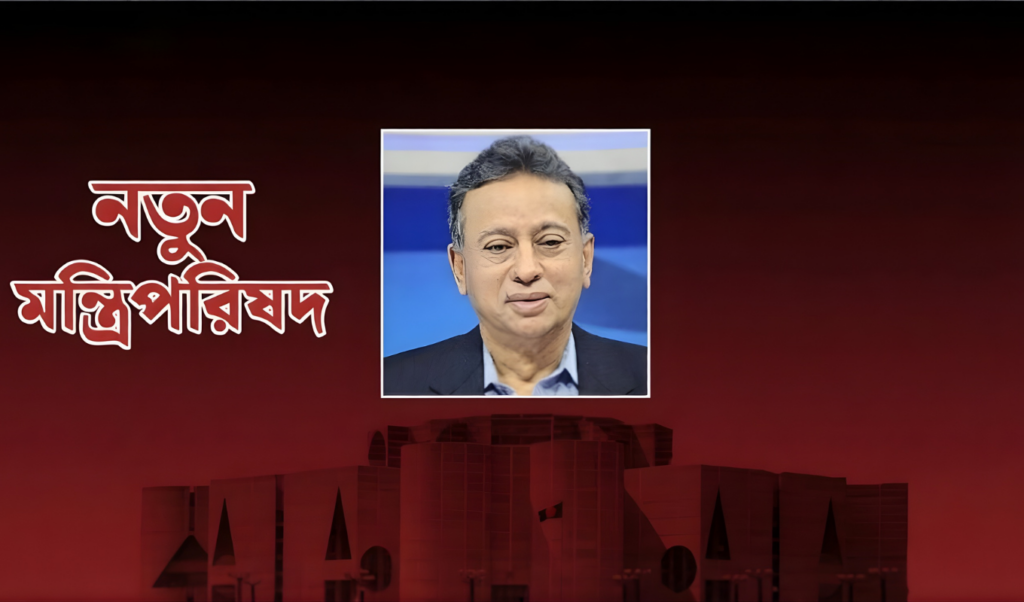
A prominent figure in Bangladesh’s political and business circles, Amir Khasru Mahmud Chowdhury has been entrusted with one of the most consequential portfolios in the newly formed government led by the Bangladesh Nationalist Party (BNP). The Prime Minister, Tarique Rahman, has appointed him Minister for Finance and Planning, placing the stewardship of the national economy squarely on his shoulders.
Mr Chowdhury was elected to Parliament on 12 February in the 13th general election, securing a decisive victory in the Chattogram-11 (Patenga) constituency. News of his ministerial appointment, announced on 17 February following the allocation of portfolios, sparked widespread jubilation among BNP activists and supporters in Chattogram—widely regarded as the commercial capital of Bangladesh.
Chattogram occupies a pivotal position in the country’s economic architecture. Its port and customs facilities handle the overwhelming majority of Bangladesh’s import–export trade, while a substantial share of national revenue is generated through economic activity centred in the region. Observers note that Mr Chowdhury’s deep familiarity with the commercial dynamics of Chattogram may prove invaluable as he confronts pressing national challenges, including fiscal consolidation, inflation management and long-term development planning.
Political Heritage and Early Life
Born in 1949 in North Kattali under Pahartali police station in Chattogram, Mr Chowdhury hails from a politically distinguished family. His father, Mahmudunnabi Chowdhury, was elected to the East Pakistan Provincial Assembly in 1954 from the Double Mooring–Sitakunda constituency. Under the United Front government, he served first as Minister for Communications and later as Minister for Relief and Rehabilitation. This early exposure to public life and governance left a lasting imprint on the younger Chowdhury.
He graduated from Chittagong College in 1969 before travelling to the United Kingdom to pursue higher studies in accountancy. Upon returning to Bangladesh, he joined the family business and steadily built a reputation in the financial and commercial sectors.
Business and Institutional Leadership
Mr Chowdhury played a foundational role in establishing the Chittagong Stock Exchange and later served as its chairman. His leadership extended to the Chittagong Chamber of Commerce and Industry, where he held the presidency, and to the South Asian Federation of Exchanges, of which he was the first president. He also served as Honorary Consul of South Korea in Chattogram, Acting Chairman of Sonali Bank, and as a member of advisory committees linked to the National Board of Revenue and the Ministry of Industries.
Parliamentary and Ministerial Career
His parliamentary journey began in 1991 after the then Prime Minister and BNP Chairperson, Khaleda Zia, vacated the Chattogram-8 seat (now Chattogram-11). Mr Chowdhury won the subsequent by-election and retained the constituency in the February and June elections of 1996, as well as in the 2001 general election.
Following the BNP’s victory in 2001, he was appointed Minister for Commerce on 10 October of that year, serving until 25 March 2004. During his tenure, he focused on trade liberalisation, export diversification and private sector development.
Career Overview
| Category | Details |
|---|---|
| Born | 1949, North Kattali, Chattogram |
| Education | BA, Chittagong College; Accountancy studies, UK |
| Key Business Roles | Founder & Chairman, Chittagong Stock Exchange |
| Parliamentary Terms | 1991 (by-election), 1996 (Feb & June), 2001, 2026 |
| Ministerial Roles | Commerce (2001–2004); Finance & Planning (Current) |
Married with one son and one daughter, Mr Chowdhury’s son, Israfel Khasru, is active in BNP’s international affairs sub-committee, while his daughter resides in Australia.
With decades of experience spanning commerce, finance and public policy, Amir Khasru Mahmud Chowdhury now faces the formidable task of guiding Bangladesh’s economic trajectory at a critical juncture.