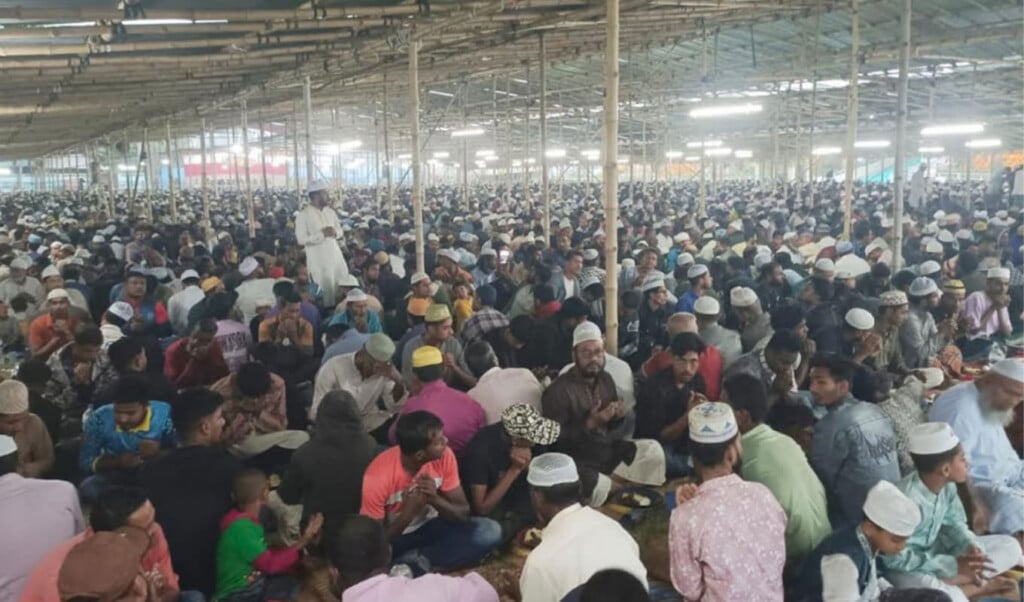
With the first light of dawn, the courtyard of Nilta Central Ahshania Mission in Kaliganj, Satkhira, comes alive with activity. Following the Fajr prayer, preparations for the daily Iftar begin, a tradition maintained throughout the holy month of Ramadan. The mission aims to serve approximately six thousand people each evening, transforming the humble courtyard into a hub of devotion and service.
In large cauldrons, chickpeas are cooked to perfection, while seven-layered firni is prepared and rows of samosas are fried in sequence. This culinary spectacle starts at daybreak, setting the tone for a day dedicated to feeding the faithful. Nearly fifty professional chefs and 250 volunteers participate in this elaborate operation, ensuring that every dish meets the mission’s high standards.
Chef Amanat Ali, who has overseen Iftar preparations for 25 years, explains, “Each day we cook 190 kilograms of chickpeas, 144 kilograms of semolina, 150 kilograms of sugar, and 600 kilograms of milk to produce seven layers of firni. Work begins at dawn and must be completed by 3 PM. By Allah’s mercy, everything runs smoothly, and the blessings of our spiritual guide accompany us.”
Mohammad Asaduzzaman, responsible for samosa preparation, adds, “From six in the morning, I work alongside five or six others. Every day, we peel and cut 180 kilograms of potatoes and prepare 154 kilograms of dough. Though the payment is modest, the peace and satisfaction derived from serving others are priceless.”
Between 250 and 300 volunteers assist in assembling and distributing Iftar plates, each containing dates, bananas, flattened rice, chickpeas, and firni. Muhammad Nazmul Hasan, a volunteer for over two decades, says, “This event runs from the first to the thirtieth day of Ramadan each year. Being part of it is a privilege I have cherished for twenty years.” Local devotee Ansar Ali reflects, “The mission provides a beautiful setting for prayer and Iftar. Six to seven varieties of Iftar are served, and everyone breaks their fast together in harmony.”
Dr. Md. Najrul Islam, General Secretary of the Nilta Central Ahshania Mission, notes, “Daily expenses amount to approximately 260,000 taka. The funds are generously donated by devotees from within Bangladesh and abroad. Our role is solely in organisation, while 50 chefs and 250 volunteers work tirelessly to execute the preparations.”
Founded in 1935 by the revered scholar Khan Bahadur Ahshanuallah (R.), the mission initially relied on locals bringing home-cooked food. Today, it has grown into a grand feast serving thousands, symbolising social unity and humanitarian service.
Daily Iftar Preparation Overview
| Preparation Step | Quantity/Number | Responsible Team |
|---|---|---|
| Chickpea Cooking | 190 kg | Chef Amanat Ali & 50 chefs |
| Firni Preparation | 7 layers (Semolina 144 kg, Sugar 150 kg, Milk 600 kg) | Chef Team |
| Samosa Preparation | Potatoes 180 kg, Dough 154 kg | Mohammad Asaduzzaman & 5–6 assistants |
| Iftar Plate Assembly | 6,000 plates | 250–300 volunteers |
| Daily Expense | 260,000 taka | Funded by donors |
The daily Iftar at Nilta is more than a meal; it is a living testament to community spirit, devotion, and service. Throughout Ramadan, it highlights Nilta Sharif as a place of faith, unity, and generosity.